Dino Martins on Cyclospora, Screwworms, and Our Lives with Parasites
In Conversation with Whitney Terrell and V.V. Ganeshananthan on Fiction/Non/Fiction
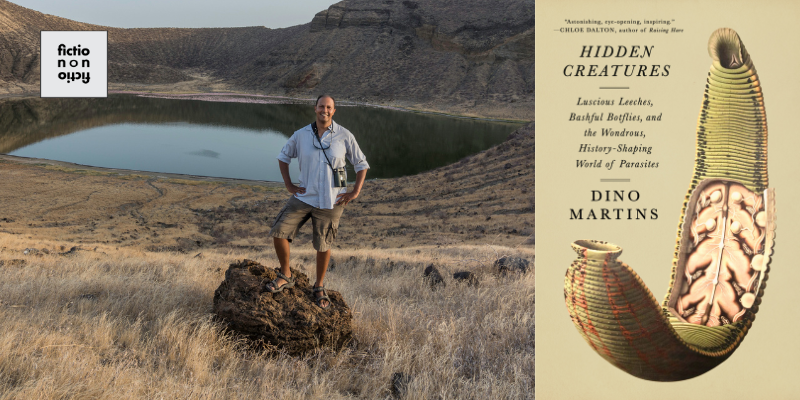
Entomologist Dino Martins joins co-host V.V. Ganeshananthan and Whitney Terrell to talk about the Cyclospora outbreak that has sickened thousands of people across the U.S., as well as the New World screwworm that has been affecting the cattle population. Martins, the author of a new book called Hidden Creatures: Luscious Leeches, Bashful Botflies, and the Wondrous, History-Shaping World of Parasites, discusses the benefits and dangers of parasites and reflects on his own lifelong interest in bugs, beginning with his childhood in Kenya. He explains how living alongside other animals has taught him to observe the world differently. Martins reads from Hidden Creatures.
To hear the full episode, subscribe through iTunes, Google Play, Stitcher, Spotify, or your favorite podcast app (include the forward slashes when searching). You can also listen by streaming from the player below. Check out video versions of our interviews on the Fiction/Non/Fiction Instagram account, the Fiction/Non/Fiction YouTube Channel, and our show website: https://www.fnfpodcast.net/ This podcast is produced by V.V. Ganeshananthan and Whitney Terrell.
Hidden Creatures: Luscious Leeches, Bashful Botflies, and the Wondrous, History-Shaping World of Parasites • Grasses of East Africa • Turkana Basin Institute
Others
Fiction/Non/Fiction Season 7, Episode 45: Jasmin Graham on Understanding Sharks • Fiction/non/Fiction Season 9, Episode 7: Kathryn Nuernberger on Mutualism, Climate, and Finding Family at the End of the World • Alien (1979) dir. Ridley Scott • The Fly (1986) dir. David Cronenberg • Stand by Me (1986) dir. Rob Reiner
EXCERPT FROM A CONVERSATION WITH DINO MARTINS
V.V. Ganeshananthan: So it’s funny, we’ve inadvertently done a series of nature episodes where we say this thing has this myth around it that it’s scary and terrible, but we’re going to talk to an expert who’s going to tell us why that’s not true. We did this episode on sharks. Your book also provides readers with a long list of supposedly adorable parasites, including fleas—so cute!—ticks, tapeworms, but Cyclospora, which has been grabbing the headlines around here, making us all terrified of our lettuce, etc. is microscopic. What parasite in your book does Cyclospora most resemble? How does it survive and reproduce?
Dino Martins: Cyclospora is not a big deal in many other parts of the world because we live with many of these things all of the time. They’re just a backdrop to life. I’d say it’s most similar to some of the intestinal worms that live in the intestine and in the stomach of different animals, people included.
Cyclospora is interesting because it’s this very specialized parasite. It can only complete its life cycle by invading the cells of the intestinal lining. It has to go into a cell in order to complete its life cycle, and it’s this very large group of apicomplexan, Coxidia protozoans, basically. It’s related to the parasite that causes malaria, and that’s getting a lot of attention, as it should. It’s quite horrific.
Even I would be pressed to call it cute, but it is deserving of our respect because this little spore-forming, minuscule nothingness basically can completely devastate entire populations. One of the messages in my book is how remarkable these organisms are and how impactful they are.
Whitney Terrell: So my understanding, which is not as good as yours, is that Cyclospora is transmitted mostly through feces-contaminated water. What does that tell us about the safety of our food system? Is this a common thing, or are we going downhill in some way? Has there been some change, or is this just a random outbreak that we can forget about in time?
DM: With most of these outbreaks today, the real cause of it is what we’re doing. What we’re doing to the planet, how we are farming, how we’re disposing of waste, how we’re overwhelming the ecological processes that would naturally balance or clean or filter or actually deal with these things, absorb them in a way, if there were, you know, lots of other things in the environment.
Yes, in this case, it looks like it’s foodborne, but I think the one message I’d say is that from looking at a range of these parasites, a number of them that we thought we had defeated—we defeated them with antibiotics and with antiparasitic drugs and with pesticides and other chemicals—but they’re actually making a comeback, and not just making a comeback, making a pretty spectacular comeback. They’re like, “Hey, you thought you’d gotten rid of us, but guess what? We’re here, and we’re really coming to get you.”
WT: That doesn’t sound very adorable! That sounds aggressive to me.
DM: It is. Part of nature, I think, is being both adorable and aggressive.
VVG: So adorable, marvelous… You have an amazing chapter called “Marvelous Maggots” in the book, and the New World Screwworm, which has been infecting cattle in the southern U.S., seems to me like a form of maggot. Am I right about that? Could you tell us about that outbreak?
DM: Yes, and I absolutely love and loathe the New World screwworm at the same time. You have the New World screwworm, but we have the Old World screwworm, who is just as horrifying as the New World one. Basically, yes, they are maggots. They are the larval form of a fly species that lays its eggs on the animals, typically on a wound or a scratch, although some can actually go into unbroken skin.
Unlike most of the maggots, these ones develop in living flesh. As they feed, scraping away, they create these large open wounds that fester. The amazing thing is some of them release a chemical that’s not detectable to us, but can attract other flies to come and lay their eggs there as well. They’re a parasite, yes, absolutely. Terrifying to look at, but they’re actually quite a widespread parasite.
Now, a tiny bit of history in North America or Central America, as well—this particular parasite was very common. It was causing huge issues, and it was dealt with in the most remarkable way. A scientist and his colleagues developed something called the sterile insect technique, and they sterilized a bunch of male flies, released them in billions, and then the flies would mate, and they wouldn’t produce any offspring. This beat the fly back, allowing the beef industry and other livestock industries to flourish in Texas, and what we’re seeing now is this: we beat things back with technology and with culture and with interventions, but we will never beat Mother Nature back entirely, and so you’re seeing this resurgence. We also have to ask questions about livestock and how dense livestock are, and you know, all these other things that are happening on the planet as well.
WT: I just want to say, I knew about these screwworm things. I have a neighbor who works for the FDA who told me, “all right, this is going to happen,” and then the news story started coming out. My question about this is, if it damages cattle by just giving them these open wounds, is that what makes them die, or does that make them risk infection, or exactly what bad thing does that wound do to the cattle once the screwworm has laid its eggs?
DM: Yes, I mean the wounds are extremely unpleasant. They are very uncomfortable. They fester. They become infected very quickly. That infection will spread through the animal. The animal becomes weak and listless and dehydrated. When the screwworm was very abundant, there are stories of entire landscapes filled with carcasses of animals with these festering wounds, that deer were almost driven extinct at one point in some parts of North America due to the the screwworm, which you wouldn’t think of now, given how well deer are doing. Another impact of parasites is that they have these abilities to track and manipulate and actually even suppress the populations of their hosts.
Transcribed by Otter.ai. Condensed and edited by Vianna O’Hara. Photograph of Dino Martins by Liam Frederick.

Fiction Non Fiction
Hosted by Whitney Terrell and V.V. Ganeshananthan, Fiction/Non/Fiction interprets current events through the lens of literature, and features conversations with writers of all stripes, from novelists and poets to journalists and essayists.