“A guy in Philly has the record,” Lena said. “Sixty-eight in a single day.”
Route 11 was at a standstill. For the last five minutes I’d been keeping pace with a telephone pole.
“Sixty-eight?” I said. “There are records for that?”
Lena was up to eleven deliveries already. That in only an hour and a half. She was keeping me updated over the CB radio. I almost never saw her in person. Just her voice fighting through the static.
Now traffic had suddenly just stopped. There was no reason for it. The driver of the car in front of me thrust his head out the window. He was trying to see what was going on up there. But all there was to see was the head of the lady in front of him. She was doing the exact same thing. And so on and so on, probably to infinity.
Somewhere out there Lena was flying along. She drove a maroon Mercury station wagon with a back end that looked like an engorged mosquito.
Actually, I wasn’t surprised that there were records for pizza delivery. I was only surprised the record wasn’t already hers.
“There’s records for everything,” she said again. “Just ask what’s his name.”
There was a sudden break in traffic. I nudged ahead a few inches more.
“That pitcher,” she said.
As if that narrowed it down. I thought of the obvious ones: Randy Johnson and Maddox and Glavine and Clemens. But no. Lena hated baseball. She had a punchline in mind.
And then I realized she meant Anthony Young.
“Ha!” she shouted when I said his name.
In my house, nobody laughed about Anthony Young. My mother was a good Catholic, but she was an even more devoted Met. The Pope was already infallible, the team needed her more. They needed any help they could get. In ’91 and ’92, the Mets had finished second to last in the NL East. This year they were on track to lose one hundred games for the first time since 1967. And the pitcher who’d chalked up more losses than anyone was Anthony Young. He was the patron saint of failure.
“It’s not his fault,” I said.
“It’s still a record.”
Young’s losing streak had finally come to an end on Wednesday, just two nights ago. Twenty-seven games in a row. It wasn’t just a record—it was a collapse of epic proportions. You had to go back eighty years to find anyone even close.
The worst part was that Anthony Young seemed like a decent guy. Especially compared to the degenerates and felons all around him in the Mets clubhouse. I couldn’t stand to watch. Young would be out there on the mound pitching his heart out, while the rest of those buffoons booted grounders and stranded runners. It wasn’t that Young lost. It was that the Mets couldn’t win. They were bad players but they were even worse human beings. This week’s highlight reel, not counting the streak, included Brett Saberhagen squirt-gunning reporters with bleach, Vince Coleman nearly blinding a toddler with a cherry bomb, and Joe Orsulak chasing a ball into the leftfield corner and coming up throwing a plastic sandwich bag.
All in one week. You couldn’t make this stuff up. Sometimes you had to wonder how poor old Ralph Kiner even got out of bed in the morning.
“My cousin knows him,” Lena said.
The Chevy ahead of me started a slow creep forward. I didn’t bother. In a second it’d just be brakes lights all over again.
“Anthony Young?”
“The guy in Philly.”
And now suddenly we were actually moving. A second ago, we’d been bumper-to-bumper. Now the cars ahead of me were launching inexplicably out of sight.
A minute later I pulled over in front of a pale green house. A little girl in a dirty pink bathing suit stood in a muddy puddle in the middle of the front yard. Her legs were skinny and streaked with mud. It looked like she was shivering. But then I realized she was just excited. The thought made me feel sad, for some reason. Her bent knees quaked as she waited for the sprinkler to tilt back in her direction.
“I’ve got to go,” I said.
“What about the Mets?”
“What about them?”
The spray tilted toward her, and the little girl hopped. She squealed, arching her back against the cold. The sound lingered in the air.
“Do they send scouts?” Lena said.
“To watch me deliver pizzas?”
“You know what I mean.” She meant for me to imagine I wasn’t hurt and everything was normal again, that I was back to being a prospect and not a pizza delivery boy. That was easier said than done.
That little girl was out there all alone in the sprinkler. The squeals were only for herself.
“What do they promise?” Lena said. “At least we can’t get any worse?”
“They mostly just watch.”
“That sounds creepy.”
“You get used to it,” I said.
Then I turned the key and the car was ticking and rattling off. The CB went off with it. I couldn’t bring myself to say over and out.
The whole car was suddenly quiet, but that wasn’t all. Aside from that one little girl, the entire street was still. I’d left the traffic behind at the turn off.
The girl was waiting again. She was bouncing on the balls of her feet. Then the water began its slow, sweeping crest overhead. Then came the explosion of spray as she burst through the wall of jets.
Afterward, dripping, she went back to giddy anticipation. Nothing existed for her except the same thing again. She went back to waiting.
It was 4:30. Where I’d parked under the canopy of a huge maple tree, it felt a lot later. The leaves were thick and green. Daylight couldn’t get through. A strange feeling came over me. There was a pressure in my head.
No, I realized—not in my head but on. It was a physical presence. I could feel something holding me back, pinning me to the headrest. It felt like Lent, like Father David pressing ash into my forehead. But instead of a cross, it felt like a circle, an endless circle going around and around.
__________________________________
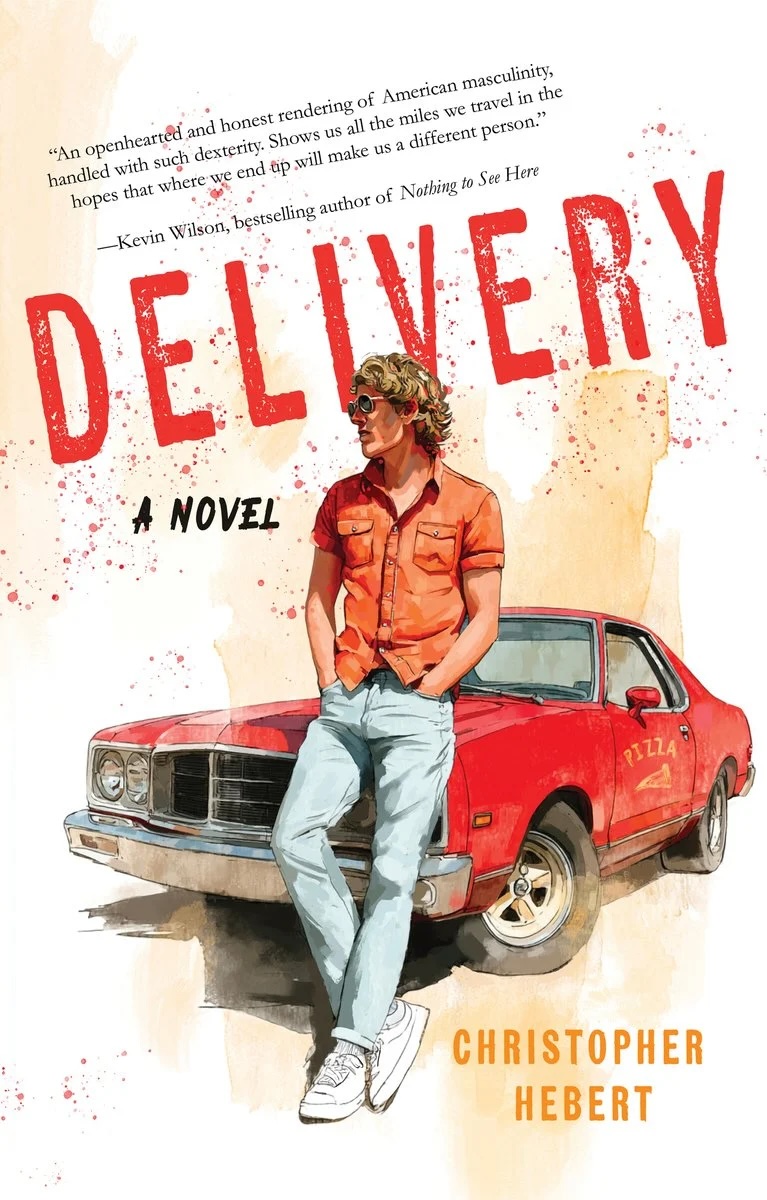
From Delivery by Christopher Hebert. Used with permission of the publisher, Regal House Publishing. Copyright © 2026 by Christopher Hebert.