Chet’la Sebree on How Chronic Illness Forever Altered Her Literary Life
“In remodeling my writing practice, I also remodeled who I was, who I could be, as a writer.”
“Your body is the first home you know.”
–Dantiel W. Moniz
*
After four months of travel and writing to complete a book proposal for Turn (W)here: A Geography of Home, an essay collection on my relationship to home and belonging through travel as a Black American woman, I herniated a disc in my neck. The pain made it difficult to do anything other than stand. Turning my head, sitting, breathing—they all were accompanied by lightning strikes diffused through my body. My muscles on fire with tension, sleep evaded me. Between the exhaustion and the pain that ached into my jaw and palm and made my fingers numb, I struggled to write by hand—my primary mode of drafting and processing.
*
Ever since my thoughts first found form in written word, I’ve tried to sift the world through the fine metal sieve of language. Despite advice from literary elders, I’ve rarely been a write everyday person; I’m more of a write-when-you-can one—routines reset by my body’s mindset and more monetarily viable commitments. But when I could, I would sit for half a day, hunched over my desk drafting almost exclusively by hand. I’d think in ink before transcribing those thoughts to type-written pages, promptly printed and edited by hand before I retyped, reprinted, and rewrote in recursive loops until the piece was finished.
Illness has been an ever-present houseguest. I didn’t imagine the herniated disc would be any different. An issue that briefly visited then left after treatment.
The herniation made this a formal exercise impossible.
But I’d dealt with injury and illness before; I figured after a few months I’d return to my regular rhythm.
*
At four years old, after a night of fitful unrest, I woke in my parents’ bed issuing a strange sound from my throat. My mom asked me if I could stop; I could not. My jaw twitched uncontrollably. What unfolded next was a night in the ER that I don’t remember, followed by four years of MRIs, EEGs, and Neurontin to manage my benign Rolandic epilepsy—a childhood seizure disorder with an unknown origin that resolved just as inexplicably. Three decades from my last episode sometimes a faint quiver in my cheek snaps me back to that distant physicality—a child unable to manage her own estate that quaked.
*
In Meghan O’Rourke’s The Invisible Kingdom: Reimagining Chronic Illness, she writes that to have a chronic illness “is not only to have a disease that you have to manage, but…a story that many people refuse to hear—because it’s deeply unsatisfying, full of fits and starts, anger, resentment, [and] chasms of unruly need.” Before the epilepsy, there was a tonsillectomy for repeated strep throat and colic after a premature birth. After it, among other things, there was scarlet fever and severe anemia, which is to say illness has been an ever-present houseguest. I didn’t imagine the herniated disc would be any different. An issue that briefly visited then left after treatment.
*
When I sold Turn (W)here on proposal shortly after the herniation, I bought eleven journals to celebrate—one for each of the forthcoming essays. What I didn’t know was that I wouldn’t return to my rhythm after twelve weeks of PT or that the disc dysfunction would lead doctors to prod for answers to connect this to other ailments. Within six months, I was diagnosed with lupus—a chronic, connective tissue disorder. Although nothing shifted in the management of the illness, already on a drug protocol that I’d remain on, I realized how the pain would permutate instead of dissipate. But I didn’t know it would become physically laborious to sit, sear stretching from neck to hip, that my hands would, intermittently, be stiff.
I tried, and failed, to return to drafting by hand. I hauled around those eleven journals, which were cumbersome to my ever-recovering spine—hoping I could recover my way of grappling with the world with each rounded letter. I would sit and write for hours until temple-splitting migraines caused me to clench my jaw, which would flare up my TMJ and land me in bed for more hours than my unstable hips could take. I pushed my body beyond its boundaries because I believed if I evicted that version of my writing life, I wouldn’t be able to write cogently.
When I shifted to drafting digitally—physically unable to keep pushing myself on paper and, with a looming deadline, incapable of waiting until my body “righted” itself—I found myself typing rambling sentences that surged nonsensically. Not hemmed by the methodical nature of notation, my fingers flew across the keyboard, soaring through ideas, shifting wildly. The drafts were unwieldy—pages of notes I was unable to resolve into legible arcs.
*
At the 2026 Association for Writing and Writing Programs conference, I participated on a panel called “Writer Interrupted: Writing and Chronic Illness.” During the Q&A, an attendee asked if we had advice about how to overcome the grief of the way these conditions shift our relationships to our work and the world. Panelist Liam Callanan responded, “grief is a companion; not an obstacle.”
*
There is no cure for lupus; its impact endurant. There was before. The illness, its management, is the ever-after.
I still grieve the writing life I had, but I also know that I am romanticizing it. Although I felt much of me had been stripped down to the studs in service of reimaging a life with lupus, in those early months of the diagnosis I willfully ignored I had the same foundation, that I still had a love for language.
*
In the final months of writing the first draft of Turn (W)here, two years into the lupus diagnosis, I did find a rhythm. I set myself a goal: write four hours a day each weekday for a total of twenty hours a week. Each drafting day started with movement—a swim, a walk, physical therapy. Then: pomodoros—for two-hour increments, I followed a cycle of 25-minutes of focused work followed by a five-minute break. This was followed by a celiac-friendly lunch and stretching or foam rolling before I returned for another 2-hour stretch of pomodoros.
And despite my indignant commitment that all first drafts had to be done on paper, I drafted Turn (W)here largely on the computer—upright at a standing desk or sitting on an exercise ball to help with core strength and hip instability with an external monitor at neutral-neck height. The drafts were messy, but, in reality, so, too, were the handwritten ones—their own version of chaos with arrows, enumerations, and strikethroughs. Still romantic for those ink-laden pages, I permitted myself to edit by hand—standing desk raised even higher to limit the pressure on my neck, document holder keeping pages at eye-level.
And though I’d renovated my routine, there was never a “perfect week” the same way there is no “perfect body.” Yes—sometimes I hit 20 hours, but more often I had to settle on 10-15. And even still, that was a brief oasis, not the norm for me as a full time academic.
*
Before I found myself in this more physically precarious state, I started doing 15/15s with the writer Diana Khoi Nguyen, where we generate intensively for 15 days twice a year. Although I may go long stretches of time without the endurance to manage my full-time job and my literary life, this essay the first thing I’ve written in four months, I do designate space for the craft. Instead of lamenting the irregularity of my schedule, I celebrate these fertile periods—engorging myself on art and films and reading in advance, which is also to say that I’ve expanded what I define as “writing.” Yes—putting metaphorical pen to page is fundamental, but so, too, is nurturing that which expands my literary capacity. If I feed my inner artist regularly, touching the waxy sheath of a magnolia leaf, then I’m full when it’s time to corral the words into something meaningful.
If I feed my inner artist regularly, touching the waxy sheath of a magnolia leaf, then I’m full when it’s time to corral the words into something meaningful.
And when I’m ready for that last part, I must be flexible about how and when it happens. Delayed by days due to morning migraines and back pain, I started to write this essay on my phone while I foam rolled. I drafted it in voice notes en route to work, typed it up wearing a posture corrector, and edited it by hand in pomodoro bursts.
My writing process doesn’t look like I once envisioned it, but the gut reno required of my life by my co-habitation with lupus, and with it, my chronic pain, has likely led to one that is more sustainable. It’s also one that yields different results.
*
In “I Am No Hybrid, No Other Than Myself,” Kazim Ali writes “I did not mean to innovate but I knew I could not speak…[so] I imagined a space in which I could breathe, in which I could speak.”
When I was committed to a former version of my routine, one that required I sit and hunch without reprieve, I was also committed to Turn (W)here unfolding as eleven traditional, narrative essays. That’s what I sold, as a poet hoping to convince myself I could be a “real” nonfiction writer. But having to augment the way I wrote made me return to my poetic roots—trained first in the craft of verse. In the end, Turn (W)here became largely a book of experimental and lyric essays, some framed as archival documents, passport stamps, and definitions. In these short vignettes and bursts typed largely on the computer, the arcs availed themselves. In remodeling my writing practice, I also remodeled who I was, who I could be, as a writer. From the impossibility, new possibilities.
____________________________
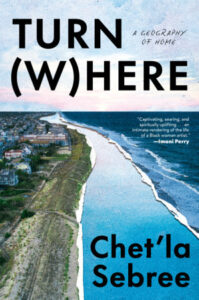
Turn (W)here: A Geography of Home by Chet’la Sebree is available from The Dial Press, an imprint of Random House, a division of Penguin Random House, LLC.

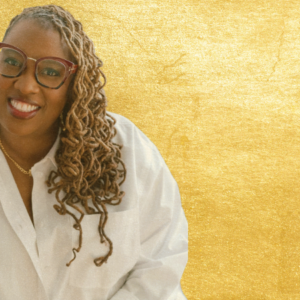
Chet’la Sebree
Chet’la Sebree is the author of Blue Opening, Field Study, winner of the James Laughlin Award from the Academy of American Poets, and Mistress, selected by Cathy Park Hong as the winner of the New Issues Poetry Prize and nominated for an NAACP Image Award for Outstanding Literary Work-Poetry. Her essays and poems have been anthologized in Ibram X. Kendi and Keisha N. Blain’s Four Hundred Souls: A Community History of African America, 1619-2019, Kwame Alexander’s This Is the Honey: An Anthology of Contemporary Black Poets, and others. Sebree is an assistant professor of English at George Washington University.