Borrowing From the Bard: A Shakespeare-Inspired Reading List
Rebecca Fallon Recommends Sally Rooney, Eleanor Catton, Emily St. John Mandel and More
The Complete Works of Shakespeare sits biblical on many a writer’s shelf, looming with almost patriarchal intensity over blank pages, scoffing at timid, non-iambic sentences. As a body of work, it’s far too much—too comprehensive, too masterful—to aspire towards. But even the best authors can’t seem to resist filching from The Bard’s pantry. While some merely garnish with a title or epigraph, others lift the full recipe of a character or relationship. It’s an understandable temptation; surely engaging in conversation with the master of the human condition can only elevate one’s own work.
I’ll confess to my own sticky fingers. My novel, Family Drama, is a story about twins who lose and find each other, and naturally I sought a relationship with Twelfth Night. You learn quickly that adhering too closely to the original script can suffocate organic elements of a new work. Dogma is no friend of transposition. My characters, being only emotionally shipwrecked, ask different questions about what it means to be lost from one another. And like any contemporary characters living in a world where Shakespeare exists, they are able to actively engage with his work within the plot, as well as being moved by it on a metatextual level. This creates opportunity for playfulness, and makes it impossible to get too reverent.
If anything, it’s the pliability of Shakespeare’s stories—their openness to evolution or explosion—that makes them great foundational texts. There are real riches to be gained when moving from stage to prose: imagining new dimensions of a character’s interiority, developing an immersive physical world. In many cases, the differences between the new piece and the familiar source text (or as Andrew Hartley put it in these pages ten years ago, the “take”) is precisely where readers can find meaning.
The recent film adaptation of Maggie O’Farrell’s Hamnet is begging for companion titles where the playwright himself appears, but you won’t find these here (if you’re curious, look to Asimov, Burgess and Kipling). The list below is simply a masterclass in how to steal from Shakespeare, featuring some world-class thieves. Each story contains shades of its foundation. All deal in Shakespeare’s timeless themes of power and family, loss and love. All strike at the most profound elements of life. But each also departs in truly original ways, allowing the author to express something honest and new through the conversation with the source.
*
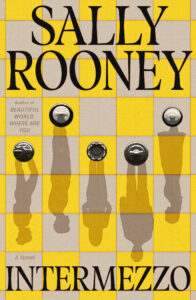
Sally Rooney, Intermezzo
Joyce may be the obvious influence on Rooney’s latest work, but as fans of Ulysses will know, a seam of Hamlet runs throughout that great Irish masterpiece. This literary gene certainly passed to Rooney’s modern-day Dubliners, and it’s no surprise that the author re-read Hamlet whilst writing Intermezzo.
Both books are about sons grieving their fathers and avoiding their doomed relationships. As a character, Rooney’s Peter Koubek is much like the Danish prince; as a human-rights lawyer, he similarly sees himself as a vehicle of justice whose actions are often misguided, resulting in more harm than good. Peter’s struggles with the nature of sanity and mortality echo some of the Dane’s more famous monologues. “Under what conditions is life endurable,” Peter wonders, to paraphrase the great question of the play. Hamlet, dense with soliloquies, translates well to the intense interiority of Intermezzo.
Even within her prose, Rooney occasionally slips into iambic pentameter. When Margaret, a local arts administrator, recalls her brief affair with Peter’s brother Ivan as “a dream, attached at the corners to no reality, shared with no one, vanishing into nothingness.” Even the most mundane moments are elevated with this language, as when Peter “made from unthinking habit too much coffee.” In three places—including the final page—direct quotes from Hamlet weave into Peter’s interior monologue. “Thou know’st, ’tis common; all that lives must die,” he muses, a nod to his consciousness of the play even as it influences him as a literary character.
Rooney avoids, however, the bloody tragedy—Peter, unlike Hamlet, is saved by having a brother. Ivan proves one reason for Peter “to be” in the end, along with his two non-drowned girlfriends, Sylvia and Naomi. Peter’s only vanquishing is an ego-death, as he’s forced to release his fixation with monogamy and acknowledge the complexities of relationships. Would such a revelation have been a better end for Hamlet? Perhaps. It certainly would have saved Gertrude a lot of grief.
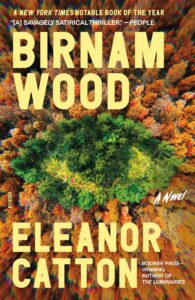
Eleanor Catton, Birnham Wood
Catton’s literary thriller steals its title directly from the prophecy of Macbeth’s Weird Sisters: “Macbeth shall never vanquished be until Great Birnam Wood to high Dunsinane Hill shall come against him.” It’s a sentiment embraced by the novel’s collective of rogue gardeners, who take up the name Birnham Wood as an expression of collective power against tyranny.
The novel’s most obvious Thane of Cawdor is the American tech billionaire who “experienced the deaths of other people as a challenge, a chance for him to test his own mortality and win.” But Catton has said that she “wanted everyone to be a plausible candidate for the role of Macbeth,” and even the worthiest characters in the book are infected with dark ambitions. The collective’s frontwoman, Mira Bunting, has her own single-minded agenda, as does ousted activist bro Tony Gallo, who had “grown used to thinking of himself in insurrectionary terms.” Perhaps the most perfectly imagined Macbeth doubles are the parents of another member, Shelley Noakes, who appear only as ideological punching bags for the collective, who view “Shelley’s father as a creature of his wife’s devising, not an autonomous adult, but a hapless pawn designed by Mrs. Noakes for the solitary purpose of throwing her own, more vivid personality into greater relief.”
By taking on the name Birnham Wood, the eco-warriors would seem to acknowledge that unity is required to defeat exploitative capitalism. At the end of Macbeth, a great army comes through the wood, lopping off branches to hide their advance, so that it appears to the Thane that the forest is encroaching upon him. It’s more effective for Macduff’s foot-soldiers than Mira’s, and if anything, Catton delivers an even bloodier ending than the source text. However, unlike Macbeth’s final nihilistic soliloquy, Catton’s thriller leaves you feeling that tomorrow and tomorrow and tomorrow are still worth fighting for.
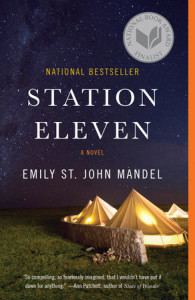
Emily St. John Mandel, Station Eleven
Station Eleven opens with a Toronto-based production of Lear starring the famous actor, Arthur Leander. Leander is Lear-like offstage as well; his life is defined by three women, “a series of failed marriages,” that leave him regretful and unsure of who loves him and how much. On the night he has a heart attack onstage, a curtain falls over the whole world as a highly contagious flu becomes a full-blown pandemic. In the ensuing chaos, North America comes to resemble Lear’s Britain: a society without order or leadership, defined by acts of arbitrary justice and violence. Both texts wonder, who will inherit this “gored state?” But for Mandel’s characters, apocalypse is only the beginning.
Twenty-years after the catastrophe, one young actor from Leander’s last production, Kirsten Raymonde, takes on the role of Cordelia within a roaming theatre troupe. Along their journey, she finds herself constantly looking for Arthur, as Cordelia attempts to “search every acre in the high-grown field,” for her lost father. She collects clippings of him from old magazines, stores them in a plastic bag. She tells other members of the ensemble about him, and this act of recounting feels a means of keeping him (and his world) alive.
From the beginning, the novel is engaged with Shakespeare’s works as embodied performances that spark various reactions and interpretations in an audience. Some characters treat Shakespeare’s words with utter reverence, and others who find him “insufferable.” Regardless, the companies who bring them to life are bound together by deep bonds of trust and a love for stories that transcend centuries. Unlike Lear, Mandel’s novel is threaded with hope—often in the act of performance itself. Even the most tragic art is a form of salvation.
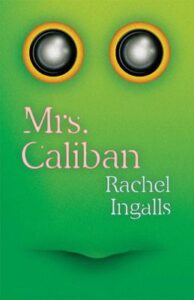
Rachel Ingalls, Mrs. Caliban
In this slim, precise novella, Ingalls cuts a slice out of the mighty beast of The Tempest: Caliban, the monster “not honored with a human shape.” Here he appears in the form of Larry, a violent amphibious creature escaped from a research institute. Froggy-faced with a smooth man’s body, he is taken in by a desperate housewife named Dorothy, with whom he begins an affair. The novel seems to ask the question: what if such a creature was not only worthy of love, but found it?
Though “an avid Shakespeare fan,” Ingalls felt that the world of Mrs. Caliban drew far more from B-movie horror tropes. Still, it’s hard to ignore that like The Tempest, this is a world that marries the surreal with the everyday, a world full of trapped characters looking for escape in one another. Both Caliban and Larry are looking for homes that have been taken from them. In The Tempest, the enslaved Caliban mourns his confinement to Prospero’s “hard rock, whiles you do keep from me the rest o’ th’ island.” Larry too was captured, dragged to a research institute where he was tortured by scientists. Both run into the arms of new masters—for Caliban, this is drunken sailor Stephano, and for Larry it is the paranoid Dorothy.
In Dorothy’s protective captivity, Larry finds himself hot-wiring cars just to feel a sense of independence. He aches for the world beyond, which he and Dorothy explore only under cover of darkness, a lush west coast with fragrant gardens and “tattered palm trees.” It’s these joint getaways that bind them together, and we see the likeness of their entrapments; her domestic boredom, her loveless marriage with separate beds and separate vacations. Mrs. Caliban’s dual role as warden and captor echo Prospero’s plea to the audience for his own release, and remind us that many prisons are self-imposed.
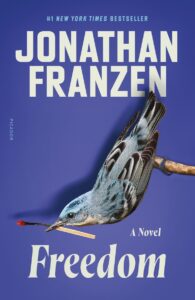
Jonathan Franzen, Freedom
Franzen’s Great American behemoth opens with an epigraph from The Winter’s Tale: the lamentation of a lost mate. And appropriately, Freedom is the story of a marriage breaking down, a family fragmenting. Patty Berglund, like Shakespeare’s Queen Hermione, attracts scrutiny for being too competent, too convincing in her role as a good wife. In Freedom, Patty’s earnest kindness earns her the resentment of neighbors, envious that she appears less mortal and flawed than themselves. In The Winter’s Tale, Hermione’s persuasive entreaties to her husband’s friend Polixenes to extend his stay with them twist Leontes into a jealous spiral. In both texts, there is a peril in pleasantness, a sense that perfection invites downfall.
While The Winter’s Tale trades in literal deaths, the Berglunds are more metaphorically lost to one another. First to go in both families are the beloved sons: Mamillius and Joey. Their losses bring on collapses in their respective mothers—Hermione’s in the form of a death swoon, and Patty’s in the form of a psychological meltdown. Both plays have a daughter as well, and Jessica Berglund, the only Freedom family member without her own chapter, feels textually banished in same the way that Perdita is sent to Bohemia. After ruining his home life, Leontes must acknowledge “I have deserved all tongues to talk their bitt’rest.” But Walter Berglund perpetually fails to see his fault in his family’s unravelling. The novel’s end is structured like Shakespeare’s original—an ostensible comedy ending in a neat suite of marriages. But in both texts lives a sadness that can’t be reconciled, losses that can’t be recovered. How late is too late, they both ask, to learn how to live?
__________________________________
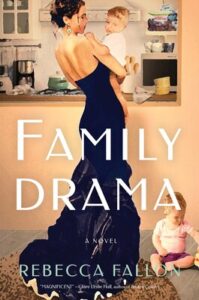
Family Drama by Rebecca Fallon is available from Simon & Schuster.

Rebecca Fallon
Rebecca Fallon is a New England-born Londoner and a graduate of Williams College and the University of Oxford. Family Drama is her debut novel.