The woman first saw the stranded pilgrim, babe in arms, on a poster on the wall of the Medieval Center at the University of Bordeaux the year she finally studied abroad. The black-and-white illustration showed a mother kneeling on the frothing waves’ surface, staring into the face of her naked infant as the Virgin Mary towered above them both, attended by angels circling her head. On the shore, the witnesses dropped to their knees in awe. The medieval abbey of Normandy’s Mont Saint-Michel, a tidal island only accessible at certain times each day, stretched from the lapping waves as though reaching for Heaven. Mary’s gown billowed in the wind; in fact, the whole illustration showed the storm, from the water breaking against the monastery to the kneeling pilgrims, bundled for warmth, waiting out the downpour on the shore.
The year she had spent in Bordeaux, the young woman had sat under this poster to eat her lunch between her class on French medieval women, in which they read both the lais of Marie de France and the humiliating letters Heloise wrote to Abelard, and an afternoon class on manuscript studies. She had looked at the poster each day without knowing what, exactly, she was looking at, until one day when they had read a copy of a manuscript called Miracula Beatae Mariae Virginis, or Miracles of the Virgin. This Marian hagiography was compiled by two English monks, Dominic of Evesham and William of Malmesbury, in the first half of the twelfth century.
“Medieval pilgrims walking across the dangerous Norman-Breton coast to Mont Saint-Michel would have seen a large stone cross rising from the sand during low tide, the croix des grèves,” Professor Compère told the class.
Because the girl was still learning the language and history of this place she lived, she understood the legend’s foundations, but not its specifics. The legend was known as the Peril: A young pilgrim, returning from her journey to Mont Saint-Michel, was caught by a sudden storm as she crossed the beach back to the mainland. The tides rose, covering her path with water as she frantically raced against rushing sea. She went into labor, and according to this manuscript, the Virgin Mary appeared to save the woman from the rising ocean. “[The Blessed Virgin] stretched out her sleeves above her, in that way [keeping the woman] untouched (intacta),” the manuscript read. Her sleeves were like “a bridal chamber” for the woman to lie in, “smelling like the sweet scent of balsam.” The woman christened her baby son “Peril” and earmarked him for the priesthood in gratitude for his miraculous birth.
Professor Compère explained each line to them. “Medieval readers,” he said, “who understood the double meaning of “intacta” as protecting the pilgrim from the sea and as someone who had never had sexual intercourse—someone like the Virgin herself—would have also understood the Virgin’s sleeves as symbolizing a protected womb in which the pilgrim could labor. The Virgin acts as both midwife and priest, sheltering the pregnant pilgrim from the storm and washing away her sins so that she, too, can be delivered.
“It was one of the most famous miracles of the Mont,” Professor Compère said. “But it was a theft.” The theft was committed by the English, he maintained, two monks who rewrote the legend of the Roman du Mont-Saint-Michel into the text they were now reading. They had stolen Saint Michael’s miracle and attributed it to the Virgin Mary.
The postscript to this legend read, “Although it is reported that Saint Michael the archangel protected a certain female pilgrim from danger in the midst of the waves of the sea, it is the Mistress of the World [in other words, the Virgin] who saved this woman from impending death in the waves.” As close to an admission as these English monks could make that they knew the original story before they wrote their own version. Why, the class discussed, did the monks rewrite a miracle originally attributed to Saint Michael and give credit to the Virgin? Or had they believed it was Mary all along, but Saint Michael stole the miracle from her in the first retelling? The young woman sat quietly, writing down what she could understand, struck that medieval audiences would call this a miracle while modern audiences would call it a legend.
Later that day, the young woman went to the university’s bookstore and bought a copy of Le Roman du Mont-Saint-Michel. It was in their robust medieval literature collection, probably assigned in some classes, but she was only really looking for the Peril, to find out how the story changed when it was a male saint who saved the laboring woman rather than the version with Mary they had read in class. Some of the plot points had changed—the pilgrim’s less-devout husband, for example, was a more robust character. The circumstances of Saint Michael’s help while the pilgrim labored and delivered in the ocean were markedly different from those in the miracle ascribed to the Virgin.
When the pilgrim found her traveling companions after the strange delivery, who had been combing the beach for her body, she told them what had happened, and that she had been blessed by God to have been directly aided by an archangel. But they saw no sign of the angel themselves, so had only the woman’s word. Why, the young woman wondered, was this enough? When was a woman’s word ever enough? The woman understood from her hasty reading that perhaps all miracles could be attributed to saints and angels if they were experienced by a believer.
The manuscripts the young woman spent her year in Bordeaux studying gave shape to her dreams. She felt a rich harmony each time Professor Compère translated the Latin words into French—effortlessly—for the class. The harmony blurred the edges of a split she had felt since her Catholic high school days, between the communion of saints and forgiveness of sins, and the promises of the rest of the world the priests warned her about, a world bursting with art and literature and music written by people separate from the church, but who seemed as holy and miraculous in their own contributions as many of the saints she read about. Here in Bordeaux, she studied the art created by the church, its music and frescos, its manuscripts and history, which collapsed a binary she hadn’t realized she believed in between what was holy and what was academic. Each time her class translated these manuscripts, she felt lighter, like maybe she didn’t need to make a choice.
For the first time in her life, she stopped going to church regularly, because although she always knew what part of the Mass happened when, no matter the language, it felt like she was going out of habit. For the past few years, she had felt increasingly hypocritical to cherry-pick what she believed and what she couldn’t abide. Here, away from the pressures of home, where she couldn’t understand the homily, her mind drifted off during the readings and consecration. One Sunday, she just stayed home instead, and when she realized no one would ever know, she did it again the next week, and the next. It was so easy to break the habit, and when she got together with American friends in her program on Saturday nights, she sensed the luxuriousness of a lie-in the next morning, and stayed up late with them, drinking cheap wine and sitting around their host families’ coffee tables, trying on a new life.
A young man in her program, with dark eyes and olive skin, so tall he hunched when he walked, once led her to the doorway of his chambre de bonne apartment and kissed her. It caught her off guard, though when she thought back on it the next morning, from beneath the threadbare sheets of his twin bed, she realized he had been trying to do just that for months. She considered the way he let his knees touch hers under a café table without moving them away, the way he pushed her hair back from her face in the basilica’s newly discovered crypt when she had been transfixed by a sign detailing it as a stop on the modern-day pilgrimage to Santiago de Compostela. And how, when he realized she was reading something absorbing, he stepped away from her and left her alone. He asked her questions about what she wanted after college, knew her café and bar orders. But because she had never been taught to ask for what she wanted, what her body felt, it took her until the moment he kissed her to consider the question. And as she leaned back into him, and eventually took his hand and followed him upstairs, the answer came as a relief. She wanted what so many other bodies wanted, and she kept wanting that for the next six months, until it was time to go home to the US.
Leaving Bordeaux meant leaving the other American students she had befriended with the intensity of young people far from home for the first time, forging a hasty and profound bond to sustain them. It also meant leaving the Middle Ages—the medieval villages in the region, the old walls of the city, the rhythm of the ancient university she had folded herself into with a heaving effort.
When the young woman returned to her university in California, the late summer was humid and heady. She felt strange being back. She laughed when she opened her parents’ refrigerator and saw a gallon of milk; the milk in France had come in such small containers. She was awed by the sense of confidence she felt each time she went into a shop or a class and realized she didn’t need to translate before speaking anymore. An anxiety lifted, but so did that sublime electricity caused by existing in between languages. Her first day of classes back home, she marched into the French and Italian department on campus and asked the advisor if she could add an emphasis in medieval studies to her French major, then began the process of researching PhD programs in medieval literature, thinking perhaps she might chase the headiness of linguistic limbo and the reverence she felt each time she encountered a new manuscript for the first time—the illumination of the borders and small drawings, the cursive gloss of margin notes. The possibility of studying these more formally, one she hadn’t known existed before her year in Bordeaux, excited her so much she had trouble falling asleep at night.
Her favorite professor in her new medieval studies emphasis at college, Professor Brown, was a woman who studied the women of the Middle Ages, and who used her hands generously when she lectured. She made herself known to this professor, gingerly at first, and then with greater courage once she told her of her year abroad, her plans to keep studying. Professor Brown’s office was lined with blown-up manuscript pages tacked to the walls. There were conference posters too, and books on wooden shelves. The office, and Professor Brown’s unabashed obsession with women who had lived and worked a thousand years ago, shaped the young woman’s dreams. She allowed herself to imagine her own life crowded with the specifics of Professor Brown’s and told her professor about her own ambition to translate Le Roman du Mont-Saint-Michel. When the young woman told Professor Brown of the literary and saintly theft—the monks who took Saint Michael’s miracle and gave it to the Virgin—she chalked the piracy up to the medieval cult that formed around the Virgin Mary during the Middle Ages. “To the medieval mind, Mary was the perfect woman,” Professor Brown told her one day, the office windows thrown open to the sticky California fall. “They associated cult-like devotion with the rituals of childbirth, so frankly, it doesn’t surprise me some hagiographers stole this story for their own saint. It happened all the time. Mary was always getting credit for miracles she didn’t perform.”
“That seems so unusual,” the young woman said. “To give credit to a woman for a man’s work.”
“Well, it is now,” Professor Brown said. She leaned forward, almost conspiratorial. “The Catholic church has never done much for women, but for a time, Mary was almost a parallel deity, crucified in spirit while her son was crucified in body. She, like God, was capable of mercy as well as power.”
The idea of mercy consumed the young woman, as she spent the fall in a fever of translation, leaving no room for digressive thinking. In this sublime concentration she filled out applications, got her statements and letters of recommendation in order. Late at night, after her schoolwork was done and her applications were in stacks on her bed, she would devote herself to Le Roman du Mont-Saint-Michel, underlining the sentences she was unsure of, correcting muddled paragraphs, and researching the accuracy of her word choice. After a few hours she would rise from her desk, creaky and stiff, and find she had left the tea bag in her cup in her dorm kitchen since dinnertime. It was always past midnight when she could shut off her mind enough to sleep.
She first saw Ted that winter of her senior year, after she’d submitted her grad school applications. She was biking to a Catholic school themed party at their public university, where hardly anyone else seemed to have gone to Catholic school. He was covered in purple balloons, only his face peeking through. At first she’d considered going to this party as Saint Lucy, maybe, her gouged-out eyes in hand, red face paint covering her real eyes, but she knew what the frat house really wanted from her, and how her friends were going to dress in sexy Baby One More Time uniforms. And even though she found it all slightly too familiar, she was trying on this new life, the one in which she didn’t go to church or see saints anymore.
On her way, she passed the balloon-covered young man on her bike, her tiny plaid skirt flapping up in the wind, her bare legs pricked with the cold. He could barely walk, and she wondered what party he was going to that Saturday night, what he was supposed to be.
Half an hour later, he showed up at the Catholic school party, greeted by lots of people she didn’t know, while she stayed in the kitchen with her friends. She’d already had two shots and could feel the pleasant swimminess climbing her neck. A few minutes later, when the balloon-covered young man entered the kitchen and opened the fridge to find a beer, she felt emboldened by the loud music and her short skirt and the floating feeling of drunkenness.
“I’m kind of an expert on Catholic schools,” she said into his ear. He turned to look at her, and she felt her skin catch fire. “And none of the priests I knew ever wore balloons.”
“I’m a bunch of grapes,” he said. “If you squeeze me, you get the most precious blood of our lord, Jesus Christ.”
“Oh!” she said. “I wanted to come as a martyred saint, but I couldn’t find fake blood on such short notice.”
He laughed. His face, sticking out through the purple grapes, seemed as familiar to her as her own, although she had never seen him before. “That’s metal as hell,” he told her. “I went to Catholic school too and found this whole theme too close to home,” he said. “This was the best I could do before I began hyperventilating from the repressed memories.”
“And the lack of oxygen from blowing up all those balloons,” she said, and again he laughed. It felt good to make him laugh.
Over the course of the night, one by one, his balloons popped—when people accidentally pressed up against him, or deliberately stuck their keys or bottle openers into them, and caused him and the young woman to jump as they talked into the early morning. Finally, when he said goodbye to her at two in the morning, she popped the last balloon when she leaned in to kiss him on the cheek. She would have liked to go home with him, but he didn’t invite her, and this scalded her, since she’d enjoyed talking to him and didn’t want to say goodbye. But before she pedaled away, he asked for her number, and two days later he called and asked her to meet him after classes.
The first time she slept with him, a few weeks later, she felt, gloriously, the full hunger of her body, the way it responded to him as though entirely separate from her mind. He seemed concerned with her pleasure in a way that suggested it mattered to his own. He took his time, and became serious while he kissed her. She felt bewitched by him, like nothing but being with him could fulfill her. The way he biked to see her as soon as his classes were done each day, and spent all weekend with her in her bed or his, made her think he was bewitched too, though neither of them said so yet.
By the time her grad school acceptance arrived that spring, the young woman was sure she was in love, which she was forced to admit as they began making plans for the following year. Ted was accepted into a master’s program in data science at Columbia, but her own acceptance was at UC Berkeley. She knew she would regret letting him go more than she would regret letting the PhD go. By the night when he asked her to move to New York with him, she had already made her choice. She couldn’t imagine a life without him, although Nora kept urging her to try harder. Moving to New York sounded like it could be an adventure too.
She flew with him to do a campus visit, just the two of them, like a real couple who came as a package deal. On the plane ride over, they held hands at takeoff and landing and shared headphones to watch a movie. They stayed in a dorm, and she tried this life on for size. While he went to meetings and classes all day, she took the subway from campus to the northern tip of Manhattan to see the medieval Cloisters, where she wandered the herb garden and walked under the shrine of the Poor Clares. The sun beat down on her bare arms. She heard chanting ahead, but as she rounded a corner to get a better listen, she found not a choir, as she had expected, but a garden empty but for one woman, cloaked in black. Her eyes were cast up through the dappled light of the trees tossing their leaves in a light breeze. The young woman watched for a moment, the hairs on her arms standing up as she took in the woman, ecstatic in prayer. When two other visitors rounded the corner, the young woman turned for a moment to look at them, her eyes wide in warning, but when she looked back, the saint was gone, and in her place was a red-tailed hawk. It turned once on the branch, looked the young woman in the eye, and took flight. Behind her, she heard the other visitors gasp.
That early spring day, she felt at home in the quiet gardens, and later in the crowded café where they got sandwiches for dinner and ate them in a small park. “I love it here,” Ted breathed into her hair that night, his body already slick with sweat as he moved against her. “I love you here.” She responded urgently, kissing his shoulders and guiding his hand close to her. Her eyes were cast upward, as the saint’s had been, in her own private ecstasy.
When they returned home to California after the campus visit, the young woman looked sideways at the cracked spine of Le Roman du Mont-Saint-Michel in her bookcase, as though she didn’t quite trust it, or herself, to reconcile the splintering she felt. In her bed, she turned to Ted and watched him while he slept. In his face, she saw younger versions of him too, and wondered what their children would look like. The thought came to her unbidden, and although it scared her, she decided to always remember, no matter how she might feel about this person someday, the thrill of seeing the child she wanted in his sleeping face.
They moved to New York that fall.
How many lives are shaped by what we sacrifice when we fall in love? There was always the chance she could apply again to PhD programs after Ted was done with school, she reasoned. And she would always go home to this person she loved so much, who made her laugh and believed so many of the things she did, who had some of the same wounds she did, or at least understood what had caused some of hers.
It was so easy to sacrifice herself in this way, even when, every year or so, Ted would ask if she wanted to apply again, to pursue the life she’d once planned. But she had convinced herself she could be practical, apply for a master’s and credential program that would allow her to speak French daily and find a job anywhere Ted did. She told him the core of her passion was satisfied by the life she had chosen, and really, teaching was fine. Months and eventually years went by when she didn’t think about the PhD she didn’t have. When the time was right for them to have a baby, she realized she had not wanted anything this much, except for two things: the PhD she hadn’t gotten, and her husband. Unknowingly, she had been practicing self-erasure since she had first learned to love.
__________________________________
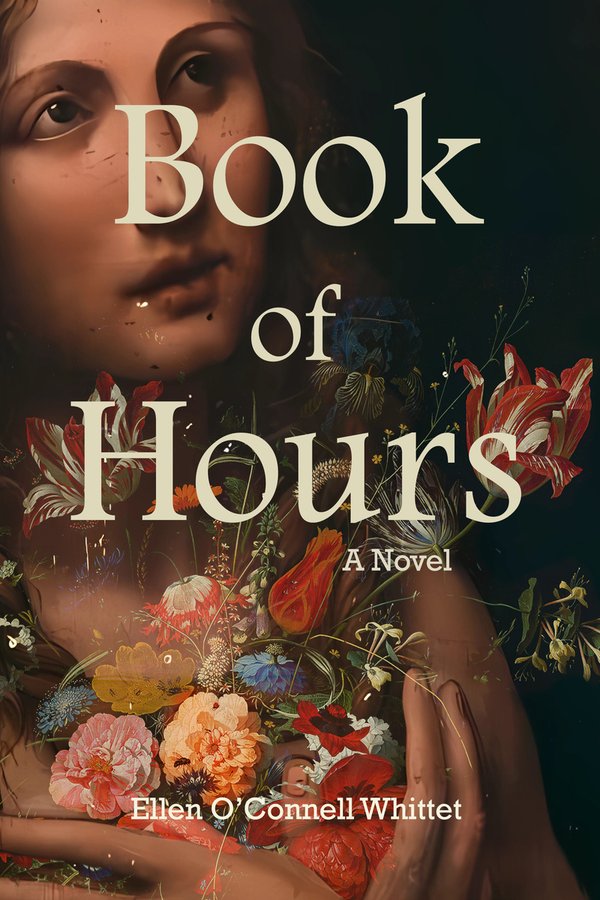
From Book of Hours by Ellen O’Connell Whittet. Used with permission of the publisher, Dzanc Books. Copyright © 2026 by Ellen O’Connell Whittet.