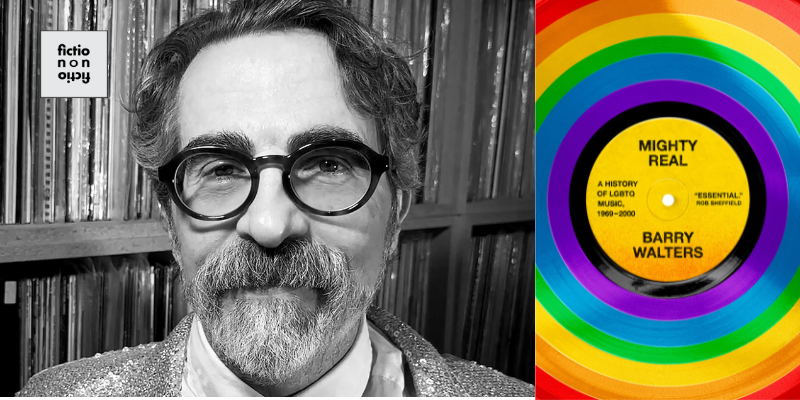
Barry Walters on LGBTQ Music 1969-2000
In Conversation with Whitney Terrell and V.V. Ganeshananthan on Fiction/Non/Fiction
Music critic Barry Walters joins co-hosts Whitney Terrell and Christian Barter to discuss his new book, Mighty Real: A History of LGBTQ Music 1969-2000. Walters talks about how he chose the artists that he includes in his book and explains how musicians like David Bowie, Lou Reed, Grace Jones, and Sylvester saved his life. He explores how social repression shaped and complicated work from LGBTQ bands, how queer acts like Queen were pigeonholed by music critics, and how mainstream groups like Nirvana spoke to the LGBTQ experience. He talks about his personal connection to Madonna’s work and reads from Mighty Real.
To hear the full episode, subscribe through iTunes, Google Play, Stitcher, Spotify, or your favorite podcast app (include the forward slashes when searching). You can also listen by streaming from the player below. Check out video versions of our interviews on the Fiction/Non/Fiction Instagram account, the Fiction/Non/Fiction YouTube Channel, and our show website: https://www.fnfpodcast.net/ This podcast is produced by Christian Barter and Whitney Terrell.
Mighty Real: A History of LGBTQ Music 1969-2000 • “George Michael’s ‘Father Figure’: When Love Meets Crime”|Billboard, Oct. 26, 2017 • “Madonna’s ‘Erotica,’ ‘Sex’: Why Musical Masterpiece, Defiant Book Still Matter”| Rolling Stone, Oct. 19, 2017 • “As Much As I Can, As Black As I Am: The Queer History of Grace Jones”|Pitchfork, August 25, 2015 •“Sylvester: Staying Alive”|The Village Voice, Nov. 8, 1988
Others
City Boy: My Life in New York During the 1960s and ’70s by Edmund White
EXCERPT FROM A CONVERSATION WITH BARRY WALTERS
Christian Barter: An important theme you hit on writing about Madonna’s music is the idea of an artist presenting one way to the straight mainstream world and purposefully completely different to the LGBTQ world. I wondered if you could talk more about that phenomenon, because that really interested me.
Barry Walters: Well, in Madonna’s case, no one was going to censor her for being queer, at least at this stage. But, as we know, that happened during her erotica era when she was making her work so queer that many thought she might be queer, and indeed the evidence suggests that Madonna may have had female lovers. But in terms of an LGBTQ artist, across the gamut men and women have often presented themselves in a way in which it reads as “normal” or something that’s aimed to them, whereas we read it as something we know that’s been cleverly coded for us.
Whitney Terrell: I was going to ask you about Elton John’s early music, which you say there isn’t much tangible queerness to his earlier records. Yet even then you mention lines like “I’m not the man they think I am at home,” which a very famous line you say “voiced our secrets by proxy.” Maybe you could talk about Elton John’s career in this aspect?
BW: Elton John is a singular example, because he didn’t write the lyrics. Bernie Toppin did that for him. Most gay artists, maybe they work with straight songwriters, but they write the lyrics, and with Elton John it was the opposite. But I think with Elton John there’s a sonic signature to his chord changes that’s uniquely his. I can’t say that his music, his music and chord changes, read as gay, but I would say that they read as no one else has those particular melodic turns and twists that Elton does on his peak songs. And the album Goodbye Yellow Brick Road from 1973, just look at the album cover. He’s got the platform ruby red slippers on, and he’s looking at Oz. The Wizard of Oz is classic gay iconography, if you will. He sort of came out with that album, and he became the Elton John that we really love. Paradoxically, people loved the sober beige Elton John, but when he flipped the switch into Technicolor, that’s when he really became a superstar, that’s what he started wearing the glasses and the outfits, and everyone loves that stuff. Maybe some thought he was not exactly manly, but they couldn’t argue with the records.
CB: So Barry, you’re writing as a music critic, and when you’re writing about Queen, in particular, you have some criticism for other music critics. You write wonderfully about their music, but you also point out the ways in which the band was dismissed by critics in their own time, suggesting that they were punished not so much for being queer, but for not conforming to the kinds of music that queers were supposed to make, which is an interesting distinction. You say “Even queers were expected not to deviate, but Queen defiantly did via prog rock, glam, metal, disco, cabaret, pop, and much more. Unfortunately, many of its original critics complied with the industry and penalized the band accordingly.” Can you talk more about this phenomenon of the pigeonholing by mainstream media of LGBTQ music?
BW: Even now, people think LGBTQ music begins and ends with girly dance pop, and on the women’s side folk rock, right, and we know it’s far broader than that. Queen came up with glam rock; they came up in a very presentational time. Queen pushed aside the kind of homogenization that had begun in the wake of Woodstock when the suits realized, “Holy shit, we can really make a lot of money selling to the White boys.” Because it was mostly the white boys and maybe their girlfriends who went to Woodstock, and so, music became more segregated. It became more demographically pitched. You were either an AM artist or an FM artist, and Queen were both of those things, and you couldn’t say that they were any one thing.
As an LGBTQ person, I completely understand that, because I have wanted to write to my people. I’ve written for Out, I’ve written for The Advocate, but I also really wanted to get inside the middle of rock criticism and write for everyone, and I did that through Rolling Stone and Spin. I never wanted to be known as a “gay writer,” and maybe that’s one of the reasons why I put this book off for so long. I really wanted to reach everyone, I want everyone to understand this music the way we do, and I did that purposefully by addressing the gay reader, the LGBTQ reader, as “we” throughout the book. I thought, Beyonce makes her music really Black. It aims it at a Black audience, and Kendrick Lamar does the same thing. And they make it so Black, so true to their experience that White people are like, “Wow, that’s brilliant. I want to know what that world is through that lens.” And it’s been happening. Straight guys like you—I presume you’re straight—have been relating to me in a really brotherly way, and it makes me so happy.
This book was nine years of writing, and there was a lot of insecurity that came up to the surface. I would sit, and there’d be times where I just cry from reading one autobiography after the other, where the story doesn’t end well like with George Michael or with Whitney Houston. I’ve kept myself alive through this music, but, it really made me insecure facing all this, and it really made me sad thinking about my friends who died, years, decades ago. They never got to grow up with me. So, I felt a lot of weight on my shoulders. I wanted to be speaking, testifying, because I had been spared. I still don’t have the virus, but back then there was no drug that you could take to prevent it or to cure it. It was a death sentence.
Transcribed by Otter.ai. Condensed and edited by Rebecca Kilroy. Photo of Barry Walters

Fiction Non Fiction
Hosted by Whitney Terrell and V.V. Ganeshananthan, Fiction/Non/Fiction interprets current events through the lens of literature, and features conversations with writers of all stripes, from novelists and poets to journalists and essayists.