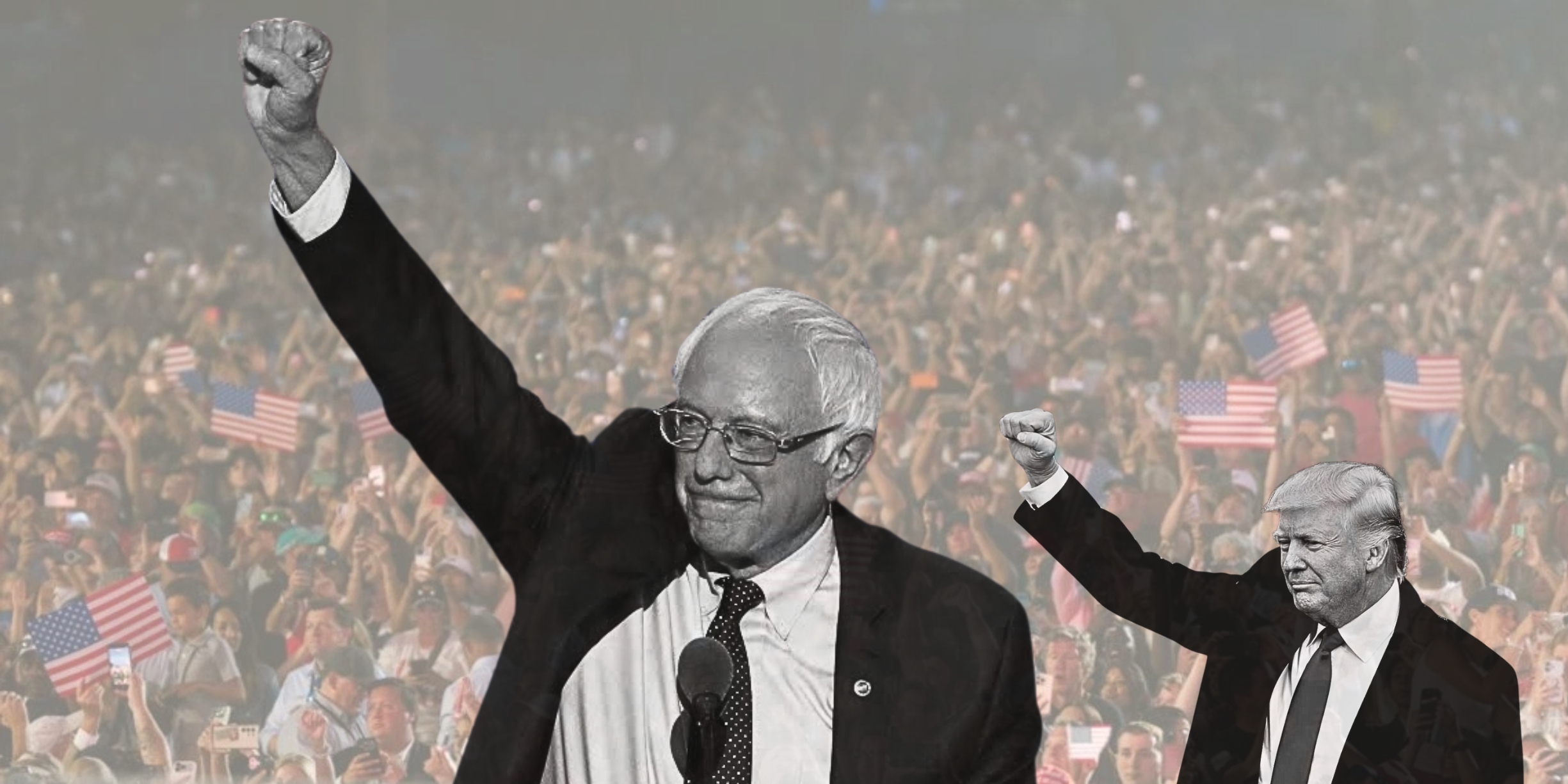
On the Populist Parallels Between Bernie Sanders and Donald Trump
Inside the 2016 Election, From Bernie Sanders’s Chief Strategist
If you tuned in at just the right time on June 16, 2015, when Donald Trump announced his campaign for the presidency, you might have thought he was reading one of Bernie’s stump speeches. From a makeshift stage, after descending into the lobby of Trump Tower on the infamous golden escalator inside his Manhattan mall, home, and office, he called American healthcare prices a “disaster,”pledged to protect Social Security, and vowed to become “the greatest jobs president ever.” He promised to increase infrastructure spending that would result in blue-collar jobs returning to the country. What could only inspire an eye roll, especially in retrospect, was the way he lambasted the role of money in influencing politics: “I’ve watched the politicians. I’ve dealt with them all my life,” he said. “They’re controlled fully by the lobbyists, by the donors, and by the special interests, fully.”
If you overlook the vile attacks on immigrants and progressives and Obamacare, the parallels to the Sanders talking points become obvious. But when Trump articulated them, he wasn’t uttering heartfelt convictions developed over decades of progressive advocacy. Without any impassioned ideology—except about his own presumed greatness—what Trump offered to restless voters was his alleged business acumen. Here was a guy who schooled amateurs on The Apprentice, whose name was affixed to The Art of the Deal, who presented himself, as Fran Lebowitz memorably observed, as “a poor person’s idea of a rich person.” As we have all seen, Trump’s greatest talent turned out to be stunning levels of unvarnished opportunism and an insatiable thirst for power.
Bernie was no poll-watcher or chameleon candidate; the heart of his campaign was the progressive beliefs he fostered and fought for over a quarter century of government experience and a lifetime of being a democratic socialist.
In looking back, however, it’s how he strategically deployed these characteristics to appear to be the “outsider” candidate, the one who could lure independent voters fed up with both parties, that ultimately helped him beat Hillary Clinton—even if he wasn’t supported by the popular vote. Trump’s team saw how Bernie’s populist rhetoric, renegade status, and grassroots appeal to many disaffected voters was resonating, and since the Democratic Party clearly wasn’t interested in harnessing that momentum, they cleverly realized they could harness it themselves in their march to the White House. Trump knew he was playing to Bernie’s voters in all three of his presidential campaigns. As he told a television interviewer in 2024, “Last time,” referring both to 2016 and 2020, “we had a lot of Bernie supporters.”
Obviously, they weren’t all of Bernie supporters. Our progressive supporters and the huge number of young people who showed up to change the composition of the electorate in Bernie’s favor in the primaries were not interested in Trump. But many of the independent-minded, working-class voters that Bernie attracted to his campaign with his core economic message were the same people we used to call Reagan Democrats in the old days.
With a tremendous sense of mistrust, disappointment, and alienation, they had drifted away from the Democratic Party. Many of these voters chose to participate in Democratic primaries in 2016, and many of them voted for Bernie. But in the general election, they moved to the Republican nominee because they were looking for change. The populist language and appeal that Trump was offering in the wake of Bernie Sanders’s defeat in the primary gave the New York real estate developer the keys to the White House.
Bernie was no poll-watcher or chameleon candidate; the heart of his campaign was the progressive beliefs he fostered and fought for over a quarter century of government experience and a lifetime of being a democratic socialist. In nearly every way, Trump was his polar opposite: no political experience, no history of activism, and ripping off contractors was about the extent of his relationship to the working class. The thing he had that Bernie emphatically didn’t was a seemingly unlimited mountain of money he had “earned” through inheritance, exploitation, and greed. Could there be a more cynical purveyor of the clarion call to make America great again?
When Trump emerged on the scene, cloaking his lack of developed policy in rhetoric that pitted the good American people against corrupt elites and migrants, the media quickly assigned him and Bernie the same label. “Populism and voter discontent defined this summer in politics,” NPR declared that August. By the end of March 2016, The New York Times Magazine posed the question: “How can Donald Trump and Bernie Sanders both be ‘populist’?”
Good question. How could two men who are different in every way—aside from their gender and their age—be conflated with the same political archetype? It seemed like a lazy label, but that’s in part because determining what this movement is turns out to be not so simple. Indeed, defining it continues to spark lively debates. There’s ample disagreement on whether populism is robust enough to be its own ideology. Or maybe it’s a schematic way of organizing the world by class, without the trappings of Marxist ideology. Maybe it’s just a vague rhetorical device politicians wield to advance their own beliefs and goals.
What is firmly settled is that at the heart of populism is a split between “us” and “them,” whether it’s an economic split between regular people and financial elites, or a cultural split that goes after immigrants, racial minorities, or pointy-headed intellectuals who occupy universities and large swaths of the Democratic Party. Bernie would point to the oligarchs; Trump to immigrants, liberals, Democrats, Obama, Hillary, environmentalists, and foreign interests sapping jobs and money away from Americans.
But within these two modes, populism in the US contains a wide range of more accessible ideologies, including several time-honored isms—such as socialism, communism, and authoritarianism. Ever since the 1830s, when Andrew Jackson established himself as the first authentic American populist, political candidates don’t typically refer to themselves as being “populists,” even as they deploy populism’s rhetoric.
There are a few boldface names in American history that would fit the bill. One of the most notable was Huey Long, the Louisiana governor from 1928 to 1932, who ran on the slogan “Every Man a King” and whose campaign urged the massive redistribution of wealth—he even had a “Share Our Wealth” program. Huey Long embodied many qualities associated with populist political figures: real charisma, the determination to champion the “little man” against the rich and powerful—whose wealth he proposed confiscating and redistributing—the cavalier labeling of anyone who disagreed with him as part of the problem, and extraordinary political success largely predicated on sowing division and trafficking in an “I alone can save you” message. He embarked on a run for president against Franklin Delano Roosevelt in 1936, but an assassin’s bullet stopped his race.
Roosevelt, too, deployed some populist rhetoric when he attacked “economic royalists” and “privileged princes of new economic dynasties.” Marching through twentieth-century American history there were George Wallace and Ross Perot, and some have even argued that Ronald Reagan used populist strategies in his presidential campaigns.
Looking at it that way, Bernie and Trump are two sides of the same populist coin, but not because of any true dedication to the “good people” on Trump’s part. Whereas Bernie’s populism elevates all Americans against a minuscule, corrupt class of wealth-hoarding billionaires, Trump’s populism divides and excludes. “The U.S. has become a dumping ground for everybody else’s problems,” Trump declared in his speech announcing his presidential campaign. Those “problems,” in his view, were immigrants.
Trump could not have been more explicit as to who belonged in his “us” group, and who were the “them” that caused their suffering.
I have no doubt that the success of Bernie’s then-fledgling campaign was on Trump’s mind when he decided to run. Bernie was attracting large, passionate crowds in Iowa, and the press had begun remarking on “Bernie-mentum.” That’s probably why Trump came in hot with talking points Bernie had developed over years of politicking: healthcare costs, disappearing jobs, and the uncertain future of the social safety net. He knew that the problems Bernie underscored in speech after speech were ringing loud and clear in the ears of an electorate still reeling from the aftershocks of the 2008 Great Recession.
But he also knew his conservative audience. So, when he inflamed the anger of the masses over the dying American dream, he directed that anger onto immigrants, Mexico, China, and the “morally corrupt” and “incompetent” people holding office, among others. And while Bernie emphasized the need for collective struggle and action, Trump positioned himself as the uniquely qualified person to save the country from within.
Never mind that Trump encapsulated the very kind of elitism and wealth accumulation Bernie lambasted against. His descent by golden escalator down to the stage where he professed his presidential ambitions was not some kind of deranged irony, but rather a visual way to underscore his résumé: Here’s my wealth and power, he seemed to declare, and that makes me impervious to outside pressure or influences. He was more explicit in his speech that day: “We need a truly great leader now. We need a leader that wrote The Art of the Deal.” He continued: “I don’t need anybody’s money. I’m using my own money. I’m not using the lobbyists. I’m not using donors. I don’t care. I’m really rich . . . That’s the kind of thinking you need for this country.”
I can’t go so far as to claim that Bernie was the inspiration for Trump’s foray into populism. He had great examples in far-right populist leaders around the world: Hungarian Prime Minister Viktor Orbán, Narendra Modi in India, and Brazil’s embattled Jair Bolsonaro, not to mention historical figures like Britain’s Margaret Thatcher. Trump blended seamlessly into and significantly bolstered the global influence of a political class that scholars increasingly call “authoritarian populists.”
As the name suggests, these politicians use populist rhetoric cynically as a vehicle for gaining power. Their ideology feeds off nativism and an opposition to diversity. They rise to office by identifying themselves as liberators of the “true people” that the corrupt political establishment has allowed to be beaten down by outsiders—immigrants, queer people, any minority that is readily scapegoated. Crucially, as political scientist Stuart Hall articulated when coining the term in 1979 to describe Thatcher, authoritarian populism is an “exceptional form of the capitalist state,” in that the dressings of a liberal democracy remain even as power accumulates in the hands of the few—or the one.
Trump could not have been more explicit as to who belonged in his “us” group, and who were the “them” that caused their suffering. “People that live here legally, they love Donald Trump,” he said at a campaign event in Pittsburgh, calling for closed borders. Skyrocketing healthcare prices were really the fault of Barack Obama and his liberal cronies, and Clinton was the “most dishonest” politician of them all. While pointing to the line of TV crews and journalists in the back of the auditorium, he said, “These are the most dishonest people. These people are far worse than the politicians.”
The most crucial and, back in 2016, the most inflammatory aspect of Trump’s campaign was his foreign policy platform. Here, too, he created a xenophobic fun house mirror version of Bernie’s talking points. Since the moment Bernie announced his intention to run for president, he had distinguished himself from Clinton in his foreign policy voting record—most significantly, his long-standing opposition to the war in Iraq. “I voted against the war in Iraq,” Bernie told reporters in April 2015. “And not only did I vote against it . . . many of the things that I said back then turned out to be true.”
If only someone as smart and charismatic as Trump were in office at that time, everything would be different.
Clinton’s support for the Iraq War was one of the biggest liabilities she faced in her campaign, and Trump exploited it, both to fan the flames of opposition to Clinton and to harness the anger of conservative Americans, which he redirected toward “others”—not Mexican migrants this time, but Muslims. In his campaign announcement, Trump claimed to have opposed the Iraq War, going so far as to say that he “made all of the right predictions about Iraq.” Unsurprisingly, he wasn’t telling the truth. In fact, the record shows he was in support of going to war in 2002. In a conversation with shock jock Howard Stern at the time, Stern asked him, “Are you for invading Iraq?” And Trump replied, “Yeah, I guess so.” I realize now that I could have put that clip to great use in a general election ad.
But as has become clear, Trump’s relationship with the truth is a very flexible one, and during the 2016 campaign, he conveniently used the false claim that he opposed the war to place blame on ISIS for the suffering of the American middle class. ISIS is why the price of gas is high. ISIS is why you don’t feel safe in your suburban enclaves, he emphatically claimed. If only someone as smart and charismatic as Trump were in office at that time, everything would be different.
His first campaign video, released in January 2016, placed the blame for America’s collapse on Democratic leaders and Muslims: Photos of Obama and Clinton were replaced by mug shots of two apparently Muslim people while police sirens rang in the background. “The politicians can pretend it’s something else, but Donald Trump calls it ‘radical Islamic terrorism,’” a faceless orator boomed. “That’s why he’s calling for a temporary shutdown of Muslims entering the United States.”
In April 2016, in front of the largest crowd of his campaign to date at Brooklyn’s Prospect Park, Bernie assured his supporters that Trump would never win. “The American people will not support a candidate who insults Mexicans and Latinos,” he said, “who insults Muslims, who insults women, who insults veterans, who insults the African American community.” At that point, Bernie was closer to Clinton in the national polls than he had ever been and ever would be. “We do not represent the interests of Wall Street or the billionaires’ class or corporate America,” Bernie said. “We don’t want their money. We’re going to do it a different way.”
A week after Bernie’s Brooklyn rally, Trump echoed his points in a tweet, saying, “The Establishment and special interests are absolutely killing our country.” His tweet linked to a video in which, while standing in one of the offices of his glass tower that pierces the Manhattan skyline, he promised: “We’ll work with the establishment, but they’re no longer going to control what’s happening. We’re going to control it, and that’s going to be good for you.” The echoes were unmistakable.
But it wasn’t going to be good for “you,” unless you were a billionaire tech mogul or spineless sycophant. Trump’s claim to credibility, the supposed shield from influence that his wealth offered, was laid down even before the Oval Office became his command center.
I am not the only one who thinks Bernie would have won.
Now America’s middle and working classes face greater food insecurity, less economic mobility, and higher healthcare costs than they did in 2016. And when an actual threat to all the American people arose in the COVID-19 pandemic, notwithstanding Operation Warp Speed, Trump repeatedly failed to protect them, prioritizing the country’s GDP over the health and lives of its people. But that was China’s fault, apparently.
When zooming out, with the retrospective understanding that 2016 was a race that would reward the outsider, Trump’s triumph over Clinton in the general election seems inevitable. As does the sense that it would have been very much tougher for him to beat Bernie. Trump could not have asked for a better opponent to hold up as a caricature of the same political elite he told supporters to blame and hate. Hillary’s extensive electoral experience became not an endorsement of her qualifications, but rather a liability for Trump to exploit. Where there was splintering among conservatives about how best to steer the country forward, Trump found the thread that unified them: frustration with Washington.
He and Bernie both embodied versions of the outsider “change” candidate that the public not only desperately sought but demanded. The difference is that the Republican Party eventually rallied around their change candidate, while the Democratic Party sabotaged theirs. If Bernie had claimed the Democratic nomination, I believe that his April 2016 Prospect Park assertion of Trump’s un-electability would have been correct.
One last piece of evidence right before the election confirmed that impression. Just a couple of days before the voting in November 2016, Gravis Marketing released a poll that was paid for by a Democratic congressman who supported Bernie. The poll had 1,600 respondents, and it found that Bernie had a 56–44 lead over Trump. A 12-point victory in a presidential campaign is a landslide, and I’m sure many down-ballot Democrats would have been carried into office by an electorate that gave Bernie a double-digit win. Yes, I understand that the circumstances would have been different if he had been the nominee instead of Hillary, but I also understand that we would have campaigned in places like Michigan and Wisconsin in the general election, not just with our candidate, but with the resources of advertising that helped Bernie win those states in the primaries.
I am not the only one who thinks Bernie would have won. It’s a strange thing to say, but the greatest truth-teller in a post-election review held every four years at Harvard University turned out to be Donald Trump’s pollster. In 2017, Trump’s chief pollster, Tony Fabrizio, noted that Bernie had the potential to garner the vote of the white working class, a group of voters who vastly preferred Trump over Clinton. “What do you think happens in Sanders v. Trump?” the moderator asked him. Without missing a beat, Trump’s pollster replied, “I think Sanders beats him.”
__________________________________
From How the Democrats Screwed Bernie by Tad Devine. Copyright © 2026 by Thomas A. Devine. Reprinted by permission of Simon & Schuster, LLC.

Tad Devine
Tad Devine is a Democratic political strategist with over thirty years of campaign experience. Prior to serving as chief strategist for Bernie Sanders’s 2016 presidential campaign, he was a senior adviser in Al Gore’s 2000 and John Kerry’s 2004 presidential campaigns. In addition to his political work and media consulting, he has held academic positions at Boston University, the Harvard Kennedy School, and George Washington University, among others.