Ayana Elizabeth Johnson on Moving From Resolve to Action, Addressing the Climate Crisis
On Hope and Creating an Ode to Fixing the Planet
People often say that hope is important as motivation to address the climate crisis. But I have something to admit: I have a tenuous relationship with hope. I don’t even like the word. It seems so passive, like wishful thinking. Like, “I hope that works out.” Or, “I hope someone does something about that.” And that vibe certainly isn’t going to get us anywhere. My aversion has been solidified by being asked, ad nauseam, What makes you hopeful? How do you stay optimistic? That always snags me because I am neither. I’m a scientist; I’m a realist. I immediately think:
Fuck hope. Where’s the strategy? What are we going to do so that we don’t need hope?
It took me far too long to realize that what people were really asking was “Can you please give me hope? I need some.” And that version of the question, that vulnerable and true version, that “Tell me how you, how I, can keep going” version, I totally get. We, those of us trying to turn things around, are not robots. We are humans with heaps of emotions and attachments and fears.
The fact that I am not prone to depression is an enormous gift, especially as someone who absorbs loads of bad climate news daily. (In a sense, my professional success has been tied to my ability to communicate about the collapse of the ecosystems I have studied. How messed up is that?) So I ease my anxiety with productivity, by completing action items. That’s not to say I haven’t been a puddle of tears on the NYC subway while reading UN climate reports, because I’m picturing the human suffering and biodiversity loss implied by those graphs. I feel all of this, deeply. I can absolutely relate to the sense of grasping for a reason to keep at it. And it would be easy, after reading all these chapters, to focus on the complexities and challenges and just throw up your hands.
After all, what is hope? The dictionary definitions of “hope” and “optimism” both include the expectation of a positive outcome. A positive outcome is a wild thing to expect given the scenarios we face. But the definition of “hope” also includes the word “desire,” something I have in abundance. I want climate solutions so badly. And while it would be foolish to assume that our story on this planet has a happy ending, every day I wake up, and I think more and more of us wake up, and consider what we can do to manifest that desire, to nudge ourselves closer to a healthy and safe and restored and resplendent life on Earth.
For who are we to give up on this planet or one another? We simply do not get to quit. Also, how do we keep moving forward despite the intimidating odds? It’s normal to grapple with all of this, and the truth is, you don’t need hope at all. As philosopher Joanna Macy has put it:
It’s okay not to be optimistic. Buddhist teachings say feeling that you have to maintain hope can wear you out. So just be present . . . And when you’re worrying about whether you’re hopeful or hopeless or pessimistic or optimistic, who cares? The main thing is that you’re showing up, that you’re here, and that you’re finding ever more capacity to love this world because it will not be healed without that.
Here’s the thing: Octopuses and rainbows and music and dinner parties and love and snow flurries and the aurora borealis all exist! The world is full of delights even as it may also be spiraling toward conflagration and deluge. So when people perceive me as hopeful, I think what they are actually seeing is that I am joyful. And thank goodness for the human ability to decouple hope from joy.
My concern is that hope is insufficient. So, I encourage you to, in the words of Terry Tempest Williams, “make vows to something deeper than hope.” If not hope, then what? Truth, courage, and solutions. Love. Collaboration and community. And all the sweetness along the way. That’s what can get us there. Possibility. That’s a word I can wholeheartedly race toward. I find motivation for action in glimpses of what could be, and in values instilled by my parents that say it is my responsibility to try, without any guarantees of success. The force that propels me is a simple and deep desire to be useful.
But if you are into hope, let me stop raining on your parade, and let’s embrace author Rebecca Solnit’s definition:
Hope is not a lottery ticket you can sit on the sofa and clutch, feeling lucky. It is an axe you break down doors with in an emergency. Hope should shove you out the door, because it will take everything you have to steer the future away from endless war, from the annihilation of the Earth’s treasures and the grinding down of the poor and marginal . . . To hope is to give yourself to the future—and that commitment to the future is what makes the present inhabitable.
Yes. I can roll with a catalytic hope like that. If by “hope” you mean simmering passion to implement climate solutions, then despite a muffled cringe at your word choice, I am with you. Because what could be more depressing than just passively watching the world burn and melt and crumble? No, thank you.
As my friend Frank says, “Having hope allows you to be ready. If you’re not hopeful, you’re not looking for solutions.” As Paola puts it, “Hope is a propellant.” As my friend Boris says, “What we need is mega-pragmatic utopianism—utopianism plus a lot of detail. We need to go all-in on that.” As Greta Thunberg challenges us, “Hope is something you have to earn.” And as Katharine Wilkinson and I concluded in All We Can Save, describing our notion of “can” in the book’s title:
“Can” speaks to sheer determination. This shit ain’t over yet. Possibility still exists, as documented in data-driven analysis of climate solutions and temperature trajectories, and as imprinted in the persistence of life despite all odds. We are a miracle. Our task and our opportunity is to face a seemingly impossible challenge and act in service of what is possible.
It’s worth repeating: This shit ain’t over yet. And while I don’t have any assurances for you—hot damn, the world is a wreck and the future uncertain—I am overflowing with motivation to work toward a better world, even knowing it won’t be a perfect world. A world with mended landscapes and renewable energy and clean air and climate justice is possible. And that is worth a shot.
*
“Do no harm.” In conversations within my book, What If We Get It Right?, the need for a new Hippocratic Oath in the face of the climate crisis was mentioned repeatedly. The original ancient Greek version was for doctors. What do we want to be devoted to? What people, community, place, ways of living?
Based on that quorum of mentions, friend/architect/philosopher Oana Stănescu and I put our heads together to create such an oath. It is not solely focused on how we might best comport ourselves professionally. Although that is a powerful place to start, what this moment calls for is beyond any professional practice, and broadly harkens back to the precautionary principle.
This oath aspires to open up conversations, and to make space for celebration, commitment, and accountability. We need new rituals for our climate-changed world: What food and music, what locations and relationships, what aspects of ceremony might you want to incorporate into your devotions, into making or deepening your vow to be part of climate solutions? All this change swirling around us is a chance to consider: What do we want to take with us? What should we leave behind?
In developing what follows, we realized something critical must come before avoiding harm: committing to the collective. Asking “What can we do?” instead of “What can I do?” The climate crisis is not a one-to-one doctor-to-patient, doctor-as-singular-hero scenario. This is a human-to-humankind-to-all-of-life scenario. So, the imperative to “do no harm” is second on our list. This is an oath meant to be taken with others.
The original Hippocratic Oath starts with swearing to the healing gods; we instead choose elements of life on Earth we hold particularly dear. Substitute in those that reverberate deeply with you, those you would be mortified to let down and elated to make proud. We offer this model for you to make your own, and pass along:
On the majesty of turquoise seas, and fireflies, and aspen trees,
On the honor of our parents, our ancestors, and humans-to-come,
On the wonders of laughter and sunshine,
I make these devotions to climate solutions for my community and for our magnificent planet:
First, move from “I” to “we.”
We will expand our sense of interdependence.
We will rein in our sense of individualism.
We will ask, “What should we do, together?”
Survival is collective, our fates are intertwined.
Second, do no harm.
We will restore and heal, not pollute and deplete.
We will regenerate ecosystems and our own resolve.
We will live lightly, as part of the Earth.
Accountability, generosity, and sweetness.
Third, less is more.
We will expand our creativity and contract our consumerism.
We will conserve, and distinguish between needing and wanting.
We will be gentle with our own imperfections and others’.
There is such a thing as enough. Basta.
Possibility exists.
This is a world of our making.
We can remake it, remix it, restore it, rebalance it.
The path of least resistance is only one of many paths.
I will be part of getting it right.
We will be part of getting it right.
__________________________
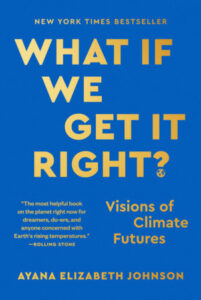
Excerpted from What If We Get It Right? by Ayana Elizabeth Johnson Copyright © 2024 by Ayana Elizabeth Johnson. Excerpted by permission of One World. All rights reserved. No part of this excerpt may be reproduced or reprinted without permission in writing from the publisher.

Ayana Elizabeth Johnson
Dr. Ayana Elizabeth Johnson is a marine biologist, policy expert, writer, and Brooklyn native. She co-founded and leads Urban Ocean Lab, a think tank for the future of coastal cities, and is the Roux Distinguished Scholar at Bowdoin College. Dr. Johnson co-edited the bestselling climate anthology All We Can Save, co-created and co-hosted the Spotify/Gimlet podcast How to Save a Planet, and co-authored the Blue New Deal, a roadmap for including the ocean in climate policy. She serves on the board of directors for Patagonia and GreenWave, and on the advisory board of Environmental Voter Project. Above all: She is in love with climate solutions.