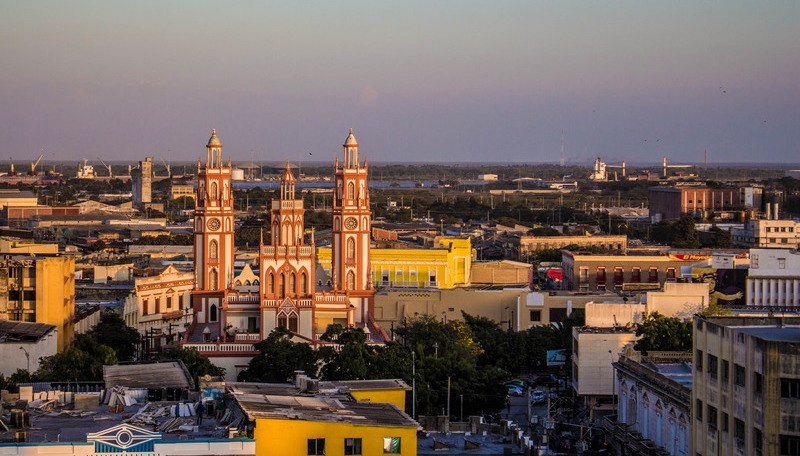
An Unsolved Puzzle: On Identity, Silence and a Legacy of Violence in Colombia
Adriana E. Ramírez Considers Her Grandmother's Life Though the Lens of Her Country's Recent History
As a child, I once asked my grandmother why she did not forgive or forget, given her fierce Catholicism. We were playing cards on the bed in her large, white bedroom in Barranquilla, surrounded by faded portraits of old saints and halfburned candles.
I think if Jesus had been Colombian, she said, He wouldn’t have been so much on forgiveness.
She looked at me closely.
You’re not Colombian, she said. You wouldn’t understand that.
*
My mother left Colombia in her twenties after she met my Mexican father on vacation in Buenos Aires. A few years later, I was born in Mexico City and when I was three months old, my family moved to Houston, Texas.
My grandmother’s violence is more subtle than a fist. It dwells in her silence, in her absence, in what she won’t say, in what she won’t do.
I am not Colombian by accent, by passport, by nationality.
But I am Colombian by blood. My father, who is Very Mexican, has a Colombian American father (a whole other story), making three of my four grandparents Colombian. I am more genetically Colombian than anything else. Still—my mother’s family has always been the connection to my Colombian self, and at the center of the storm that is my mother’s family stands my grandmother.
*
I have been trying to make sense of my grandmother since I can remember.
The Colombian grandmother of my childhood summers was funny, mean, pious, and hard—despite being tremendously sensitive in her own way. My grandmother was silent. My grandmother offered hugs, but never longer than necessary. She was a woman of stillness and efficiency, on horseback or comfortably seated under an umbrella on the beach, the focus of every photograph.
Spending over half my childhood summers in Colombia, I was often a tourist on my family’s coastal terrain, more camera than denizen, forever trying to reclaim something my mother left behind when she met and married my father.
To my deeply Colombian grandmother, I am her eldest and most foreign grandchild. I am the daughter of the one who left country and family. I am her only grandchild who speaks Colombian Spanish with a Mexican accent.
My mother has theories for everything. It is her way. She believes that because I grew up so far away from Colombia, I see her better than everyone. My eleven cousins on that side of the family all report different interactions with her, some in which she is far more tender. But unlike my cousins, I am out of her reach when it comes to day-to-day care and criticism. And because of this distance, my mother asserts, I interact with her as she is. But it is because of this distance, I argue back, that I don’t know her, not really.
*
As my mother often points out, my grandmother set the example—she left her family first.
She and my grandfather took their children away from the small villages their ancestors had built back in the sixteenth century in the mountains of Santander, in northeast Colombia. She left and headed for the safety of the coast, along with untold thousands of other Santandereanos, doing whatever was necessary to survive, as Colombians always have since the beginning of time.
It was the aftermath of civil war that pushed my grandparents away from their homelands in the 1960s—a conflict so violent, they simply called it that: the Violence.
This is where her story begins, my mother once told me.
Not when she was born? I asked. Her childhood?
My mother laughed and left the answer to my questions, like so many others, just hanging in the air.
*
One night in the summer of 1995, relaxed in her overstuffed living room chair, one of my mother’s sisters, Aunt Nidia, declared that during the Violence of 1948, my grandmother learned to internalize all her emotions, and she never stopped.
Don’t underestimate trauma, Aunt Nidia said, even if we don’t call it trauma, it’s still trauma.
Even at twelve, I knew that Colombia was a dangerous place. I knew about the guerrilla. I had heard about Pablo Escobar, cartels, and the cocaine trade. As a Colombian-by-blood trying to function in an American middle school, I was keenly aware of the association between Colombia and violence, as were most of my peers with their drug lord jokes.
But I never knew why so much conflict existed in Colombia particularly, or really anything else about the original disputes that yielded so much bloodshed. I certainly never knew that my grandparents had left the mountains where their ancestors had lived for hundreds of years because of a particularly awful conflict—which means something in a country that’s had at least eight civil wars, more than a dozen local wars, three coups d’état, and countless uprisings.
My mother agreed with Nidia.
Your grandmother had dreams before the Violence. She was beautiful, smart, with long and wavy brown hair to her waist. When she was a girl—she wanted to be a doctor, something that wasn’t impossible even during that time. If your grandmother had been born in another country or even another year…But she wasn’t.
My grandmother lacked options, my mother asserted, she is someone who is the way she is because of the circumstances that dictated her life. I know that not everyone who grew up during that time made the same choices, but given who she was, when she was, and how she was, my mother insisted that my grandmother never really had a chance to be any different.
My aunt chimed in, Colombians do not forgive, and your grandmother is the most Colombian of Colombians.
My mother nodded vigorously.
My aunt continued: She never forgave her country for forcing her to leave home—or her countrymen for not being more civilized. She never even forgave your grandfather.
We sat in silence for a few seconds that felt like hours. The subject of my grandfather had that effect.
Eventually, I spoke.
Even blood cannot forgive, I said, quoting something my grandmother had once said, understanding maybe a little more about my motherland than I had before.
Exactly, said my mother. My aunt nodded.
My mother ruffled my hair a little bit, You’ve never sounded more Colombian.
*
My grandmother keeps a blade on her tongue, sharpened and meant to draw blood, even, or especially, when she expresses love. She speaks in aphorisms and with the weight of history.
There is a violence to my grandmother. Not a physical violence—she is not one to quickly raise a hand, although I’ve heard stories that she pinches harder than fate.
Both my grandmother and Colombia are a puzzle I will never fully unravel—both parts of me that feel less like the facts of my origin and more like myths.
My grandmother’s violence is more subtle than a fist. It dwells in her silence, in her absence, in what she won’t say, in what she won’t do. It will emerge, quietly, in a small statement, a little quip, a phrase—something designed to both harm and help, an expression of concern or an explanation that hurts a little too much.
My grandmother keeps her resentments just below boiling—somehow scarier when fully in control. My grandmother believes in Hell, and my grandmother also firmly believes that everyone that has ever wronged her belongs there, roasting slowly. My grandmother plans to outlive all her enemies, mostly all the men that wronged her, and so far, she’s on track to bury them all.
*
Esther Angarita Sarmiento, called Pita Esther by her grandchildren (a corruption of “Abuelita”), is and has always been a survivor, beautiful and sharp, unknowable and impossible to fully grasp. Like her country. And like her country, she endures—through deceptions, woundings, and tremendous loss. Both my grandmother and Colombia are a puzzle I will never fully unravel—both parts of me that feel less like the facts of my origin and more like myths.
But I also know that she was once a girl. She was once a young woman with dreams of becoming a healer. She had crushes and went to dances. She walked along the mountainside with her friends, splashed her feet in creeks, gossiped relentlessly, and laughed at silly things the boys did.
She was only twenty when the Violence began.
*
Dreams change, my grandmother told me once after beating me at another hand of cards. Dreams change when they have to, she continued as I scooped up the cards.
“A lo hecho, pecho,” she said, a common phrase that translates roughly to “what is done is done” with a tiny hint of resignation. I nodded. She shuffled the cards silently for a minute.
That’s how life is, she said, before dealing another hand. She looked me over before finishing her thought. At least in Colombia.
__________________________________
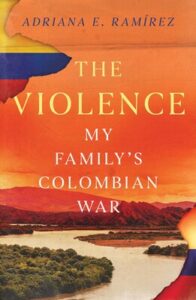
From The Violence: My Family’s Colombian War by Adriana E. Ramírez. Copyright © 2026. Available from Scribner, an imprint of Simon & Schuster.
Adriana E. Ramírez
Adriana E. Ramírez is a writer, critic, and poet based in Pittsburgh. She is the winner of the 2015 PEN/Fusion Emerging Writer’s Prize, a former critic-at-large for the Los Angeles Times’s Book Section, and the cofounder of Aster(ix) Journal. Her writing has also appeared in The Atlantic, The Boston Globe, People, ESPN’s The Undefeated (now Andscape), LitHub, Guernica, Nerve, and elsewhere. She once lost terribly on Jeopardy!.