America’s First War on Drugs Was Also a War on Jazz
Lisa E. Davis on the Historical Anti-Black Crusade of Law Enforcement and the White Cultural Establishment
In May 1947, Billie Holiday had a one-week engagement at Philadelphia’s Earle Theatre, one of the biggest venues in the city for Black entertainers. The Earle Theatre was built as a vaudeville palace in 1924 on the ground floor of a seven-story office building. It had 2,768 seats and welcomed musical stars like Duke Ellington, Count Basie, and Benny Goodman.
Billie Holiday was at the height of her fame. In the fourteen years since John Hammond discovered her singing at Monette’s Supper Club in Harlem, Billie Holiday had toured with Count Basie’s band, been one of the first Black performers to integrate an all-white band when she joined Artie Shaw’s orchestra, and, at the age of twenty-four in 1939, opened at Barney Josephson’s groundbreaking integrated jazz club Café Society. It was at her inaugural gig at Café Society that Billie Holiday introduced her signature song, the haunting anti-lynching ballad “Strange Fruit.”
“Strange Fruit” catapulted Billie Holiday to stardom, but John Hammond, the white executive who had signed her to Columbia Records, had not wanted her to record it. Holiday signed a one-year deal with Milt Gabler’s label to record the song. Although it is easy to criticize Hammond for his cowardice, he may have been prescient. The release of “Strange Fruit” put Billie Holiday in the crosshairs of racist federal and state law enforcement, who hounded her for the rest of her life. Beginning in 1940, the Federal Bureau of Narcotics (the predecessor to the DEA) began its obsessive surveillance of “Lady Day,” hoping to use her drug addiction to silence her. Billie Holiday had often said that she modeled her singing voice after Louis Armstrong and Bessie Smith. By May 1947, she was sharing the bill with Louis Armstrong at the Earle, as an artist of equal stature.
Laws criminalizing the entire range of recreational drugs were a powerful weapon with which hostile law enforcement could target Black people in general and Black jazz musicians in particular.
None of this mattered to the federal agents gunning for her arrest. As Holiday herself described it in her memoir, Lady Sings the Blues, on the last night of her engagement at the Earle, she had a hunch that the feds would be waiting at her hotel to ambush her. She begged her bandmate Bobby Tucker and her road manager (and dealer) Jimmy Asundio not to go back to her hotel. They laughed off her concern, but when she pulled up to the hotel a short while later, the lobby was teeming with cops. When a federal agent walked up to her car, Billie claims she grabbed the wheel from her chauffeur and sped off in a hail of bullets.
Although much of her memoir has been criticized as a mix of exaggeration and self-conscious mythologizing, there is no dispute that Billie Holiday was ultimately charged with illegal narcotics possession based on that sweep of her Philadelphia hotel room. Her manager, Joe Glaser, gave her the baffling advice to decline representation and plead guilty. Holiday acquiesced, hoping to be sent to a rehabilitation facility. Instead, in 1947, she was sentenced to serve a year and a day in federal prison in Anderson, West Virginia. By all accounts, Billie Holiday was a model prisoner, but during her entire sentence, she didn’t sing a note. Because of the criminalization of her addiction, Lady Day would be silenced for far longer.
After her guilty plea, the New York Police Department revoked Billie Holiday’s cabaret card, banning her from the most lucrative and consistent gigs in New York jazz clubs. Lacking the supportive family, dedicated patrons, or honest managers that surrounded a jazz great like Thelonious Monk, Holiday never regained her cabaret card for the rest of her life. Although she performed in Europe and in large concert halls, the inability to book jazz clubs severely limited her earning potential.
Unlike Monk, the intellectual property that Billie Holiday created primarily drove revenue for others. She made her first recording in 1933 and recorded steadily over the next quarter century, but like Bessie Smith before her, she did not receive any royalties for her Columbia recordings. It was not until she signed with Milt Gabler’s Commodore Records in 1941 that Billie’s contract included royalties. Even then, the typical royalty rate for artists was between 1 and 4 percent, leaving the label with the lion’s share of income for her recordings. As a result, when Billie Holiday died in a New York hospital in 1959, handcuffed to her bed by the sadistic NYPD, her only money was the wad of $50 bills strapped to her leg.
In June 1948, the brilliant jazz composer and pianist Thelonious Monk was leaving a gig at the Royal Roost, a New York City club, when police approached and searched him. They found a small bag of marijuana and arrested him. Although this was a misdemeanor even in 1948, after a trial on August 31, Monk was sentenced to thirty days in jail on Rikers Island. Sadly, Monk’s real punishment for that nickel bag extended far beyond those thirty days.
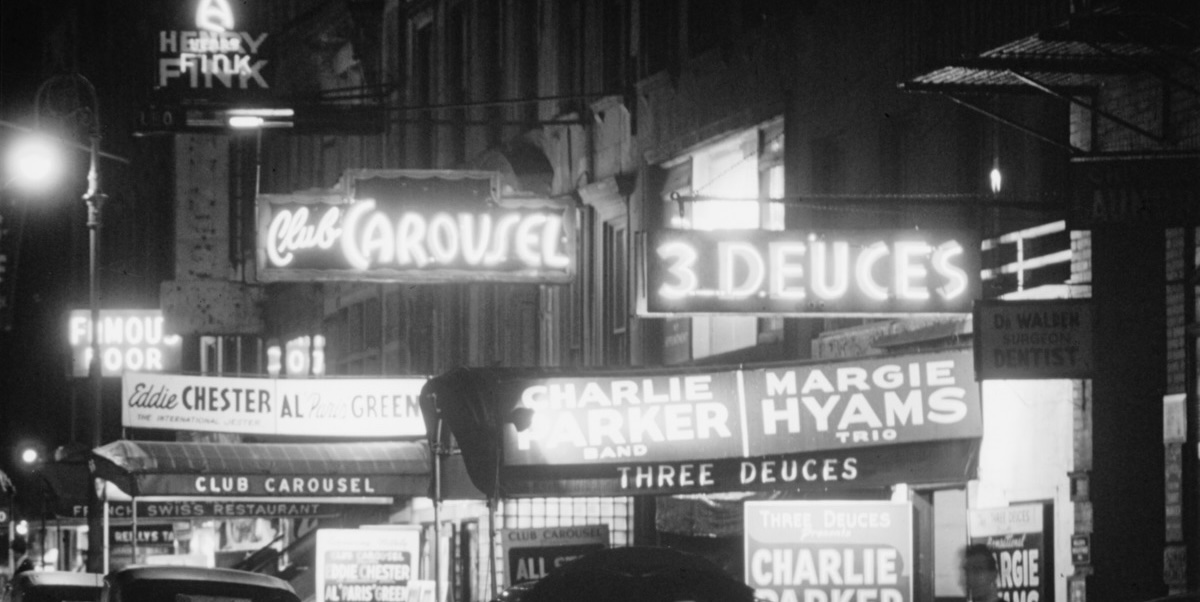
Due to their convictions and incarcerations, the NYPD revoked the cabaret cards of both Billie Holiday and Thelonious Monk. Without cabaret cards, neither artist could work in any New York City establishment that sold alcohol, which eliminated every venue in the epicenter of jazz. Monk and Lady Day were barred from lucrative gigs on Fifty-Second Street—which boasted so many jazz clubs that it was nicknamed “Swing Street”—and from Harlem clubs like Minton’s Playhouse, where Monk got his start as the house pianist in 1941.
Although the NYPD did not start requiring musicians to have cabaret cards until 1940, the law had its origins in Prohibition-era New York City. During the 1920s, Harlem became a mecca for Black artists, writers, and musicians. Harlem clubs attracted high-society white people who came to mix with artists like Langston Hughes and Zora Neale Hurston and to indulge in the illicit thrill of mingling across the rigid color line. As detailed in the legislative history of the cabaret card law, New York politicians panicked at the thought that tourists or naive (white) New Yorkers would “run wild” in New York clubs and dance halls after rubbing elbows with people of “poor moral character,” and in 1926 legislation was passed requiring that the character of every staff person who worked in entertainment venues such as clubs and dance halls pass muster with the NYPD. The original legislation addressed permanent workers such as maître d’s, waiters, and kitchen staff. In 1940, at the urging of Mayor Fiorello La Guardia, the law’s scope was expanded to monitor musicians who appeared at any venue that served alcohol, regardless of whether their employment was a one-week engagement or as part of the house band.
In 1941, the union covering bartenders and hotel and restaurant workers sued the NYPD to invalidate the cabaret card law. In Friedman v. Valentine, the union challenged the entire cabaret card scheme as exceeding the scope of the police department’s authority. The union also argued that the requirement that all applicants seeking work in restaurants, dance halls, cabarets, and nightclubs pay the police department a $2 application fee and be fingerprinted violated their due process rights by imposing an undue burden on their ability to find employment.
The court blithely dismissed both arguments. Justice Ferdinand Pecora of the New York State Supreme Court endorsed the New York City Council’s view that workers in dance halls and cabarets were uniquely positioned to take advantage of patrons. The court stated that the test of a law’s constitutionality was “whether an evil exists and whether there is a logical relation between the eradication of the evil and the enactment of regulations intended to cure the condition.”
Although the opinion was written ten years after the end of Prohibition, the Puritanical contempt oozes off the page. Judge Pecora rejected the contention that the fingerprinting requirement imposed an undue burden, citing the myriad professions that required finger-printing as a prerequisite to obtaining a license. The judge ignored the fact that these other professions involved business operators, rather than low-level workers. It gave short shrift to the fact that the law gave the police department the discretion to prevent every type of worker in an entire segment of the hospitality and entertainment industry from earning a living. The law allowed the NYPD to with-hold cabaret cards from those convicted of misdemeanors involving disorderly conduct or relating to “narcotic drugs.” Once the regulations were amended in 1940 to define jazz clubs as cabarets and to require musicians with limited engagements of one or two weeks to obtain a cabaret card in order to perform, the NYPD had a powerful tool for controlling the lives and livelihoods of Black musicians.
The NYPD of the 1940s boasted very few Black officers. In 1943, Black New Yorkers were 6 percent of the city’s population but less than 1 percent of the police force. Given that the cabaret card law originated in politicians’ fear that jazz music and alcohol would lead to debauchery and interracial socializing, it is hardly surprising the NYPD would focus its attention on placing Black jazz artists in legal jeopardy to imperil their livelihood.
The criminalization of a range of recreational drugs from heroin to marijuana made it much easier for the police to achieve that goal. That criminalization was thanks to Harry Anslinger, the virulent racist in charge of the federal government’s narcotics policy for thirty years. Anslinger got his start during Prohibition, chasing down bootleggers for the federal government. Once Prohibition was repealed, he feared he would be unemployed and looked for another illicit sub-stance to police.
According to journalist Laura Smith, Anslinger initially “focused [his agency’s enforcement efforts] on cocaine and heroin,” but the small number of users threatened his agency’s relevance, so he pivoted to marijuana and embarked on a campaign to demonize the drug in order to criminalize it. He began with the name. In the early twentieth century, cannabis was known by many nicknames, including juju, tea, and reefer. Anslinger popularized the term marijuana so that the public would associate the drug with Mexican immigrants. He asserted that there was a link between marijuana use and violence, although research showed that this assertion was completely false. Throughout the 1930s, Anslinger worked to conflate race, drugs, music, and crime in the minds of the public. Anslinger’s efforts culminated in the passage of the Marihuana Tax Act of 1937, which made the drug illegal.
Anslinger’s efforts were successful because the criminalization of recreational drugs was racialized from the start. The first widespread use of opiates was among wounded Civil War veterans, who used the drugs to ease the pain of injuries sustained during what still holds the record as the deadliest war in American history. After the Civil War, male doctors commonly prescribed morphine to female patients to help with menstrual cramps, “diseases of a nervous character,” and even morning sickness. From the late nineteenth century into the twentieth century, most opiate addicts were middle- and upper-middle-class (white) women. San Francisco passed the first law criminalizing the drug when it outlawed the operation of Chinese opium dens in 1875. It is telling that private sale and use were not outlawed, insulating white dealers and users from arrest and prosecution.
Once drug use crossed class and racial lines, the Harrison Narcotics Tax Act was passed in 1914, a federal law criminalizing the sale and use of opiates. Laws criminalizing the entire range of recreational drugs were a powerful weapon with which hostile law enforcement could target Black people in general and Black jazz musicians in particular.
At its birth in the early twentieth century, jazz was viewed with contempt and suspicion by the larger white society. The reasons aren’t complicated. Black people in America were widely hated and viewed as inferior. Jazz, as an unequivocally Black creation, was condemned and feared by white music critics and listeners. Initial critical reactions to jazz presage the reception that bebop, rock and roll, and Hip Hop later received, often using the same adjectives.
Black people in America were widely hated and viewed as inferior. Jazz, as an unequivocally Black creation, was condemned and feared by white music critics and listeners.
In mainstream periodicals of the day such as Current Opinion and The Literary Digest, critics derided both jazz music and the Black musicians who played it. In an article titled “The Appeal of Primitive Jazz,” the author described Black jazz musicians who “shake and jump and writhe in ways to suggest” Saint Vitus’s dance, a medieval term for an illness characterized by involuntary movement. It dismissed the music as the “delirium tremens of syncopation…strict rhythm without melody.”
This article appears to have been the first of many racist attacks on jazz under the guise of artistic “criticism.” At least one Black musician, James Reese Europe, attempted to rebut the scurrilous attacks in an article titled “A Negro Explains Jazz.” Europe was a famous musician and World War I veteran who served as a lieutenant in the famous Harlem Hellfighters regiment. As such, he had the gravitas and the authority to defend jazz from ignorant condemnation.
Europe described how the colonel of his regiment had recruited him to find a band to serve and play with him at the front lines. Although Europe and his band members spent time in the trenches seeing active combat, the purpose of his article was to defend jazz music. Europe details the “wild” reception French audiences gave his band in Paris that turned a one-night concert into an eight-week engagement. Europe returned from the war even more convinced of the artistic merit of Black jazz music. He argued that even Black classical composers like Harry Burleigh and Will Marion Cook did their best work when drawing on the cultural heritage of “their race.”
Unfortunately, Europe’s passionate defense did nothing to stem the steady flood of mainstream condemnations of jazz, rooted in racism. Outlets as disparate as Ladies’ Home Journal and The New Republic ran articles characterizing jazz as a “known danger” and ex-pressing fear that the mere act of listening to jazz could turn white people into the “savages” they believed Black people to be.
Commencing with the emergence of jazz as a popular art form around World War I, white critics relentlessly condemned it as nothing more than cacophonous “jungle music” and its Black practitioners as untutored savages. By the end of Prohibition, a wide swath of mainstream white America viewed jazz musicians as immoral, corrupting influences per se. Even the white critics who loved jazz often viewed its Black innovators with condescension born of racism. These attitudes made Black musicians ripe targets for persecution by zealous law enforcement, at great cost to their mental health, livelihoods, and their very lives.
Billie Holiday and Thelonious Monk are unquestionably two of the greatest jazz musicians that America has ever produced. Both left an indelible mark on the music, innovating and inspiring an untold number of their contemporaries, as well as generations of musicians who came after them. Despite—or perhaps because of—their genius, law enforcement persecuted them continually. Harry Anslinger, the viciously racist head of the Federal Bureau of Narcotics, specifically targeted both Billie Holiday and Thelonious Monk. Anslinger hired a Black undercover agent to infiltrate Billie Holiday’s circle and colluded with her abusive husband to set her up for arrest. Billie was vulnerable thanks to a heroin addiction aided and abetted by enablers in her inner circle. Monk was harassed for “offenses” as disparate as possession of marijuana or refusing to snitch on pianist Bud Powell when heroin was found in their car.
Both Holiday and Monk lost their cabaret cards, and thus their ability to work in New York City clubs, because of these arrests. Despite his battle with racist law enforcement and mental health challenges, Monk left behind a jaw-droppingly large and brilliant body of work comprised not only of recordings but compositions for which he retained copyright ownership. Monk’s catalog includes such classics as “’Round Midnight,” “Crepuscule with Nellie,” “Epistrophy,” and “Ruby, My Dear.”
Conversely, when Billie Holiday died handcuffed to a hospital bed, despite her extensive and brilliant body of work, she was nearly destitute. Her lawyer claimed that he was entitled to 10 percent of her record royalties, which were only disgorged after her husband, Louis McKay, successfully sued on behalf of her estate.
There are multiple reasons for the wildly disparate fates of Monk and Lady Day, from their gender to their family backgrounds, to formal training or its absence, to being surrounded by supportive managers or exploitative ones. A key difference between Thelonious Monk and Billie Holiday, though, was in whether their particular form of creative expression could be protected under intellectual property laws, and therefore monetized by them.
____________________________
Excerpted from Our Minds Were Always Free:A History of How Black Brilliance Was Exploited—and the Fight to Retake Control by Lisa E. Davis. Copyright © 2026 by Lisa E. Davis. Reprinted by permission of Simon & Schuster, Inc. All rights reserved.

Lisa E. Davis
Lisa E. Davis is one of the foremost entertainment attorneys in the country. She is cochair of the Entertainment Group of Frankfurt Kurnit Klein & Selz, representing celebrities in the film, television, publishing, music, theater, and sports industries. Davis has been ranked as a New York area “Super Lawyer” since 2007 and featured on the cover of Super Lawyers magazine about her career and advocacy for racial justice. She is recognized in Who’s Who Legal 2024, by Best Lawyers in America 2023–2025, Crain’s New York Business’s 2023 Notable Women in Law, The Hollywood Reporter’s Power Lawyers 2025, 2024, 2023, 2021, and 2020 lists of New York’s Top 20 Entertainment Attorneys, Variety’s Legal Impact Report, and more. Davis has been quoted in Elle magazine, The New York Times, and Black Enterprise magazine. A graduate of Harvard College and New York University School of Law, she clerked for the Honorable Constance Baker Motley in the United States District Court for the Southern District of New York. A frequent speaker and panelist at conferences, she is a member of the New York City Bar and the Black Entertainment and Sports Lawyers Association. Davis also has a political blog, Journal of the Plague Years. She practices law in New York and lives in New Jersey with her family.