I was born thirty-five years ago in a place called Mazinagar. My family lived on a narrow street, not far from the town square. At the time, there were only two other houses on the street; the rest was still farmland. The gate of our house opened to a courtyard, bordered by three small rooms and a kitchen. In the corner were two roofless latrines—one with the toilet and the other with a tap, bucket and footstool for bathing. Next to them was the handpump where we washed dishes and did our weekly laundry, creating ravines of soapy water that snaked their way around the courtyard. A chinaberry tree stood in the middle of the yard. A door led to the animal shed, where we kept two goats and a cow.
On summer nights, when it was too hot to sleep inside the rooms, we dragged our charpoys out and set them in the courtyard. The sky was overlaid with a blanket of stars, and when we were young, my brother and I counted shooting stars together. Of all the siblings, only he and I were curious about this—why did stars burn themselves into darkness? He told me that I was the cleverest of us five, and that when I learned about stars in school, I should let him know the answer.
When I think of that house, two sharp memories awaken. One is the smell of dust, clinging desperately to every object. The duvets under which my sisters and I shivered on cold nights remained thick with dust even after we beat at them with brooms at the start of each winter. Dust particles danced in streams of afternoon light when Mother swept the yard. A dry film coated the pitcher of water, the mirror in the bathroom and the front gate.
The other is the smell of excrement. My three sisters and I shared the room next to the shed. All night, we smelled the faint whiff of animal dung, which Mother patted into cakes and slapped onto the back wall of the house, to be used later as kindling. For a few days each month, all of us bled together, so synchronized that we followed an order—first I started my period, then Azra did, then Zahida, then Rubina. The soiled rags we’d used were washed and hung to dry in the room, so there was often a hint of menstrual blood, which smells nothing like blood from a fresh wound but instead like the blood of animals sacrificed on Eid. Even on days when no one was bleeding and there were no damp rags in the corner, a stale odor remained, as if our blood had become its own animal, a fifth inhabitant of the room.
In moments of fondness—those are rare, I am no nostalgist—I remember happier things from my childhood home. The small bubbles that formed on top of the butter Mother churned each morning. The laughter of the women who worked at the peanut farm nearby, as they walked past our house each dawn. The tinkling of bells that sounded throughout town in the evening, as the shepherds returned home with their flock. The wrinkled fruit of the chinaberry tree. The curls of Father’s tobacco smoke in the night air.
*
That year, again, my brother threatened to take me out of school. I was fifteen and he was twenty-two, and we were searching for a bride for him. Zahida and Rubina, my older sisters, were both engaged to our cousins, and the aunts had been restless for a while, demanding that the weddings take place soon. My mother wanted to sort out the matter of Lateef’s wife first. Azra was still too young to help at home and I was in school during the day. Mother didn’t want to lose all help around the house.
“So take Tara out of school,” Lateef said, whenever this was brought up. “She’s wasting her time with those useless books.”
“Let at least one of them study,” my mother grumbled back.
We settled on a girl from a nearby village. My mother thought she was no match for Lateef’s beauty. And it was true that our brother’s thick, curly hair, long lashes, the scent of his attar, his broad shoulders and his height were the talk of the town. On his right hand sat the emerald ring I had always wanted, the one he inherited from our maternal grandfather. The green glinted when he entered the courtyard, or when he raised his hand to hit us.
When we were very young, my sisters and I had considered ourselves lucky, with an older brother who was sweet and gentle, with none of the surly aggression we saw in our friends’ brothers. Whenever we got hold of money, which was rare, we asked him to get us fritters and roasted chickpeas from the market. Sometimes, he bought little gifts for us—hairpins, or cones of henna. We treasured these gifts, fought among ourselves like cats to claim them. I remember once, when we were quite young, Father’s radio played an old song about a lost brother. All four of us teared up, thinking how much we loved our own beautiful brother.
But then things changed. Around the age of seventeen, Lateef dropped out of school. A couple of friends convinced him that it was a waste of time. Instead, he began buying and selling goats and chickens, and playing middleman to peanut farmers in the area. He became a different, more menacing man. He snapped at us, telling us that our clothes weren’t modest enough, the food not warm enough, the floors not clean enough. The speed and totality with which this happened shocked everyone except Mother, who said with pride that this aggression was what being a man meant. “A man’s only a man between fifteen and fifty,” she said, looking scornfully at our father, hunched over in his charpoy.
Now, five years later, Lateef had sold a good amount of Mother’s gold to buy a corner shop a few minutes from the house. He had assumed the role of head of household, relinquished without regret by our mild-tempered father, who was content to sit in silence with his radio, listening to the transmission and turning the air hazy with pipe smoke. The shop made Lateef only a modest amount of money, barely enough to cover food for the seven of us, but it allowed him to observe everyone in the neighborhood. He knew who used the telephone at the shop to call the city, whose wife came to buy washing powder with her toenails painted, which family had enough to buy a month’s worth of lentils and rice, and which ones were so cash-strapped that they sent their children to get groceries at the end of the month, children who could ask for credit without shame. Expertly, my brother turned this gift of constant, intimate surveillance into social capital. Since nothing could be hidden from him, people didn’t hide anything from him, about themselves or others. My brother didn’t gossip or taunt, but simply held on to information like a trusted bank. Within months of opening the shop, he was a respected man in the neighborhood, entrenched in the social and economic life of our small town two hours from the country’s capital.
With me, he held a peculiar, fierce grudge. He wanted me out of school. He had withdrawn all the other sisters one after the other, claiming that school did nothing but corrupt young women, filling their heads with ideas and making them shameless. When Azra was taken out, Lateef had insisted that I be as well, since I was older. Mother fell at his feet and threatened to stop eating. He backed down, but since then, he had a stick to threaten me with any time he was angry.
“You wait,” he would say. “Any day, I’m going to take you out of that den of whores.”
*
Lateef and my parents went to visit his future wife’s father one afternoon in December. The man was kind, well-respected and eager to marry his daughter off. The mother had died of tuberculosis the previous year and there were no siblings, which was a tremendous benefit in my mother’s eyes—no one to fill her ears with nonsense. The father said he had nothing to give in dowry. The mother’s illness had eaten into everything they had saved. My mother assured him that we were not a money-minded family; all we wanted was his daughter’s hand in marriage. In fact, our father had been the town accountant before he retired, cycling from one house to another with a battered register clamped in the cargo rack. Lateef was a shopkeeper. Money was counted daily, spoken of incessantly, felt in its paucity like a ghost in each room. After they returned with a date for the wedding, Mother sat in her corner of the kitchen grinding garlic.
“How can a mother eat into her daughter’s dowry? May God kill me before I even think of such a thing.”
“God did kill her,” my father said softly, from his perch by the radio.
About Father, there is little to be said. Compared to our mother, who had always been stocky, he was flimsy and weak, a negligible man. They looked lopsided whenever they walked on the street together—she, with curious, expressive eyes and a wide back, hair dyed a blazing red, and he, with his measured gait, bird bones and thinning white hair. His work as an accountant had spared him the sun marks and whittled skin that Mother carried. He rarely spoke, except to ask for his meals or a glass of water. When we were young, he had hit Mother for small things, like a piece of bread served cold, while we looked on, unflinching, curious the way one is curious about a partridge about to be hunted. But that was a long time ago; I could not remember the last time he raised his voice. My mother is a fool who can barely read the newspaper, but once, remembering the days of his youth, she had recited a verse in High Persian: “In old age, even the wolf becomes a saint.”
*
The wedding took place on an empty plot of farmland behind our house. The eve of the wedding, Lateef brought home a few bags of rose petals and we spread blankets in the courtyard. A handful of our girlfriends from school came over. For dinner and a small fee, Mother got an old woman from a neighboring village to come by with a small drum. We sang deep into the night, alternating between rural songs that the old drummer knew and film songs that a couple of friends who had TVs had learned by heart. We had begged many times for a TV, but money was always short, and Mother was scared of it. The first time she saw a TV at her sister’s house, she stared at the news reporter in petrified silence. Then she turned to us and asked, “What happens if he comes out?”
Lateef’s wife, Salma, moved in with us. Mother had purchased a new bed and armoire for his room, and the walls were freshly distempered. Lateef had picked a soft pink color, and we giggled each time we walked past, tickled by the insinuations of the pink walls.
“What’s so funny?” Mother asked.
“Lateef has a wife now,” Zahida said, because she was the oldest and was afforded the most license.
“So?”
“So he and Salma must enjoy their nights.”
The rest of us laughed a shy, lewd laughter, the kind that felt like acid climbing up your throat as soon as it ended.
“What’s funny about that?” Mother asked. “Wait till you all get married. You’ll learn that there is nothing funny about that.”
Zahida’s smile disappeared. Mother had a way of becoming a cloud over us.
*
For the first few days, we did not let Salma do any housework. Mother told her to sit back and enjoy being a new bride, something syrupy and artificial in her voice, like the scent of neem soap that almost covered the smell of shit in the latrine.
“The henna on your hands hasn’t even washed off yet,” she said, shooing Salma away from the handpump.
“I’ll need to do dishes for that to happen,” Salma replied, equally eager to please.
Within weeks, however, many responsibilities had been shifted to her—not only the dishes, but also the kneading of dough for bread, the cutting of onions and tomatoes, the sweeping and sprinkling of water in the courtyard each evening, and the milking of the cow. On my walks back from school, I saw Salma instead of my mother sitting by the back wall of the house, shaping dung cakes and smacking them onto the bricks. Taking Mother’s lead, Zahida and Rubina also began handing off chore after chore to Salma, who must have expected this, because she never complained. Once, however, Mother found a pair of Zahida’s bloodstained underwear in the pile of clothes Salma was about to wash. She rushed to where Zahida was sitting on a charpoy, combing her wet hair. She snatched the comb and thwacked it on Zahida’s temple.
“Who the fuck do you think you are? How dare you make her wash that?”
Zahida looked up in shock, then began to swear with the same vitriol. She called Mother a fat, ugly hag.
“I’m ashamed to walk down the street with you, you witch!” she screamed.
Soon they were both stamping their feet and wagging their fingers, and Rubina and Azra were grinning, and the chickens in the courtyard were clucking as they went about looking for stray feed. This was how it always was. On the surface, we were better off than many families in town, with enough to eat, clothes that were always clean, heads that were not bowed down by generations of debt. But within the house, violence lurked like flammable gas. The potential for combustion was always present, the end of civility always near.
*
One night in April, we had just finished dinner when Lateef cleared his throat. Mother was preparing a pipe for Father, and my sisters were in their corner of the yard, reading the women’s magazines they borrowed from their friends each month. I was doing my homework. Salma was washing dishes at the handpump.
“I’m thinking of taking Salma to Islamabad this weekend.”
Mother frowned, then perked up.
“To see a doctor?”
She thought Salma might be pregnant already.
“No, just for some sightseeing.”
There was silence. My mother looked bewildered and even Father looked up. Lateef sheepishly raked his hand through his hair.
“My friend from the wholesale market is letting me borrow his car. I figured she’s never been, so I’ll take her.”
The sound of water sloshing had stopped.
“Neither have your sisters. Why don’t you take them along as well?”
From behind their magazines, Zahida and Rubina looked at one another.
“What will they do there?” my brother said, irate. Not even he, who answered to no one, could admit that he wanted to spend a day alone with his wife. Love was the only forbidden emotion in our house.
“The same things you’ll do,” Mother said curtly. “Either they go with you, or you’re not going.”
So it was decided. On Sunday, all four of us woke up at dawn. We took turns ironing our clothes and putting on the lipstick and rouge that Zahida had purchased for the wedding. Salma hunched over the stove, making tea and bread for everyone.
“Shouldn’t someone be helping her?” Zahida said, giggling, as she combed her hair. “Tara, go help your sister-in-law.”
“No need,” my mother said. “She wants to be the madam of the house, doesn’t she, coming and going to the city with her husband in a car. Let her see what being a madam means.”
Zahida and Rubina snickered, with a villainy that bordered on hysterical. Their own wedding dates were set, and they knew that soon enough they would be relegated to the same status as Salma.
“We shouldn’t even be going,” I said. “What’s wrong with the two of them enjoying some time alone?”
“And we stay back to do her work all day?” Rubina shot back.
“You don’t have to worry, no one ever asks you to do anything because you’re always busy with your stupid books.”
Ignoring the two of us, Mother said, “Make sure you stay close to them and listen for if she tries to fill his ears with rubbish.”
As we lined up to squeeze into the back seat of the car, Lateef grabbed my face by the chin.
“Wash the make-up off. Do you think you’re a film star?”
“They’re both wearing it too,” I cried out, pointing to my older sisters.
“I’m talking to you.”
Hot tears poured from my eyes.
“Go on, wash it off, we’ll wait,” he said, averting his eyes, calmer now that he had succeeded in rattling me.
At my mother’s command, Zahida sat in the front seat with Lateef. The rest of us—Rubina, me, Azra and Salma—piled into the back. We drove out of town and past my mother’s old village, soon crossing the river that had been, till then, the boundary of all we had ever known. Around the Dharabi hills, the car started slowing down. Lateef said that there was too much weight in the back, causing us to break into hysterical laughter.
“You, fatty, get in the front,” Lateef said, pulling the brake and looking at Salma in the rearview mirror. Zahida and Salma switched, and we continued driving past one ravine and the next, past hillocks and small pastures and rusty bridges. Everyone fell silent. Something new was happening, some history being made in the mile after mile we were putting between ourselves and home. Even Lateef changed. When we stopped at a petrol station, he bought crisps and cartons of juice for us, unasked, and Rubina teased him, “The change of scenery has turned our miserly brother generous.” We laughed, giddy, and he winked and continued to drink his juice. It was as if our hierarchies had drowned in the ravines, as if we were now different people, belonging to a different kind of family. We passed Chakwal and then Mandra, then got on to the G. T. Road. By the time we reached Islamabad, it was ten in the morning. Lateef stopped at a big market with outdoor seating. We sat in a corner, our faces half-covered with shawls, while he ordered tea and fritters.
A thrill was coursing through me. A woman with her head uncovered passed by us. I looked away in embarrassment, thinking that her chadar had slid off and I was catching her in a moment of undress. But I looked again, and there was no chadar at all. The car park was full of shiny cars. Much of the signage was in English and, for the first time, my education was distinguishing me, because I could tell which shop was a bookseller and which one was a bank, because I could read English and none of the others could.
The waiter brought over a tray filled with teacups and freshly fried food wrapped in the previous day’s paper: 9 April 1988, it said, under the masthead. Just as he placed the tray on the table, a massive explosion went off nearby. We all ducked down, and the waiter collapsed on the floor in shock. Several smaller explosions followed. Our teacups shook, and mine—closest to the edge—fell to the floor and shattered. My heart was thumping rapidly, and my ears were ringing. Some people ran inside shops for cover. We remained in our chairs, petrified. Azra and I clung on to each other’s hands.
After a few minutes of silence, Lateef ran off to find out what had happened. He returned with little information besides what we already knew; there had been an explosion nearby. No one knew where. He looked shaken and said we should return home. We protested, begging him to stay. This was our first time away from Mazinagar, our first time in a city we had heard so much about. Who knew when we would do this again? The explosion had already happened, hadn’t it? After arguing for a while, he gave in.
We went to the zoo, where we fed leftover fritters to the animals. Then we drove up a steep incline, the car gasping and belching, to see the green hills that circled the city. From above, the city appeared like a miracle. Who had created such a neat, tidily tucked-in place, with its angular streets and perfect squares lined with beautiful houses? My sisters and I gaped openly at every bareheaded woman we saw. Some of them wore perfume, so when they walked by us, the air turned alive with the fragrance of orange and jasmine. Their shoes were new. Their hair was neatly cut, unlike the wispy tendrils our braids ended in.
Walking back to the car, I noticed a family. The father was wearing a button-down shirt, creased from wear but evidently well-ironed. The mother’s head was uncovered, and she wore light pink lipstick. They had two children—a boy and a girl—who were dressed in Western clothes—trousers for him, a dress for her—instead of the crumpled, hand-stitched clothes worn by children in Mazinagar. The man and his wife were sitting on a bench, the woman’s head on the man’s shoulder. The children were running after each other. I turned dizzy with longing. The whole drive back home, as we retraced our way over the ridges and ravines, the longing remained stuck like a bone in my throat. How would it feel to be that woman with the light pink lips?
I returned to Mazinagar transformed. The place of my birth began to repel me in a way it never had. Now, I saw how petty and insignificant my little plot of the earth was. How sooty and unglamorous, how beholden to the old.
As I lay down in my bed late that night, I promised myself that I would find a way to join the beautiful, free people of the city.
__________________________________
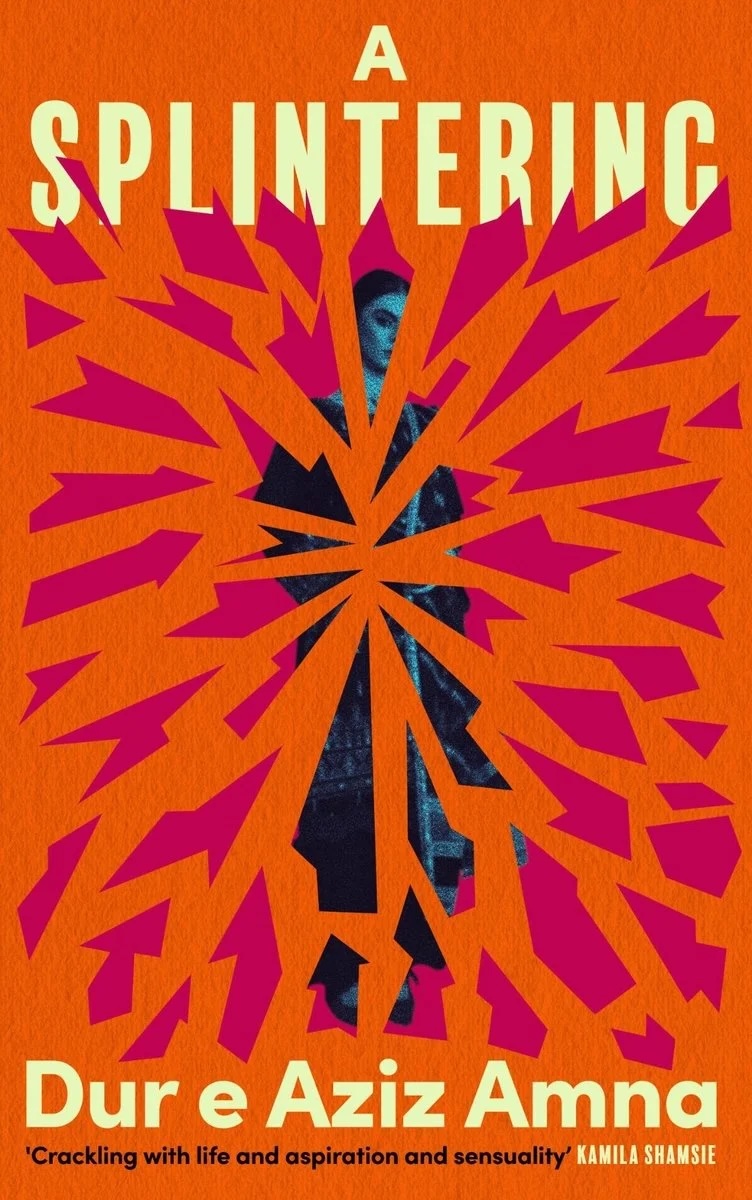
From A Splintering by Dur e Aziz Amna. Used with permission of the publisher, DZANC Books. Copyright © 2026 by by Dur e Aziz Amna.