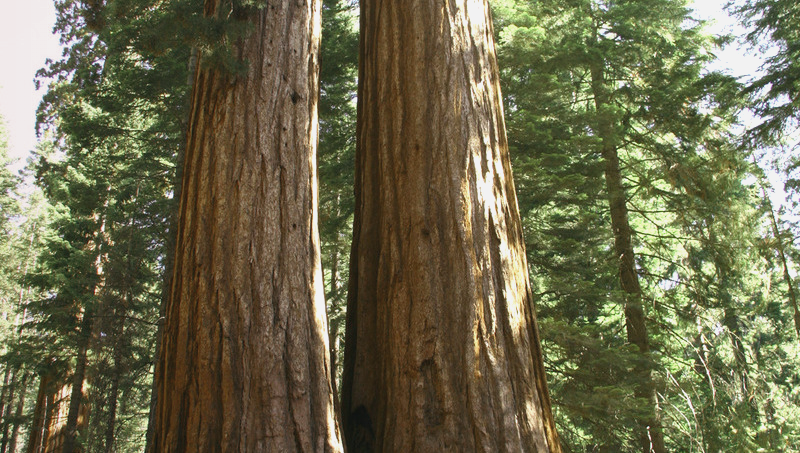
The fantasy of chaining myself to a redwood
as the distance between my body and the chainsaw
decreases. The fantasy of lying between a harvester
and old growth forest. I have had both,
done neither. I have wanted to feel the wind
the chainsaw gives off inch closer
and closer, the harvester vibrating the road
beneath me, but my body knows neither sensation.
I am no real agitator, have sabotaged nothing,
but why this is, what reason there could be, I’ve hidden
from myself, redacted like classified information
within the document from which I glean a life,
though what’s left unredacted might itself be revealing.
I think of the chainsaw, its noise, its volatility.
Maybe the wind it gives off would give my life
more meaning than I can give it myself.
No, the chainsaw would rip through my body.
Sever it in half. The wind cannot give
what it does not have, what isn’t its to give.
*
Should trees have standing? Should elephants
have standing? Should we recognize nature’s claim
to legal rights? Should nature be able to take you to court?
Should rivers have standing? Should the courts
run the river? Who should control the public lands?
When should water belong to the public?
Who should pay for cleaning up hazardous waste?
Should the polluter also pay punitive damages? How clean
is clean? How should the airline industry respond?
Who should win the garbage wars? Should Utah’s judiciary
require all court filings to be made on recycled paper?
Should the butcher, the baker, and the candlestick maker
be held responsible for hazardous waste?
Are they lying now or were they lying then? Should they
be regulated, and if so, who can regulate them?
Should we ban single-use plastics? Should ocean waters
be utilized to produce freshwater? What is fracking wastewater?
What is the smart grid and why should we care?
Should climate damages cases be heard in state
or federal court? Should you know about the pesticides
in your clothes? Should we set priorities
based on risk analysis? Whose pocket should be picked?
Whose line in the sand? Should there be one?
*
There is an animality to dying. The ease with which it can happen,
the swiftness of it, of indiscriminate mortality
stunning a body from afar or within, discarding it,
that reminds me we are animals, that a child is an animal,
as well as a seed. Under halogen lights, not clouds
or stars, I hold it, a foil-laminated bag, gusseted on the sides,
in which seeds of durum are kept, about 3,000—
small, oblong, desaturated yellow. They feel heavy
in the bag, and they shift as I squeeze it, as my gloved hand
squeezes it, shivering. It is just below 0° in the vault,
where trays of seeds are stored on shelving units
that can expand and collapse, more efficient this way,
so that all 5,000 square feet can be utilized. The facility,
located in Fort Collins, can withstand floods
from Horsetooth Reservoir, survive tornadoes,
the impact of a 2,500-lb. object traveling at 125 mph,
which is supposed to make us feel safe,
knowing that we’re planning ahead, for catastrophe,
though such fortification belies the vulnerability
of those who, now or in the future, the seeds are for—
this part is not on the audio of the self-guided tour,
which has moved on, something about freezing seeds
with liquid nitrogen—the children of our children of our children,
and so on, whose future has an animality to it
__________________________________
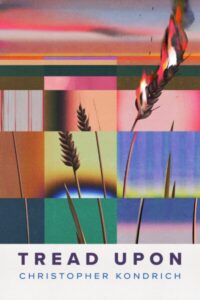
From Tread Upon by Christopher Kondrich. Copyright © 2026. Available from Copper Canyon Press.
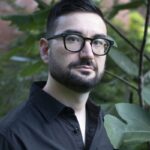
Christopher Kondrich
Christopher Kondrich is the author of Contrapuntal and Valuing, which won the National Poetry Series and was named a best book of 2019 by Library Journal. His poems have appeared widely in such venues as The Atlantic, The Believer, The Kenyon Review, Los Angeles Review of Books, New England Review, The New York Review of Books, The Paris Review, Ploughshares, Poetry London, and The Yale Review, and he has received fellowships from MacDowell, the Virginia Center for the Creative Arts, and Yaddo. He is also the coeditor of Creature Needs: Writers Respond to the Science of Animal Conservation and an associate editor for 32 Poems. He is currently Visiting Poet in Residence for the Creative Writing MFA program at the University of Maryland.