A New Language: On Primo Levi’s Translation of Kafka
Maïa Hruska Considers the Act of Writing and Translating After Auschwitz
Not only did Kafka create a new language to describe the world, he also invented a new punctuation: he put question marks where there had never been any before. “Why” is the word that keeps emerging from Josef K’s mouth throughout his long trial. And the same is true for K the land surveyor during his numerous interrogations, for Gregor Samsa after his transformation, and for Karl Rossmann as he travels through America. Kafka’s characters do not expect any recompense for their misadventures, only an explanation for what is happening to them. And to each “why,” they are all given the same response: such a question has no answer here.
Levi made the same observation at Auschwitz when a guard brutally snatched away an icicle that he was using to quench his thirst. When Levi asked “Warum?” the guard replied: “Hier ist kein Warum”—”there is no why here.” There were no explanations in a concentration camp. And yet Levi kept asking the question, at least to himself. In his mind, the why of a scientist blended with the why of Job. In Kafka’s work, the why of a lawyer blended with all the whys of a child.
Josef K knew nothing about the crime of which he was accused: why him? Primo Levi didn’t know why he deserved to survive: why him, rather than someone else? He couldn’t get over getting out. “I found myself implicated in the character of Josef K. I accused myself, as he did.” They both reproached themselves for existing. One day, a pious but tactless friend told Levi this theory: if he had been spared, it was because God had decided that he should be. In other words, Levi had been saved in two senses of the word: both physically and divinely. He had been chosen, in part to testify and in part to translate, on behalf of those who had died. A highly practical way of preserving the notion of providence. But to Levi, this way of thinking was not only absurd, but intolerable.
Josef K knew nothing about the crime of which he was accused: why him? Primo Levi didn’t know why he deserved to survive: why him, rather than someone else?
Both Levi and Josef K felt the shame of still being men. The final scene of The Trial describes the execution of Kafka’s protagonist by two impatient gentlemen. They wonder who will deliver the first blow to the prisoner. Held to the ground, Josef K “now knew it would be his duty to take the knife as it passed from hand to hand above him and thrust it into himself.” Levi recounted a similar experience in If This Is a Man. Dragged to a corner of the Buna laboratory in the Monowitz concentration camp, he remembered: “I [was] not even alive enough to know how to kill myself.”
*
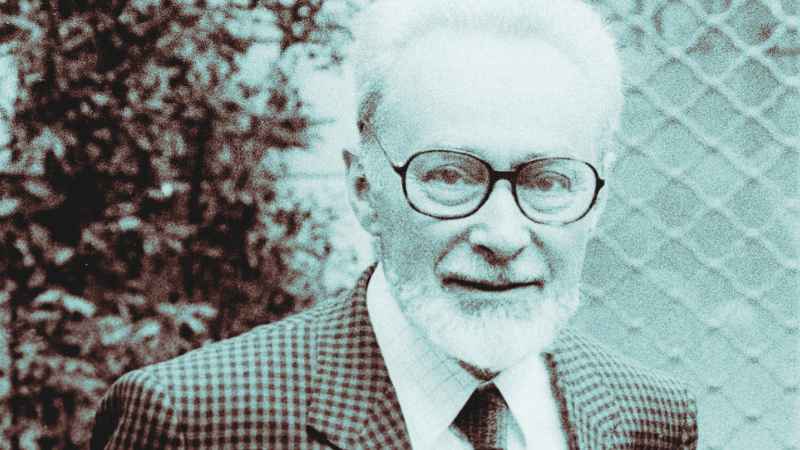
Levi worked on his translation of The Trial during the summer of 1982. He had learned certain rudiments of German during his doctorate in chemistry at the University of Turin in 1941; the rest he had picked up at Auschwitz. It was from this hybrid soil, mixing scientific German with barked Nazi commands, that Levi’s translation of Kafka would grow.
Because, in order to obey the orders and prohibitions bellowed by camp guards, you first had to understand them. On several occasions, Levi compared the Lager to Babel, with the tower taking the form of a watchtower: “The confusion of languages is a fundamental component […] everyone shouts orders and threats in languages never heard before, and woe betide whoever fails to grasp the meaning.” Levi observed that the prisoners with no knowledge of German—in other words, almost all of the Italians—died shortly after their arrival. Misunderstandings were severely punished. There was a clear paradox here, in that learning the language of death increased one’s chances of survival.
Levi, who had worked as a chemist before the war, resumed his work fairly soon after the war. He found a job in the 1950s that sometimes took him to Germany on business trips. The way he spoke the language surprised his German counterparts. “I realised then that my pronunciation was coarse, but I deliberately made no attempt to soften it; for the same reason, I never had the tattoo on my left arm removed.” Levi noted ironically that he had learned German the way other men might learn Italian in a brothel. Kafka’s 1919 short story “In the Penal Colony” features a baroquely cruel camp where machines equipped with ink-dipped needles carve each prisoner’s sentence into his flesh. Levi emerged from his own penal colony with a tattoo on his forearm.
But Auschwitz had also left its mark on his diction—a sort of verbal tattoo. In Russian, there is a word that is not easily translatable: osvoit. The official translation is “to master,” but it is derived from the personal pronoun svoi (my), so in fact this Russian verb implies that ‘mastery’ of something must occur through its appropriation. To genuinely master an object, a place, a language, you must make it your own. Make a place for it inside you. Incorporate it—literally—until it becomes part of your own substance. Levi didn’t merely learn German; he absorbed it.
In 1923, Kafka wrote this line at the bottom of a page of his diary: “We are digging the pit of Babel.” What pit? And who is ‘we’? The more he dug, the less he knew about what made a man.
*
In 1959, Levi was shocked to receive a letter informing him that a German publisher by the name of Fischer had just acquired the translation rights to If This Is a Man.
His book had attempted to render, in Italian, the horrors of Auschwitz. Could the language of Auschwitz render the testimony of an Italian? This idea did not inspire him with confidence. Had the German editor bought the rights to salve his own conscience? Levi feared that the translator would mutilate the text by cutting any passages that struck him as unbearable or too shameful for future readers.
What Levi didn’t know was that he and Fischer actually belonged to the same ‘camp.’ The family owners of Fischer Bücherei were Jews of Hungarian origin, who had been dispossessed of their publishing house by the Nazis before it was returned to them after the war. During Levi’s long correspondence with his translator Heinz Riedt, he realized that this project would give the onerous memory of Auschwitz back to the Germans. Of the German translation, he wrote: “More than a book, it should be a tape recording.”
The publication of this translation galvanized Levi. He felt like he was winning a battle against German denialism: “I had written the book in Italian […] but its true recipients, those against whom the book was aimed like a gun, were […] the Germans. Now the gun was loaded.” As his biographer Myriam Anissimov pointed out, only fifteen years had passed since the liberation of the camps: the Germans who had worn uniforms back then were still alive.
The translation destroyed the partition walls that Levi had erected between Turin and Auschwitz, between his life as a man and his life as a non-man.
By contrast, the publication of his translation of Kafka in Italian in the spring of 1983 left him feeling empty, helpless, defenseless. Of all the translators studied in this book, Levi was the only one to express regret. “It’s a pathogenic book,” he told a journalist when it came out. “I felt attacked by this book. […] It pierced me like an arrow, like a spear.” The process of translating Kafka led Levi to understand his initial hostility towards that author’s work. This hostility was not literary or aesthetic in nature, but physical. He felt threatened by Kafka as by a “[…] like the prophet who tells you the day you will die.”
Levi translated The Trial at home—75 Corso Re Umberto, in Turin. This was the apartment where he was born, grew up and remained through adulthood. He left it only once, and not by choice: when he was deported to the camps at the age of twenty-five. After the liberation of Auschwitz, Levi naturally went back to his old home. It was within these walls that he wrote If This Is a Man from the notes that he had secretly scribbled—and then destroyed—during his captivity. In a 1979 interview, three years before he started translating Kafka, Levi explained that he owed his moral and physical survival after the camps to the miraculous fact that he had not lost his family or his home.
Philip Roth, who visited Levi in Turin for a long weekend in the autumn of 1986, provided an attentive description of the writer’s study for the New York Times Book Review: it was comfortable, quiet, tidy, and, like his writing, “simply furnished.” In this pokoj, though, Roth did note one particular detail: “an unobtrusively hung sketch of a half-destroyed wire fence at Auschwitz.”
Levi had to invite Kafka into his pokoj to translate him. The tête-à-tête between the two men lasted a year—the same length of time as his captivity in Auschwitz. The experience plunged Levi into a state of depression that he couldn’t escape. “My defences collapsed as I translated him,” he admitted. The translation destroyed the partition walls that Levi had erected between Turin and Auschwitz, between his life as a man and his life as a non-man. He moved through his translation as if driving along a road at night. Kafka’s headlights blinded him. The swerve that followed proved fatal. According to the coroner’s report, Levi ended his life on April 11, 1987, throwing himself from the third floor of his spiral staircase.
Translating Kafka had stripped him of all semblance of tranquillity. Had it demolished the walls of his pokoj?
____________________________
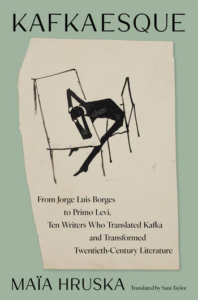
From Kafkaesque: From Jorge Luis Borges to Primo Levi, Ten Writers Who Translated Kafka and Transformed Twentieth-Century Literature by Maïa Hruska, translation by Sam Taylor. Copyright © 2026 by Maïa Hruska. Translation copyright ©2026 by Sam Taylor. Excerpted by permission of Ecco, an imprint of HarperCollins Publishers.

Maïa Hruska
Born to a Czech-French family in 1991, Maïa Hruska was raised in Germany and now lives in London, working in publishing as the head of legal at the Wylie Agency. She’s fluent in Czech, French, German, and English. Kafkaesque is her first book.