7 New Poetry Collections to Read This May
Rebecca Morgan Frank on New Work From Carolina Ebeid, Laura Kasischke, Luis Muñoz and More
2026 keeps bringing back the dead: there are new books of poems from Larry Levis, Fanny Howe, Franz Wright, and of course Lucille Clifton’s At the Gate: Uncollected Poems 1987-2010 (BOA Editions), edited by Kazim Ali and born from new access to digital archives. This spring release coincides with the ongoing development of the Clifton House in Baltimore, where Executive Director Joël Diaz and Clifton’s daughter Sidney Clifton warmly welcomed some of us attending AWP Baltimore last month. To have Clifton re-enter the room, and to have the opportunity to enter the rooms where she wrote so many of her poems, is a gift in these times.
So “another bird has cracked herself / against our window, a kamikaze jay/or cardinal committed to sacrifice,” one Clifton poem begins, soon turning to “she was a woman, I know it.” May poetry continues to bring us down to Earth with titles like Callie Garnett’s Shit Hike (Song Cave) and Arden Levine’s Spoke (The Word Works) and collections from such cult favorites as Laura Kasischke and Karen Solie, as well as a vital debut from Indigenous language revitalization activist Beth Piatote, whose poems will introduce many of us to the Nez Perce language. Idra Novey and Garth Greenwell team up on translations of Spanish poet Luis Muñoz, and Nightboat Books delivers Antonio Ochoa’s engaging bilingual prose poem sequence, Small Sargasso Mountains. And in case you missed my January 2026 preview, don’t forget Derrick Austin’s stunning third collection, This Elegance (BOA Editions) officially drops this month.
Come back in June to welcome Craig Morgan Teicher as he rotates in as my new co-columnist here for the poetry round-ups, following two wonderful predecessors, Christopher Spaide and David Woo. I’ll be back to share a hot July line-up!
*
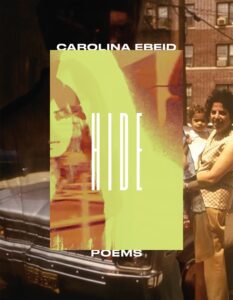
Carolina Ebeid, Hide (Graywolf)
“How the brain can’t archive every /sound you’d like to hear again /. You could listen by holding your hand to your ear. // Grief may redraft your whole anatomy.” The griefs of Hide hold the intersections of family names and photographs and origin: Cuba and Palestine. Language is layered as subject– in “Ghazal Over Waves,” “bread was rye or Wonder, pan dulce or flat khubz. Water was maye, mine, un vaso de agua” –and as “a sudden surge of current,” “a channel (O) for an ancesteer to pass through” via the mysteries of the glitch of the “computer-generate voice that speaks Arabic” playing back all of the words simultaneously. Ebeid’s layered play comes to the visual surface in her interventions with photographs and pattern poems. One threads sayings about the devil, another, the final poem, offers a fragmented one-word – tr/an/sg/ra/ce”– from which unfurls lines made of the title of a musical composition, repeated, formally a fitting end nod to Ebeid’s lyricism. Unified by voice and eye, Ebeid’s poems foreground the wealth of making itself, even here, where “the world is such a barrel of bones / such an intimate iced-over desert place.”
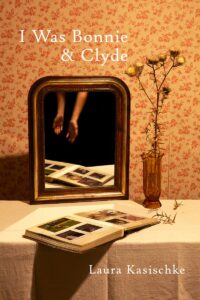
Laura Kasischke, I Was Bonnie and Clyde (Copper Canyon Press)
Kasischke’s latest collection is beautiful and terrifying. Death comes “Along / with every-/one I’ve ever known, and any- /one who ever wore/ a paper party hat / to smile in some old photograph.” “Torture”—and the book’s first section—ends “No one was killed./. No matter what we did. / No one survived/ no matter where / we ran or hid.” This is a world cluttered “with all these demons’ broken plastic / sandals tossed off all these decks of / demon cruise ships” and evoked “[l]ike a nanny with a pram/ strolling straight into the traffic.” At times, these twist like modern fairytales, slyly referencing Mr. Peanut, Ripley’s Believe it or Not, Icarus, robots, or in “The Exterminator,” the assumed poisoner’s weapon “A kiss / blown in-/ to an abyss.” This is a funhouse mirror and Kasischke gets us just right. “The Glass Brain” ends “You were an eye in a mirror in the past for a while. / And then you became the past.”
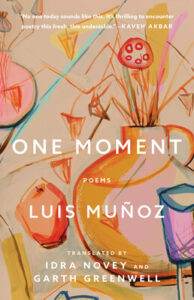
Luis Muñoz, One Moment, trans. Idra Novey and Garth Greenwell (Simon and Schuster)
Parts of Luis Muñoz’s “Reading a Fourteenth-Century Poem Together” could serve as an ars poetica or a snap review of this collection: “It dawns/ it dusks, / and above all / it afternoons endlessly, / with the fervent spacious feeling/ of a miniature.” I’ll admit, I was curious the moment I saw Garth Greenwell and Idra Novey paired as translators for what is an American debut of a well-published Spanish poet—a previous bilingual edition of his work, featuring Curtis Bauer’s translations was published in Spain over a decade ago—and these sly verb choices alone kept my attention. Muñoz largely works through compression in “miniatures” like the resonant title poem, which opens, “You’re coming undone / too, isn’t that right?” The slippage in tone and target and realities in these jewel-like poems struck this reader most in the slightly longer poems, such as “With Special Glasses for Seeing Souls,” which begins, “–I saw one shaped / like a tennis ball / jammed / between the metal bars / of a gate.” Or the crown triptych, “Three Friends,” populated by “The Breather Poem,” “Thievery Poem,” and “Doctor Poem,” in which “[t]he white he lives in / vibrates / like a drum.”
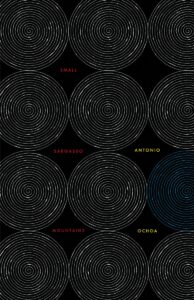
Antonio Ochoa, Small Sargasso Mountains (Nightboat Books)
In Small Sargasso Mountains, Ochoa’s prose poems are all delivered first in English, uninterrupted, and then in Spanish, as Ochoa warns, “The myth of the origin is dangerous. One must take distance to be able to move inside the multiple. Poems that repeat themselves in Spanish and in English are multiplicities. In the space between each iteration relativity can be perceived.” These “multiplicities” begin with, and return to, literal meditations on the spiral and unravel into something more expansive and riveting, a compelling sequence that moves like a lyric essay, embodying literary and linguistic criticism, morphing between myth and anecdote, between cosmos and earth, between characters of the speaker’s daily life and those of his reading life. One poem/page opens with a memory of “when Lorenzo fell out of a moving van onto a cobblestone street,” while in the next, “Samuel Beckett’s head started to float in 1989.” Stick around to encounter Nietzsche, xoloitzcuintles, Medusa, a poet on Tumblr, Ibn’ Arabi’s Contemplation of the Holy Mysteries, and, in more intimate moments, the speaker’s mother first showing illness: “Sometimes she couldn’t remember the names of things, simple things, like orange juice, or salt, or tree, or cloud.”
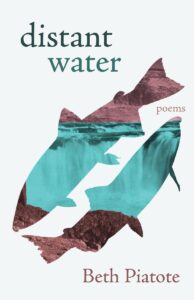
Beth Piatote, Distant Water (Milkweed)
“I am speaking my language / and crow’s. Through the noise each dawn we hold safely each other’s language /in our mouths.” Whether braiding an anthropology museum’s self-description with a letter to that same museum from the Klamath Tribal Council regarding “the missing remains of our ancestor, a child” into a found poem, or weaving English translations beneath lines in the Nez Perce language, scholar, fiction writer, and playwright Piatote makes interventions and extensions thrive as poems in her debut poetry collection. Perhaps this is most evident in the prosey “kú’nu” which positions a linguist’s question to the speaker—“What discourse particles do you work on?”—and his preference for the “part to the whole,” against “xelé-ylece’óykaslix I’m working on the whole thing.” The poem’s ending punch—“kú’nu is how I would answer/ if he’d understand I’d say/ kú’nu”—relies on the one-word translation of “I don’t know”: kú’nu. In “ka.kal’awnik’ay’,” a staggering journey into the underworld featuring “Orpheuas, Inanna, and an Adorable Baby” along with The Border Guard, centers Coyote, the bearer and protector of story, undivided from language: “I have broken the dam / and released all the words.”
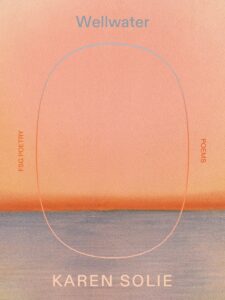
Karen Solie, Wellwater (Farrar, Straus and Giroux)
“Ghosts if you believe in them. If you don’t, / the similarly see-through unquiet miles. / Is this beauty, all this grass?” Whether we’re in those “Grasslands” or in the “Basement Suite” where “one is closer to God because / closer to consequence, to creatures no one loves/ but the specialists” (cue a litany of weevils), Solie holds us to the fire of the intersection between the natural world and what we’ve made of it, between regret and, well, where we are. “I didn’t know what I had,” the title poem opens, “drove the watertruck to the well / in a swimsuit, anointed with baby oil.” Everything is a before knowing—what better metaphor of innocence to experience for a generation than baby oil? Here’s a speaker who shrugs “Enough already, about the soul,” who chides the rat, “you can’t live here,” and “Rat, unlike you I’m ashamed/ of what I do, which is nothing.” Picador’s UK edition of Solie’s Wellwater has already won the T.S. Eliot Prize and the Forward Prize (shared with Vidyan Ravinthiran), and now lands in the U.S. From litanies of pesticides to “the padlocked gates of Leal Rental, a grey pitbull shining like a nail,” Solie holds the cards: “I’m sorry, I can’t make this beautiful.”
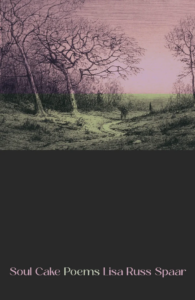
Lisa Russ Spaar, Soul Cake (Persea Books)
“Does eternity mean continuation / of the selves we are? / A kind of everlasting / of the temporal joys, the fuck-alls.” Spaar’s colloquial flippancies only reinforces her fervency. Her title comes from a medieval “soaling song,” and the center of the book is a series of carols of her own, from “I rarely dream in plot” (“Influenza Carol”) to “Therapy Carol” to “Only one time to live, that we know of, / though I’ve loved you so lavishly / I’ve been mythic, girl, boy, man, even me” (“Lush (1) Carol”). Spaar’s formal virtuosity and sound-driven wit unravel over her sure-footed enjambments, range over the breadth of wintery landscapes and ruins, and zoom into the intimacies of elegies, of body and soul: “December, Mon Amour,” opens, “I find your hand behind / my back and lace it, // conjoined fist, apple, beneath my coccyx. / This is the feast day toward which // since then I will always arch / body at last opened, yours. Ajar–.” Spaar gives the lyric back its song, while still staying in the present, amidst the “gantlet of elegant shill” found in “Before I Can Exist, I Have to Enter the Gift Shoppe.” “Shoppe,” of course: we’re in on it with her.

Rebecca Morgan Frank
Rebecca Morgan Frank's fourth collection of poems is Oh You Robot Saints! (Carnegie Mellon UP). Her poetry and prose have appeared in such places as The New Yorker, Ploughshares, American Poetry Review, and the Los Angeles Review of Books. She is an assistant professor at Lewis University and serves on the Board of Directors of the National Book Critics Circle. She lives in Chicago.