5 Book Reviews You Need to Read This Week
“It’s a character study of a woman becoming corrupted by the only kind of power she considers herself able to wield.”
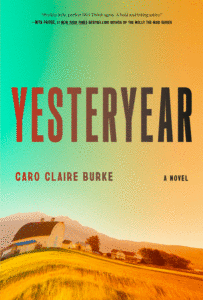
Our smorgasbord of sumptuous reviews this week includes Hermione Hoby on Harriet Clark’s The Hill, Avi Shlaim on Omer Bartov’s Israel: What Went Wrong, Parul Sehgal on Gisèle Pelicot’s A Hymn to Life, Nicolás Medina Mora on Álvaro Enrigue’s Now I Surrender, Sophie Gilbert on Caro Claire Burke’s Yesteryear.
Brought to you by Book Marks, Lit Hub’s home for book reviews.
*
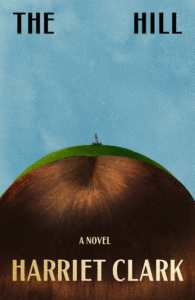
“The premise sounds like a bad dream: Towering above your life stands a hill that you must keep ascending and descending forever. Or, to put the conceit of Harriet Clark’s breathtaking debut novel in more concrete terms: 8-year-old Suzanna pledges to visit, each week, the hilltop prison where her mother is serving a life sentence until that sentence is complete — to become a sort of secondary prisoner of her mother’s fate. The Hill might be dreamlike, but it’s far from nightmarish, instead charged with a hushed quality of distillation, lustrous with the obscure meaning of familial romance, plus the sense—common to dreams— of promising some final understanding that can be carried into waking life.”
…
“Childhood, much like dreams, is difficult to write about without succumbing to vagueness and sentimentality; there’s also the unfortunate way it means so much more to the person who experienced it than to anyone else. There are none of those pitfalls here. Clark renders Suzanna’s state of unknowing exquisitely.
…
“Part of Clark’s subtlety is the way in which the category of ‘what Suzanna refuses to know’ remains undefined. Is it, as her grandmother would have it, full comprehension of her mother’s crime? Is it the realm of cold hard facts in general? Or is it nothing less than her own personhood, what with Suzanna’s self-curtailing commitment to remaining within visiting distance of the hill? Whatever the case, Suzanna’s mode of consciousness seems to grant her less quantifiable, more precious forms of knowledge. Even into her teenage years there’s a visionary quality to the way she experiences the world—as if she were a tiny, strange saint of a religion of her own devising.”
–Hermione Hoby on Harriet Clark’s The Hill (The New York Times Book Review)
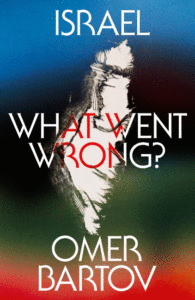
“The moral and political degradation of Israel is the subject of this remarkable book. The author, Omer Bartov, has impeccable credentials for writing it: he was born on a kibbutz, he served as an officer in the IDF, and is currently professor of holocaust and genocide studies at Brown University in the US. It is dedicated to his father, Hanoch Bartov, ‘the last Zionist,’ a reference to the liberal brand of Zionism to which the whole family were evidently dedicated. Yet this book is written more in sorrow than in anger. Its goal is not to condemn Zionism but to explain its evolution from a dream to a nightmare.
…
“Had a written constitution in the spirit of the Declaration of Independence been adopted, he argues, and had generations of Israelis been raised with respect for the constitution and pride in a bill of rights for all human beings, ‘the creeping racism of Israeli society might have been tempered, and the astonishing indifference to the genocide being perpetrated in Gaza and the daily crimes and pogroms on the West Bank might have elicited a greater sense of scandal.’ Maybe. History does not disclose its alternatives. Arguably, however, Bartov does not go back far enough in history to explore the roots of Israeli racism. Zionism is a self-avowed settler-colonial movement and its principal political progeny—the state of Israel—is a settler-colonial state. The logic of settler-colonialism is the elimination of the natives in order to take over the land and its resources. Ethnic cleansing is the means by which this goal is achieved. In 1948, the newly born state of Israel carried out the ethnic cleansing of Palestine: 750,000 Palestinians became refugees and the name Palestine was wiped off the map. This is what Palestinians call the Nakba, meaning ‘catastrophe.’ From the point of view of the victims, the viciousness of Zionism is nothing new; they have known it all along.
…
“As a historian, Bartov believes that the first step in building a better future is understanding the hopes and aspirations of the other, as well as the errors and sins of the past. One hopeful conclusion that he draws from Israel’s campaign in Gaza is that, in the long term, it will liberate Israel itself from its status as a unique state rooted in the Holocaust. This will hardly help the 73,000 Palestinian victims, but it does give rise to a faint hope that the liscence that Israel has enjoyed throughout its history may be expiring. Anyone seeking an explanation of Israel’s ‘fall from grace’ will find no better guide than this perceptive, sophisticated, erudite, elegantly written and strikingly fair-minded book. Even traditional supporters of Israel, who are feeling discomfort, perhaps even disgust, at its recent atrocities, may find in Omer Bartov, to borrow the title of Rabbi Moshe ben Maimon’s famous 12th-century book, A Guide for the Perplexed.”
–Avi Shlaim on Omer Bartov’s Israel: What Went Wrong (The Guardian)

“Reviews and interviews have been full of quavering compassion for what Pelicot endured, and vague cheers for her heroism. But they have been oddly reluctant to engage too deeply with what she has made. The book is treated as confession, a howl of pain, its ‘anguish’ and ‘unflinching honesty’ much praised. Pelicot’s achievement, as parsed in a Washington Post review, is, in fact, anti-literary: It lies in her refusal of self-interrogation. ‘There is only whatever you do to put one foot in front of the other’ in a case of such brutality. ‘There is only what it takes to survive.’
Why read such a book? I almost didn’t. It was only when I overheard a critic, who had given it a long, admiring review in a magazine, confess that she felt unsettled by Pelicot—she didn’t quite trust her as a narrator but had not wanted to say so—that I felt a prickle of curiosity. Why had Pelicot left herself vulnerable in this way? Was it possible that there was more urgent work at hand, beyond the recitation of facts or appealing to the reader—something private, and risky?
This is exactly what you will find, from the very first page and its terrifically tense opening paragraph, as Monsieur and Madame Pelicot sit down for breakfast for the last time, the morning of his arrest. How poised is the scene; how immediately apparent the narrative’s dense, layered architecture, its impatience with ready-made language and scripts for sexual violence. And, yes, suffusing it all is Pelicot’s interesting unreliability—to herself above all.
…
“What the simplistic, anti-literary readings lose as they press this book into thin forms—victim’s plaint, feminist manifesto—is the richness of its investigations and its ambition to say something original about victimhood and survival. The book is closer to an anti-manifesto, if anything, an investigation into what escapes our grasp, how thoroughly we can conceal knowledge from ourselves, and how we are encouraged to do so.”
–Parul Sehgal on Gisèle Pelicot’s A Hymn to Life (The New York Times)
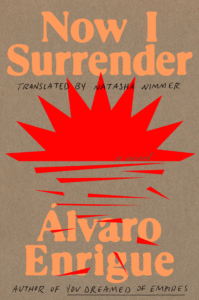
“…it’s not every day that one comes across a contemporary novel about politics that wrestles with fundamental questions with such argumentative originality and intellectual depth that one walks away from its pages convinced that it ought to be discussed in philosophy journals just as much as in literary reviews. Now I Surrender, the third masterpiece by the Mexican writer Álvaro Enrigue to be brought into English by the brilliant translator Natasha Wimmer, is unlikely to be received as a major intervention in political theory, but that is precisely what it is. A collage of archival research, field diaries, film criticism, travelogues, nature writing, and narrative history that blurs the line between fiction and nonfiction, Enrigue’s book accomplishes a nearly impossible feat: It succeeds equally well as a breathtaking historical novel and as a groundbreaking work of political theory that offers the final chapters of the centuries-long war that pitted Mexico and the United States against the Chiricahua Apache as a refutation of both the Hollywood western and the Western nation-state.
…
“The rebuke of this difference-obliterating machine is a central theme of Now I Surrender, which as much as a novel is a political and philosophical argument for an ideological alternative to that oppressive political theory we still call ‘the West.’ It is an argument that takes the form of a kaleidoscopic journey across space and time that is always dazzling and at times a bit dizzying. A chapter set in the 1830s is just as likely to be followed by one set in the 1920s or by one set in the 2010s. Some scenes are recounted in the third person by an omniscient narrator who frequently lapses into free indirect discourse; others record the stories that Pancho Villa tells around a campfire. A few sections consist almost entirely of telegrams and depositions that may or may not be based on historical documents, but roughly a third of the book consists of the essayistic diary in which a contemporary Mexican novelist records the progress of his research on Apache history and the incidents of his family’s road trip from their home in New York to the heart of Geronimo’s homeland. The stylistic range is so wide that different parts of the novel read like homages to such radically different writers as Cormac McCarthy, Sergio Pitol, and Jorge Luis Borges.
In the hands of almost any other novelist, this baroque profusion of forms, modes, and registers would achieve nothing more than confusion. But Enrigue is no ordinary writer: By the time we reach the end of Now I Surrender, we know that the grand aria of Geronimo’s final surrender and the melancholic chorale of the writer’s family road trip to a land populated by ghosts are bound together by a tangled chain of events set in motion by Camila’s kidnapping. The Apache past, the novel argues, is not a foreign country—indeed, it’s the present-day Mexicans and Americans who are foreigners in the Apachería. ‘We aren’t the children of these lands,’ Enrigue writes. The political implication is momentous: ‘We should have to give it all back.’”

Book Marks
Visit Book Marks, Lit Hub's home for book reviews, at https://bookmarks.reviews/ or on social media at @bookmarksreads.