5 Book Reviews You Need to Read This Week
“Kim Kardashian has become ubiquitous, as if she were a very hot dictator whose portrait hung in every home in America.”
Our favorite criticism of the week includes Philippa Snow on MJ Corey’s Dekonstructing the Kardashians, Hamilton Cain on Douglas Stuart’s John of John, Becca Rothfeld on Nelio Biedermann’s Lázár, Sigrid Nunez on Jayne Anne Phillips’s Small Town Girls, and Jess Bergman on Andrew Martin’s Down Time.
Brought to you by Book Marks, Lit Hub’s home for book reviews.
*

“To think about the Kardashians for too long in our current political and cultural moment—a time of fascism, genocide, and war—is to feel a little like Kim herself in a very famous scene from Keeping Up, fruitlessly searching for a lost diamond earring in the ocean as her sister Kourtney reminds her that ‘there’s people that are dying.’ And yet: it is impossible to say that the Kardashians lack impact … Post Keeping Up, Kim Kardashian has become ubiquitous, as if she were a very hot dictator whose portrait hung in every home in America.
…
Predictably, Corey has been criticized in certain quarters for her merging of the lowest and loftiest forms of culture. Why, some wonder, would a perfectly sane psychotherapist be so intrigued by the Kardashian family? The answer is simple: because it is possible to argue, as Corey persuasively does, that they are physical manifestations of America’s psyche; flesh-and-blood representatives of a post-internet mindset that prizes aesthetics over meaning.
…
Kim’s very womanhood has made it possible to use her as a pawn or a cipher, both in arguments in favor of female empowerment, and in arguments against it. She is Schrodinger’s Girlboss, at once making bank in a male-dominated world and ruthlessly upholding both sexual and financial inequality by monetizing everything, including her own flesh. The same double bind crops up in matters of race … Corey, refreshingly, suggests in Dekonstructing the Kardashians that she prefers to avoid ’embedding moral perspectives’ in her coverage of the family. This decision allows her to sidestep a particularly frustrating trend in modern pop-cultural criticism: a mania for categorizing individuals, artworks, and media objects as wholly ‘good’ or ‘bad,’ ‘feminist’ or ‘unfeminist,’ when in fact the truth is usually more complex.
…
At one point in Dekonstructing the Kardashians, Corey positions Kim Kardashian as a sex worker, of sorts: a woman whose empire is built, at least in part, on the release of a sex tape, but also on her body, and on a degree of exposure beyond that which is typically expected of a mainstream star. When Corey asked an adult entertainer with a minor role in Keeping Up with the Kardashians whether she thought of Kim as a ‘sex worker,’ the response was an ‘unequivocal yes.’ Sex workers, like celebrities, are often demonized for treating their job as a job rather than as an act of martyrdom, making the comparison all the more apt. Nobody, of course, needs as much money as Kim has, and any economic setup that permits an individual to amass such wealth is quite obviously fucked. Nevertheless, Corey’s resistance to moralizing helps her to make an even-handed, clear-eyed case for the Kardashians as a phenomenon that is interesting rather than ‘good.'”
–Philippa Snow on MJ Corey’s Dekonstructing the Kardashians (Bookforum)
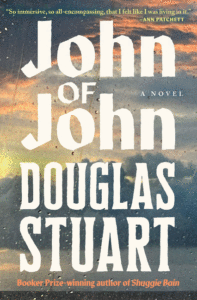
“In a 2021 interview…Douglas Stuart cited his unconventional and very non-M.F.A. training: ‘I had to leverage the only skills I had, which came from fashion and textiles. Fashion requires you to be observant, to pay attention to the tiniest detail, to be imaginative and have the ability to pull many strands of inspiration together and turn them into something new’ … This training moves front and center in John of John, building out a muscular narrative with scrupulous technique. It’s his finest work yet.
…
Stuart’s prose is gorgeous and his plotting strategic; nothing is lost. A throwaway item in an early chapter loops back like a boomerang hundreds of pages later … Stuart is particularly strong in a pair of set pieces, one on the lambing season and the other a weeks-long Communion as Free Presbyterians travel among parishes. Larger themes emerge: spiritual rituals, rural poverty, affluent outsiders extracting value from the community. There’s a wealth of detail.
…
The novel, then, is a lament for a culture on the brink of extinction, but it’s also about a stubborn people rooted in thin soil and craggy coast. Dangers, both public and private, force Cal, John, Innes, and Ella toward difficult choices. John of John explores a range of relationships — romantic, religious, erotic, familial — enriched by a dollop of melodrama. It’s among the most affecting father-son stories I’ve read … Succinct moments drive the plot; when the revelations hit, they hit hard. John of John is one of 2026’s literary triumphs.”
–Hamilton Cain on Douglas Stuart’s John of John (The Boston Globe)

“All this is so familiar that reading Lázár is like visiting a museum of older novels. The scenes in which Russian invaders ravage rural Hungary might have come from All for Nothing, Walter Kempowski’s 2006 masterpiece about the Eastern Front; the scenes in which Lajos mocks Ilona for fretting so anxiously about Hitler might have come from The Oppermanns …The book’s ambivalent nostalgia has not kept it from succeeding prodigiously. On the contrary, Lázár has topped the German best-seller list for twenty-nine weeks and is set to be translated into more than twenty-five languages. Naturally, Tom Tykwer…is planning to adapt it into a movie. Indeed, the novel’s antiquated air is the basis of its somewhat chintzy appeal … He wrote it by hand. I was almost surprised he didn’t use a quill.
…
For what, in the end, could be quainter than Biedermann himself? He joins a vaunted tradition of wunderkinder, mythologized at least as much for their precocity as for their actual work … The inevitable Mann comparisons arrived on schedule … It is hard for me to imagine how one could think anything of the sort. Of course, it is refreshing to see a revival of the sprawling, maximalist mode that Mann mastered. Lázár and its popularity are nothing if not a resounding rejoinder to the thin, tart works of auto-fiction that have been so beloved of late.
…
Biedermann’s fiction appeals in large part because it is so unapologetically fictional—because it is outfitted with all the accoutrements of the traditional novel. Lázár has a plot (a luxury that many of the meandering autobiographical meditations of recent years have dispensed with), a cast of fractious characters, and an ambitious frame of reference … But these quiet intimacies are overwhelmed by fussy images that make little sense … On the whole, Lázár is showily but hollowly gothic. The characters are antiques dressed as human beings, and their traumas pile up without consequence.
…
Lázár is less of a reflection on the present than a sentimental escape from it. Souvenirs of a romanticized fin-de-siècle Ruritania are presented without interest or elaboration. The obligatory sanatoria are visited, the obligatory spa towns are frequented, the obligatory Freudian analyst is consulted. These paths, like the rest of the book’s warren of byways, take us nowhere. Minor characters are introduced, then dropped. Lajos’s transparent skin, initially so intriguing, does not end up mattering or meaning anything. Reading Lázár is like running on a treadmill. There is a great deal of frantic activity, but no progress, and we end up exactly where we began.”
–Becca Rothfeld on Nelio Biedermann’s Lázár (The New Yorker)
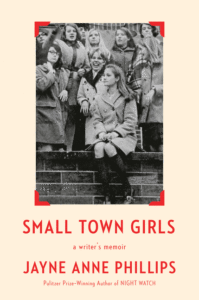
“Most fiction writers have given so much of their own experiences to their characters that, after long careers, they are rarely inspired to become late-life autobiographers. Over the years, however, many are likely to have published a variety of nonfiction pieces…a curation of which might illuminate how a person came to be the successful writer that she is.
Most of Jayne Anne Phillips’s memoir, Small Town Girls, is taken from such earlier sources.
…
Her love and respect for the people and their pasts, and for the splendor of the landscape — her compassion for the victims of the region’s devastating poverty and her grief at the ruin of ‘one of the most biologically diverse ecosystems in the world’— give the writing at times the feel of a meditation, one that is ideally served by the eloquence and precision of the author’s prose.
…
Phillips writes generously and insightfully about people she has known and recollects with special tenderness the times she shared with her beloved dog Sasha. But one of her best pieces, ‘Real People’, is about a family whose name she never learns. This brilliantly detailed portrait of the neighbors across the street, observed by Phillips from a window above her desk over a period of seven years, is one of the finest descriptions I have read of how a fiction writer’s mind works.
…
As Phillips writes in ‘Outlaw Heart,’ her contribution to a series of essays by writers on their vocation: ‘Surely our hope in holding a world still between the covers of a book is to make the world known, to save it from vanishing.’
Surely.”
–Sigrid Nunez on Jayne Anne Phillips’ Small Town Girls (The New York Times Book Review)

“The four friends at its center—Cassandra, Malcolm, Antonia, and Aaron—are a decade or so removed from Martin’s youngest characters, closer to midlife than their bygone adolescence. But that’s not to say the book suggests maturity always correlates with age. The core cast may be older this time around, but they still feel like iterations of the same basic Martin type—self-aware self-saboteurs with a taste for mild sexual humiliation—and the book’s opening chapters feature some of his preferred narrative beats: a relapse, a risky kiss, a friends-with-benefits fling that turns sour.
This repetition is sort of the point. Like their more youthful counterparts, Down Time’s characters are treading water: trapped between addiction and sobriety, breaking up and settling down, precarious labor and professional stability … Soon, Covid-19 will arrive, and the stasis afflicting Martin’s central quartet is both frustratingly amplified and violently disrupted. On the one hand, the virus ensures that nothing will ever be the same again. But on the other, the reality of lockdown is profoundly repetitive, trapping them all in an endless present tense.
…
The pandemic imposed unique setbacks on every generation—learning loss for the very young; failure to launch for the recent college grad—but Martin’s novel is particularly interested in the melancholy of emerging from the pandemic’s disorienting depths on the cusp of middle age and finding yourself suddenly lapped by most of your peers.
…
This might be where the limits of the pandemic novel, even a pretty good one, finally assert themselves. Six years after the world shut down, we are still living with the aftershocks of that moment, from a supercharged skepticism about the scientific establishment and institutions in general, to a decay in social niceties once taken for granted. But, as even these familiar points probably suggest, there simply may not be much insight left to wring from an event that has been processed countless times—in novels and newspapers, on the nightly news and in the endless scroll of social media feeds. Down Time is refreshingly original in its choice to plot the pandemic as a point on a timeline that extends in either direction, rather than viewing it in isolation. Even so, it can’t quite escape the appearance of a diorama: a faithful re-creation attesting mostly to the patient attention it took to construct. As far as diversions go, there are far worse ways to spend your downtime.”
–Jess Bergman on Andrew Martin’s Down Time (The New Republic)

Book Marks
Visit Book Marks, Lit Hub's home for book reviews, at https://bookmarks.reviews/ or on social media at @bookmarksreads.