Your Favorite Male Rapper’s Favorite Rapper
Jessica Lynne on Missy Elliott’s Offstage Sonic World
When Missy Elliott’s debut album, Supa Dupa Fly, dropped in 1997, it was the summer before my eighth birthday. I wasn’t old enough to buy CDs without parental permission, but I thought I was grown enough to complain about the melancholy Christian hymns my mother always played in the car (convinced, I’m sure, that my brother and I were absorbing the righteous messages). One Saturday, God must have been on my side, because she turned the dial to 103 JAMZ, a station beloved throughout Hampton Roads, Virginia—home to The Boodah Brothers Morning Show hosted by Chris “Big B” Belcher and Lawrence “Kool DJ Law” Brown.
This time, a woman’s voice bled through the speakers: Ann Peebles’ soft lament melting into the infectious staccato of Timbaland’s snare as Missy announced her flyness. My mom was excited until she got confused—“Now what did they do to Ann’s song?”—but we kept driving and the song kept playing—which felt like a win to me. This was hip hop, a world beyond my gospel-trained ears that seemed full of a self-assured aesthetic pleasure that I knew I wanted for myself when I grew up. As the music faded out, the DJ came back to proclaim Missy “one of the seven cities’ finest”—Portsmouth, to be exact, close to home. “That wasn’t half bad,” my mom admitted—back then, that was her code for “impressive.”
Peebles wrote and recorded “I Can’t Stand the Rain” in 1973 after a thunderstorm ruined her concert plans, exclaiming the now famous refrain in frustration. But her partner Don Bryant and DJ Bernard “Bernie” Miller heard a song in that brief complaint, and the trio went on to create the song that would become her biggest hit.
She gives herself room to revel in the playfulness and re-invention of a new genre, defying expectations of Black women just as hip hop was becoming the dominant sound of radio.
In it, Peebles elegizes a departed love, personifying the objects of her home as silent interlocutors in the exercise of remembrance: Hey windowpane, she begins, do you remember how sweet it used to be when we was together? But the singer is not quite in mourning; instead she seems to decry the imposition of a nostalgia that attempts to haunt her. Her voice suggests that yearning for a past romance might be, in fact, an inconvenience.
Some twenty years later, Missy capitalized on the restless mood lurking inside the original song. Alongside fellow Virginian Timbaland’s sparse sonic pulse, she stretches Peebles’ electronic timbal into a soundscape from which she asserts her haughtiness: I break up with him before he dump me / to have me yes you lucky. As the verses make clear, Missy comes prepared for rain with her umbrella, her friends, her sense of independence and sexual agency. She gives herself room to revel in the playfulness and re-invention of a new genre, defying expectations of Black women just as hip hop was becoming the dominant sound of radio.
But there’s another resonance here: by sampling Peebles, Missy places herself in a clear lineage of Black r&b songstresses who were choosing to self-style in defiance of major label norms just as they were taking active roles in the behind-the-scenes management and execution of their music. Peebles released “I Can’t Stand the Rain” with Hi Records, a small Memphis soul shop whose echoes we might hear in the regional sound Missy would cultivate with her own record label, The Goldmind, Inc. Art reflected life: as Missy’s lyrics rejected assigned gender scripts, so too did she reject being an artist with no business agency. She wasn’t gonna just sit by the window, she was gonna go out into the storm.
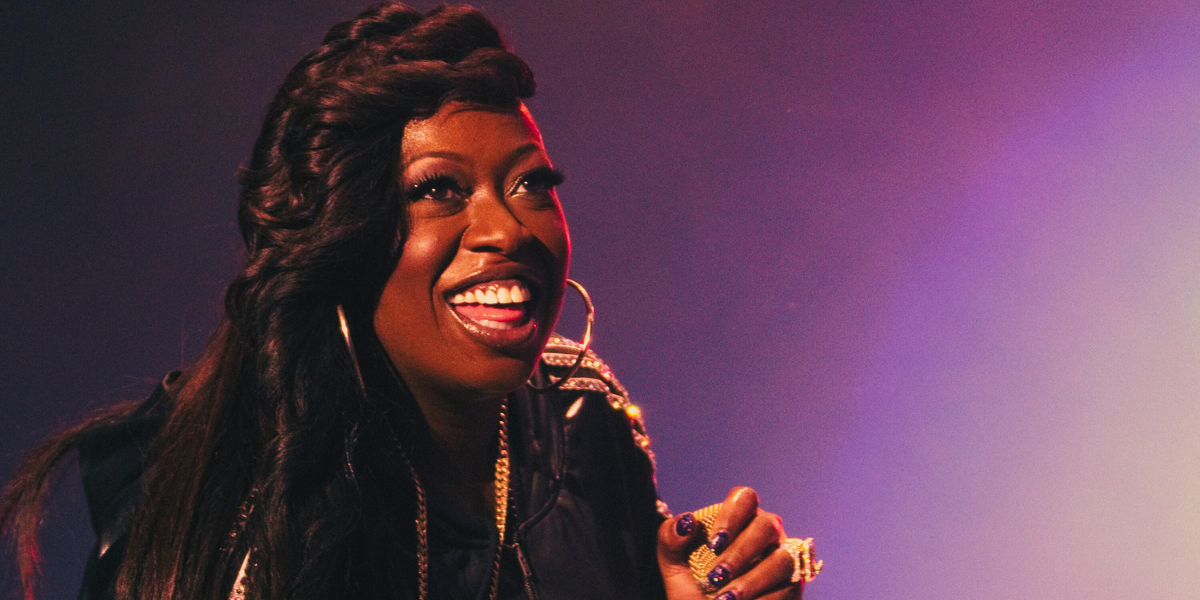
In 2025, Missy Elliott’s reputation as a groundbreaking emcee is secure. But her full identity as an artist—songwriter, producer, businesswoman—seems to elude even the most devoted lovers of hip hop. Why shouldn’t we think of her in a more complex manner—the way we do, say, that other famous Virginian, with his big hats and skateboards?
Missy, born Melissa Arnette Elliott in 1971, first entered the music industry as a singer and rapper in the girl group Sista, alongside vocalists Chonita Coleman, Radiah Scott, and LaShawn Shellman. The group attracted the attention of Jodeci’s DeVante, who signed them to his Elektra Records imprint, Swing Mob, in 1991. Even then, as Clover Hope notes in The Motherlode, Missy was writing most of the group’s material.
How can we understand Missy the star emcee alongside Missy the songwriter and producer?
Their 1994 debut album is a 20-track assemblage of assertive sexual desire, longing, and pleasure. On “Sweat You Down,” Missy raps about chasing a cutie from the neighborhood: Unstrap my bra strap, Imma sit in your lap / and you can hit the boom bap then take a nap / Get up, sugar, drink a brew when we’re through / and I’m off to the next guy cause I did you. On “I Don’t Mind,” she is laid back fantasizing about the sex she’ll have, with an edict for her paramour: I told you downtown means lower.
Sista’s commercial success never truly materialized, and Swing Mob dissolved in 1995 before Jodeci went on a very long hiatus starting in 1996. But Sista was the incubator for Missy’s frank, explicit approach to sexuality, and for her style of songwriting and production, informed by the moods of the 90s Black girl group—a mysterious sensuality that paired sublimely with the cool of an around-the-way homegirl.
In the early years of her career, Missy continued to channel this energy by singing and writing on tracks like “Steelo” by 702 or Total’s “What About Us.” But industry executives didn’t see her star potential until she dropped a guest verse on the Bad Boy remix of Gina Thompson’s “The Things That You Do,” inflecting Thompson’s one-note plea for attention with braggadociousness and a delivery that showcased the inventive range of Missy’s wordplay. Anyone who says that they’ve gotten over the infectiousness of Missy’s hee-hee-hee-hee-how, hee-hee-hee-hee-hee-hee-how is lying.
Sylvia Rhone and Merlin Bobb at Elektra Records offered the deal that would allow Missy to experiment lyrically, visually, and sonically as an artist while retaining the control she had worked hard to establish behind the scenes. Speaking to Hilton Als for his 1997 New Yorker profile of the rapper, Bobb noted that he and Rhone “wanted to set her up in a small situation where she could develop her songwriting and producing abilities, whereas other companies wanted to sign her as an artist and make some fast money” without recognizing what else she could bring to the table. “Missy was shocked,” he said, “when she understood that we were interested in her business sense.”
With this new corporate leverage, she established The Goldmind as an imprint of Elektra, extending the reach of her creativity and formalizing her frequent collaboration with Timbaland, her neighborhood friend, Magoo. The Goldmind distributed Supa Dupa Fly, but it also empowered Missy to develop artists of her own choosing, and the first artist she signed was Nicole Wray—also raised in Portsmouth and refined by the church choir. Missy wrote the eponymously titled lead single for Wray’s 1998 debut album, Make It Hot, in which the singer, though suspicious of a cheating partner, remains confident that her love will make him stay.
She is your favorite male rapper’s favorite female rapper.
Peaking at number two on the r&b singles chart that year, the song’s lyrics hew closely to familiar genre narratives but are transformed by the sparse yet eclectic instrumental sound being refined by Timbaland and Missy. Emblematic, in some respects, of the tension that would go on to surround Missy: a tangle with prevailing romantic sagas, articulated with a refreshing sense of experimentation.
How can we understand Missy the star emcee alongside Missy the songwriter and producer? In the public discourse, these elements of her artistry always seem at odds with one another. In Elle Magazine, Rachel Kaadzi Ghansah described Missy’s music as “wild and hyperdimensional”; for the BBC, Arwa Haider described her visuals as “outlandish.” She is your favorite male rapper’s favorite female rapper. Online, folks position her in contrast to other women artists—Lil’Kim, Trina, Cardi B—whose visual performance of sexuality is more explicit. Even the Als profile (written long before social media) trafficked in such dualism, praising her aesthetic choices “beyond the clichéd horny-boy images of girls in Jacuzzis chugalugging champagne.”
When describing the rehearsals for their group performance of “Not Tonight” at the 1997 MTV Music Awards, Als noted that unlike the costumes worn by fellow rappers Lil’ Kim, Left Eye, Angie Martinez, and Da Brat, Missy would be “dressed as herself — as though her fellow entertainers were her bitches.”
Rank misogyny aside—why should her choices be a condemnation of the choices of other women?—there’s no doubt that Missy regularly elided an uber-femme, vixen aesthetic for herself as a performer (especially in the early part of her career). Yes, her hair is always laid, her nails are always perfectly manicured, but she is the artist who chose to style herself in a giant black trash bag in the iconic look from the music video for “The Rain,” and don a blinged out two-piece denim set in “Get Ur Freak On.”
Still, this contrast, which dwells on surface aesthetics, threatens to obscure what she holds in common with the artists many critics have implicitly dismissed as hypersexualized pawns in a man’s world. When Als approves of Missy’s lyrical departure from “the material world of money, jewels, and men,” I am left wondering whose album he was listening to all those years ago. On “Sock It 2 Me,” does she not tell her man to swing his dick in her direction?
As if her own lyrics aren’t enough, the binary opposition between Missy’s supposed modesty and the commercial norm of femme vulgarity falls apart when you consider her role behind the scenes in shaping other artists. The terms “femme” or “butch” can be generative for describing a mode of gender expression, but for many they remain shifty and porous. Unlike some of her contemporaries (say, Lauryn Hill), Missy never rejected or belittled explicit markers of femme subjectivity. In fact, she became one of the major forces in the evolution of femme aesthetics through the Y2K era.
We might start by studying Missy’s relationship with the late singer Aaliyah. She was not the first artist Missy nurtured, but their collaboration remains memorable as the visibility of their sisterhood was translated into an era-defining r&b experience. Missy and Timbaland wrote and produced much of Aaliyah’s 1996 album, One in a Million.
As Y2K approached, the internet loomed, and hip hop increasingly positioned itself as the cultural milieu, Missy helped retire a certain kind of lyrical coyness and usher in unabashed thirst.
The seduction of a song like “If Your Girl Only Knew” expresses the ambivalence of a slippery situation: Aaliyah longs for an affair she knows would implode the life of the man who has been pressing her, and potentially her own. If your girl only knew, she purrs, that you was dissin her, to talk to me, running through the list of potential consequences. The surprise comes when Aaliyah admits her own interest in dude: If your girl only knew / That I would want to kick it with you. But we shouldn’t be surprised: these are Missy’s lyrics, and Aaliyah channels her daring as she comes close to crossing that seductive threshold. She admits her desire, but remains sublimely cool and in command—“what-if” on her own terms.
In a song on Supa Dupa Fly, Aaliyah runs point with Elliott as they detail the perspective of a best friend who is skeptical of her homegirl’s chosen lover. Bestie’s not saying a break-up is mandatory, but the guy has yet to demonstrate his value. Aaliyah sings of a best friend who has grown tired of her complaints about her man.
But in the second verse, Missy reminds us that friendship demands loyalty over judgment: My best friend say, I can stay with her / At her house, no doubt, anytime I like. Sometimes your girl is going to do what she wants to do no matter what advice you try to give, and it’s your duty to fall in line. This might mean you open the door with the box of tissues, or show up on the block mean mugging and ready to fight—as in 702’s late-90s anthem, “Where My Girls At.”
“If Your Girl Only Knew” is for the late-night creep, but 702 sings for the woman who has already decided how best to check someone foolish enough to step to her man. “He’s my property,” sings Meelah on lead—asserting ownership the way Missy did on “You Don’t Know,” her own song featuring Lil’ Mo. As both writer and performer, Missy was again tapping into a lineage: “You Don’t Know” becoming a riff on Shirley Brown’s classic “Woman to Woman,” in which Brown confronts Barbara, her husband’s mistress, woman to woman, over the phone.
But Missy’s millennial versions leave the niceties behind: Imma teach you not to touch my shit, she croons on her chorus. You must learn the rules, 702 warns. In each instance, the central negotiation is firmly heterosexual, a conventional conflict. And yet even within these established dynamics, Missy invites those of us who are women to reconsider how we make sense of ourselves collectively within a patriarchal and sexist society, in conflict as well as solidarity.
As Y2K approached, the internet loomed, and hip hop increasingly positioned itself as the cultural milieu, Missy helped retire a certain kind of lyrical coyness and usher in unabashed thirst. One example: SWV’s “Can We” off their 1997 album, Release Some Tension. Coko, Taj, and LeLee are blissfully calling for something beyond respectable sexuality. Something kinky and nasty that won’t leave a hint of regret the next morning. The list goes on: Destiny’s Child’s “Confessions.” Mariah’s yearning for velvet kisses. Keyshia Cole letting go to the tune of Mtume’s “Juicy Fruit.” Fantasia getting free. Tweet loving up on herself. Missy wrote or produced for each of these artists, creating a catalog of hits that are now r&b canon. As Naima Cochrane writes in Vibe, “You were sometimes hearing Missy and didn’t even realize it.”
What do we make of the fact that Missy most often chose to narrate experiences of desire through other women artists whose gender presentation more readily aligns with the category of “high femme”? Posing this question does not lessen the significance of her creative interventions, but maybe it does point to the ongoing limitations that result from the narrow social frameworks of gender itself.
Maybe the simplest, most direct answer to the question is that Missy has not just flipped the script (in that ’90s parlance), she has queered the script—darting in and out of normative aesthetic expression, evading categorizations about her individual sexuality, giving us persona but not sacrificing her sense of personhood. Perhaps this too is why most of us remain in the dark about the fullness of her legacy. We are so used to conflating her public offerings with her true, private sense of interiority.
I didn’t have the language for it back then, but Missy is very much
I’ve never heard Missy describe herself as a Black feminist—that label might be too heavy here—but through her work, she was certainly refusing some of the machismo of a genre and industry that was holding fast to poor assumptions about how Black women could show up (as only a record label commodity to be packaged and sold) and what their gifts were (not as creative architects, but receptacles for the creativity of men). “I always said if a man would have done half the records that I’ve done we would know about it. But we don’t know all the records I’ve done for other artists,” Missy told the Associated Press in 2016.
She was inducted into the Songwriters Hall of Fame three years later, just the third rapper to receive the accolade and the first woman in hip hop to do so. Her comments to the AP strike me as too reserved when I consider the weight of her hand on so much of our music—music that keeps us sweating on the floors of our favorite clubs, music we’ve made love to, music on the playlist for that homieloverfriend we so desperately miss. Music that’s made us feel damn good about ourselves.
As a kid, I felt as though Missy was just like me: a Black girl growing up where the Chesapeake Bay meets the Atlantic, cruising I-64 east or west, spending Saturdays walking the Oceanfront strip and all day Sundays in church. And back home during the early months of the pandemic, with my own car and plenty of time to drive with no plan or destination in mind, I’d ride around those childhood streets of ours listening to Missy flaunt her fleet of cars the way she does on “Slide,” the way a real diva like to floss it, the volume all the way up so I’d drown in Timbo’s drums and you couldn’t tell me the song wasn’t made for me and my little used Nissan Sentra. An entire treatise of greatness for all the haters who ever attempted to doubt us, test us. Missy on the rise like a sun, she raps at the end of the first verse. If you think that I’m done, I ain’t even begun. We probably haven’t even witnessed half of what she can do. In this future, the lines between musical genres are blurred, the rapper herself is a household name, and Black women live nuanced lives that do not require us to betray our multiplicity and magnitude.
I didn’t have the language for it back then, but Missy is very much that Black girl I gleaned in girlhood. I was in awe because I was watching her hold onto the parts of herself that felt sacred, the parts that were never up for consumption, while still changing the world. There’s a nuance to this rubric that still takes me aback as I think about what this task should look like for myself.
As a writer, I am learning that there are things that I never have to put on the page, stories and feelings that can remain inside the private cipher I architect for myself. What becomes public—to whomever encounters my work—is not an untruth or a mask but a pleasurable declaration that I remain in control of. This is the future Missy’s been living in that so many of us have to catch up to.
I’m headed that way. Won’t you join me?
__________________________________
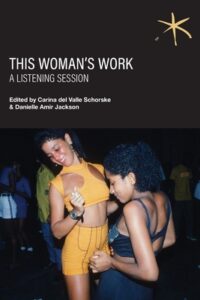
This essay by Jessica Lynne appears in Aster(ix) Journal’s Winter 2025-26 issue, ‘This Woman’s Work’.

Jessica Lynne
Jessica Lynne is a writer, editor, and art critic. She is a founding editor of ARTS.BLACK, an online journal of art criticism from Black perspectives. Her writing has been featured in publications such as Artforum, Frieze, The Los Angeles Times, The Nation, and Oxford American. She is a recipient of a 2025 Rabkin Prize which celebrates the creative and intellectual contributions of visual arts writers. Jessica holds an MFA in Writing from Sarah Lawrence College and was the host of the award-winning podcast, Harlem is Everywhere.