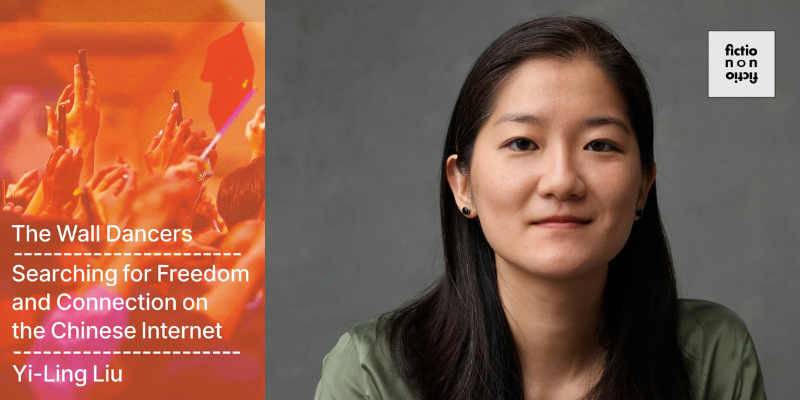
Yi-Ling Liu on Internet Censorship in China and the U.S.
In Conversation with Whitney Terrell and Jennifer Maritza McCauley on Fiction/Non/Fiction
Writer and editor Yi-Ling Liu joins co-hosts Whitney Terrell and Jennifer Maritza McCauley to talk about state-controlled censorship. Liu, the author of a new book, The Wall Dancers: Searching for Freedom and Connection on the Chinese Internet, explores what it means to build community through the internet while contending with surveillance and suppression. Liu, Terrell, and McCauley discuss the sale of TikTok to U.S. companies, the growing online surveillance and censorship in the United States, and how American citizens can learn from Chinese “netizens” about how to survive under censorship. Liu tells the stories of four people– a renowned feminist, a gay dating app entrepreneur, an aspiring rapper, and a famous science fiction writer—who all found ways to dance around The Great Firewall and earn success for themselves and for their communities online. Liu details the widespread impact of each of these “wall dancers” and reflects on the inspirations that led them to foster social change through online media. Liu explores the importance of cultural exchange and connection online and considers her own personal experience with living and creating under censorship. Liu reads from The Wall Dancers.
To hear the full episode, subscribe through iTunes, Google Play, Stitcher, Spotify, or your favorite podcast app (include the forward slashes when searching). You can also listen by streaming from the player below. Check out video versions of our interviews on the Fiction/Non/Fiction Instagram account, the Fiction/Non/Fiction YouTube Channel, and our show website: https://www.fnfpodcast.net/ This podcast is produced by V.V. Ganeshananthan and Whitney Terrell.
The Wall Dancers: Searching for Freedom and Connection on the Chinese Internet
Others
“The Little Man at Chehaw Station” by Ralph Ellison • Journey to the Center of the Earth by Jules Verne • Waste Tide by Chen Qiufan, trans. by Ken Liu • The Three-Body Problem by Cixin Liu, trans. by Ken Liu • Sale of TikTok to U.S. Companies | Politico • TikTok Censorship Investigation | Los Angeles Times • Sale of NVIDIA Chips to China | Associated Press • The Great Firewall • Lü Pin on Feminist Voices • The Feminist Five • The Mitu Movement in China
EXCERPT FROM A CONVERSATION WITH YI-LING LIU
Whitney Terrell: Your book orients itself around the stories of people who have learned to carve out identities and communities for themselves online, despite strict censorship in these walled gardens, as you’ve described. You also call them the wall dancers, from the title of your book, on the top of the Great Firewall. You highlight four of the people in the book, but there’s tons of them, including yourself, who exist and learn to navigate this system, and create change for themselves and others. What lessons can we Americans, in the face of less freedom on our internet, learn from these people?
Yi-Ling Liu: That’s a great question, and something that I’ve been talking a lot about as I am taking this book on tour in the United States. Something that has resonated with many people is this sense that Americans are going to have to learn how to be wall dancers too, and Americans are going to have to start asking themselves a lot of the same questions that the wall dancers and the subjects that I’ve been covering have been asking their whole lives. I think these questions can be both on the smallest of scales and largest of scales.
At the very beginning, it starts with not taking for granted or not expecting that they live in an open and free online landscape. That’s been the assumption for a very long time. And I think Americans need to start being cognizant and aware that these walls exist and that these systems of algorithmic control and surveillance are very much in place. It requires having a clear sense of what one’s moral compass is and what red lines one is willing to cross and not willing to cross. So, for example, when a media company decides to lay off its talk show host for fear of political backlash, what is the correct response to that? When the tech elite aligns their rhetoric to fit the policy of the current administration, what is the correct response to that?
At the level of the individual, there isn’t really one way to dance. It requires, broadly, for everyone to think more deeply about what does it mean to think for yourself? What does it mean to carve your own kind of sources of information and spaces of information in an information landscape that is now completely warped by forces of algorithmic control? What does it mean to protect your private life from state surveillance and encouragement? It means something as technical as building up digital security and digital hygiene. And then
WT: What do you do?
YLL: To begin with, I’m surprised by the number of people who don’t use Signal as a form of communication.
WT: Well, the Secretary of Defense uses Signal.
YLL: That didn’t really help them.
Jennifer Maritza McCauley: Yeah, I’ve never even heard of Signal.
YLL: I would highly recommend downloading Signal and looking into it. And then, the last and most important thing is thinking what does it mean to build community and nurture solidarity across borders, geographies, communities that wouldn’t ordinarily be brought together? That’s already taking place, but we certainly can do a lot more of it.
JMM: So, the wall dancers are people who, despite the technological roadblocks, were able to build realities and safe spaces for themselves and for their communities and create change. One of the change makers, Lü Pin, quits her job to become a freelance internet writer for women’s issues and ends up becoming a renowned feminist activist. Can you tell us more about her story and how the Internet influenced her ability to create change?
YLL: Lü Pin is one of China’s most influential feminist activists. Many young women know her as the godmother of China’s feminists. She was born in the 70s, and her own feminist awakening happened with her first job out of college. She was working as a state journalist at a women’s newspaper. It made her, on one hand, think very deeply about women’s rights, but on the other hand, she felt stifled by the environment, because at the end of the day, it was this party mouth piece. So she decided to quit.
She decided to become a freelance writer, and she founded Feminist Voices, which at the time was an online magazine that started as a kind of email thread, but slowly became much more influential after she turned it into a social media account on Weibo, the platform that I was mentioning that’s kind of like China’s corollary, in many ways, to Twitter. Weibo was becoming really popular at the time. This was the early 2000 and 2010s. A lot of people were calling Weibo this digital town square. And because Weibo became so popular, so did feminist voices. It became this hub for young feminist activists across the country who wouldn’t have ordinarily met to come together. Many of them actually did, thanks to Weibo and thanks to Feminist Voices, find each other in cities like Beijing and Guangzhou and Shanghai, which allowed them to mobilize several successful campaigns on issues from sexual harassment to domestic violence to gender inequality in the workplace and at schools.
This all changed in 2015 after the government crackdown on a group of young feminist activists called The Feminist Five. Lü Pin just happened to be in New York at the time and decided not to go, out of fear of repercussions upon returning. She was quite sad and disillusioned for a few years, thinking that perhaps the movement was over. But in fact, it wasn’t. It reemerged online, both domestically and in diaspora, but this time through the Me Too, movement that first started in the U.S., as you’re all familiar with. It then also took root in China, except they called it “mitu,” which is the spelling for rice bunny. Chinese internet users love using homonyms, and so in China, it’s called the mitu, remember mitu movement. A lot of young women in China, both in the country and in the diaspora, we’re pushing for increased awareness of sexual harassment and sexual assault through their less online campaigns.
Transcribed by Otter.ai. Condensed and edited by Rebecca Kilroy.

Fiction Non Fiction
Hosted by Whitney Terrell and V.V. Ganeshananthan, Fiction/Non/Fiction interprets current events through the lens of literature, and features conversations with writers of all stripes, from novelists and poets to journalists and essayists.