Ye Hui on the Innovations of Translation, His Writing Process, and the Relief of Finishing a Poem
In Conversation with Peter Mishler
For this installment in a long-running series of interviews with contemporary poets, contributing editor Peter Mishler corresponded with poet Ye Hui.
The poets corresponded using a messaging app that translated their responses. Dong Li, the English translator of Ye Hui’s The Ruins, joined in to help when needed.
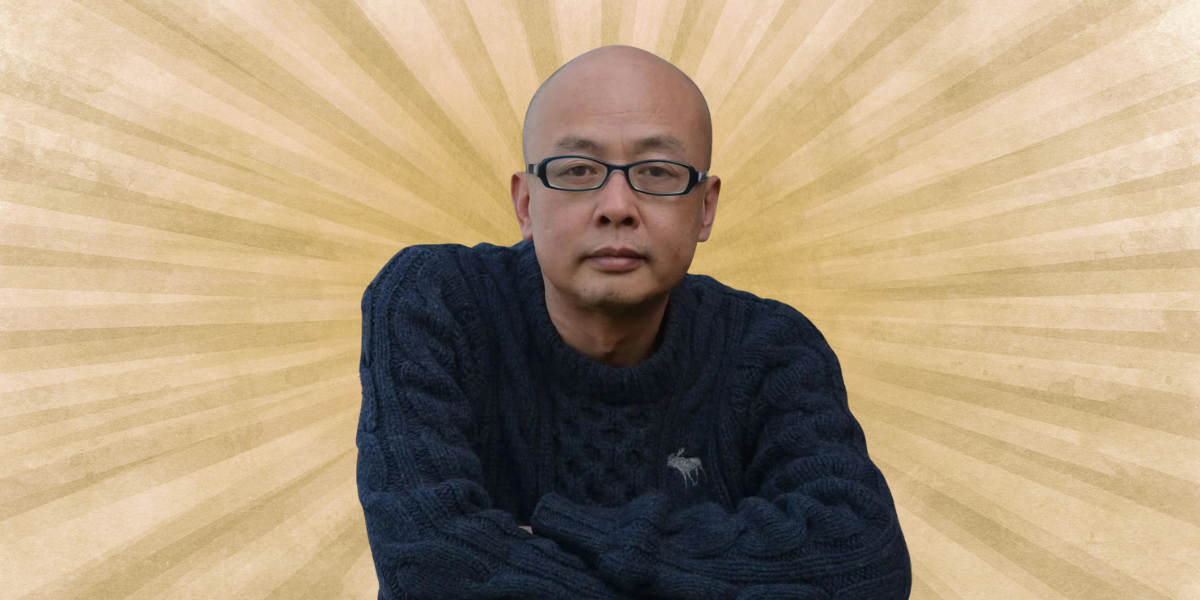
Ye Hui is an acclaimed Chinese metaphysical poet who lives in the countryside of Nanjing. He is the author of three poetry collections,《在糖果店》(At the Candy Shop; Hungyeh Publishing, 1999), 《对应》(The Correspondence; Flower City Publishing House, 2009), and《遗址》(The Ruins; Shanghai EP/Changjiang Literature & Art Publishing House, 2019). His poems in English translation have appeared or are forthcoming in 128 Lit, The Arkansas International, Asymptote, Bennington Review, Blackbird, The Cincinnati Review, Circumference, Copihue Poetry, Guernica, The Kenyon Review, Lana Turner, The Massachusetts Review, Nashville Review, Poetry, Poetry Northwest, and Zócalo Public Square. The English translation of his latest collection, The Ruins (Deep Vellum, 2025), was awarded a PEN/Heim Translation Fund Grant and longlisted for the National Book Critics Circle Gregg Barrios Book in Translation Prize.
*
Peter Mishler: How interested or curious are you about the differences or innovations that occur in the act of translation?
Ye Hui: Any discrepancies that arise during the translation process certainly wake up my imagination. A poem can only be partially captured in written form, anyway. Some of my friends have attempted to re-translate Dong Li’s translations into Chinese, and I have discovered many details that I had previously overlooked.
I don’t remember the exact content of the poem, but it was the first time I had seen someone write poetry around me. It was very surprising, and I felt that I too could write like that.
PM: When you say that a poem can only be partially captured in written form, is that something you’ve always believed or understood?
YH: As a young person, I thought that words could convey everything. Or perhaps I simply believed that I was not yet skilled enough to utilize them effectively. However, as time passed, I gradually realized that there are aspects of the poetic world that cannot be fully expressed through words. A person could spend their entire life writing only one poem, continually adding to it.
PM: How do you know when a poem is finished?
YH: My sense of this is merely a feeling. It’s the sense that the line will leave you after you’ve written it down. Relief begins to settle in, and the poem has already taken on its form.
PM: What is the most fascinating connection between your work in architecture and your poems?
YH: I have simply been exploring the relationship between architecture and people. This relationship leads me to imagine traces of the past. It gives me a historical perspective, but more importantly, it allows me to understand how people living in different times and in different houses think differently and whether and how their emotional life differs from ours.
How does this world composed of people, architecture, and land come together? How do these elements relate and respond to one another? I think about these elements’ spatial relationships. I think about a possible place where they emerge together, which puts me in a headspace that suspends time. All this fascinates me.
PM: Are you interested in writing poems for the same reasons? Suspending time? Understanding the past?
YH: In China, people often observe their fortunes through things in nature, believing that there are undetectably subtle ties between them and the world. We may not know how these connections exist but seem to be certain of them and are more than ready to try. I think poetry might offer a perspective on exploring the relationship between ourselves and the world.
PM: What is your earliest memory of being a poet?
Normally, I dedicate a specific period of time to writing, usually 7 to 10 days at a time, away from everyone. It’s like entering a state of meditation.
YH: When I was in my first year of high school, I wanted to document the story of a wounded rabbit. At that time, I only knew how to write in a formal, descriptive style, but I didn’t want to do it that way. So, I only wrote a few brief fragments.
Later, when I visited a friend’s home, I saw a piece of paper on his desk with a poem written by his brother. I don’t remember the exact content of the poem, but it was the first time I had seen someone write poetry around me. It was very surprising, and I felt that I too could write like that. It was a wonderful feeling.
PM: Do you find yourself paying attention to wounded things in your poems?
YH: Yes. I definitely pay particular attention to this. For someone like me, who had few playmates as a child, everything around me is magnified, and there is a natural sense of closeness. As you start to care about these things, your inner world becomes increasingly sensitive.
PM: Where do you write? Is there anything you can share about your process, either during your writing practice or even to prepare yourself before writing?
YH: Normally, I dedicate a specific period of time to writing, usually 7 to 10 days at a time, away from everyone. It’s like entering a state of meditation. I have a small study room where I close the curtains even during the day. I think that might help me to focus better on my inner thoughts without being distracted by the passage of time. My handwriting is not neat, so I prefer writing on a computer. The computer allows me to focus without having to worry about my writing.
PM: How many hours a day will you spend writing during that time frame? Is there anything that becomes a part of your process to awaken your imagination?
YH: I might spend half a day or even longer. In fact, even when I am not writing, my mind is constantly churning out new lines. However, spending extended periods of time can cause problems with my spine and neck. I used to take a Western medicine to alleviate dizziness, but I no longer use it. I realize I can’t rely on medication to sustain myself.
PM: How would you describe your composition process? One line at a time? A quickly written first draft?
YH: The process of brainstorming can be quite lengthy. In the past, I would keep everything in my mind. At that time, I could remember a multitude of ideas and emotions. Now, to keep track of them, I write them down quickly, almost like shorthand, while new scenarios keep emerging simultaneously and adding to them.
PM: How do you edit or revise your work?
YH: The initial draft will be followed by a period of time, perhaps a few months, during which there will be some adjustments, primarily related to line or section breaks. I will also make cuts. It will be difficult to add more content, and it is highly unlikely that it will be successful anyway.
PM: Who are the poets from past generations that you see your poems as being in conversation with?
YH: It wasn’t until the early 1980s that I came across poetry from outside China. These were translations of 19th-century poems by international poets from the 1940s. Afterward, various literary movements flooded in: French poetry, contemporary American poetry, and more. There were so many of them that I felt like a poor child suddenly inheriting a vast fortune.
For a long time, I felt queasy about it. What truly influenced my writing was the ancient Chinese I Ching (Book of Changes). This is a prophecy book that masquerades as a record of facts, and it is also an epic poem. It taught me that time is not so concrete and that changes in individual words can lead to a complete upheaval of the whole. This was very enlightening for me.
PM: What American poets did you read in translation during that time?
YH: There are so many examples, such as Dickinson, Williams, and Lowell. There’s a long list of names, but I’m not very focused, so I haven’t delved deeply into any of them. But these poets showed me the richness and breadth of poetry. Many years ago, I read Ginsberg’s poem about his trip to China. Due to illness, he felt helpless and fearful, but he connected his experience to the Buddhist concept of reincarnation. I admired his ability to authentically and effectively observe the self. This sense of powerlessness, too, is a genuine aspect of a poet’s reality. Thus, to some extent, I have observed life’s other possibilities through American poetry.
I often give up and rarely attempt to rewrite them, because I firmly believe that they will return in some other form.
PM: Dong Li, your English translator, told me that he thinks you may be the witch in your poem of the same title. Do you agree with this?
YH: This is a brilliant metaphor. But the witches I know are actually ordinary women in Chinese folk culture who have acquired some kind of power. They do not have their own temples and mostly live in villages. Some of them also perform agricultural work on a regular basis. I think there’s something poetic about them, in that they use everyday objects around them to summon magic just like poets do.
PM: What is the story behind this poem?
YH: The origin of “The Witch” is a story about a sick girl who suddenly recovered, just as she was on the brink of death. From that moment on, it seemed as though a different person had taken up residence within her body, akin to a secret exchange. I wanted to explore this idea further, but my initial attempts were lengthy and ultimately unsuccessful. Only a few short lines remained, and I am not sure even these succeeded.
PM: Are you more likely to abandon a “failed poem” or try to rewrite it?
YH: I often give up and rarely attempt to rewrite them, because I firmly believe that they will return in some other form. This mindset brings me peace.
When I hear music composed by humans, I feel as if I hear a sound directly emanating from within the world itself, devoid of any human voice and touch.
PM: What did you hope to include in “The Witch” that was not included in the finished poem?
YH: I wrote about how she used hyacinth beans to predict the weather and even fate. In fact, there were many such methods in ancient China. There’s a book called Meihua Yishu (Plum Blossom Divination) that describes how to predict events for the next day by observing plum blossoms. Witchcraft is a very specialized skill, and clearly, I am not familiar enough with it or do not want to write about it in such detail.
PM: To mention something else Dong Li has said about your poems, he has called you a metaphysical poet. What are your thoughts?
YH: I’ve never had a clear definition of this. Does it truly exist?
PM: Are you interested in surrealism?
YH: I have always remained vigilant regarding ideologies. Initially, surrealism revolutionized art. Now, it has evolved. Regardless of my personal interest, it has become an integral part of contemporary poetry.
PM: What has been on your mind lately about poetry? What’s been preoccupying you?
YH: Two years ago, I began writing poems about a collection of poems, which also form their own collection. The book is titled Catalogue. It seems that it is only within the framework of a catalogue that these poems can acquire their own language and imagery. This is fascinating to me. As I conceive these poems, I also imagine our lives and the world we inhabit. I wonder: do we also exist inside some kind of analogous catalogue? This is my own approach. I always enjoy veering off course, never aiming directly at the target. Veering off just might be the source of my imagination.
PM: Is there another art form besides poetry that you feel is closest to how you write?
YH: Music, a phenomenon that is naturally absent in everyday life. When I hear music composed by humans, I feel as if I hear a sound directly emanating from within the world itself, devoid of any human voice and touch. There’s only desolation and nothingness. It penetrates deep into my consciousness. Now I rarely listen to it because it exhausts me.
*
“Morning Suddenly Becomes Loud”
by Ye Hui
A flight of birds
Glides on the other bank as if in another world
The trees wave in their own diminished light
The old houses are fading away
Only I know, in fact, they exist
In different ages and moments
On the strange street, faces come my way
Like leaves after leaves that blow
From some courtyard that always lies hidden
Someone stands before a gate in a deep alley
The gate, not yet opened
A boy sits by a desk, a picture book spreads
In front of him, he turns around his ashen face
He has been dead for years
Morning suddenly becomes loud
Translated by Dong Li
From The Ruins published by Deep Vellum (2025).

Peter Mishler
Peter Mishler is the author of two collections of poetry, Fludde (winner of Sarabande Books' Kathryn A. Morton Prize) and Children in Tactical Gear (winner of the Iowa Poetry Prize, forthcoming from the University of Iowa Press in Spring 2024). His newest poems appear in The Paris Review, American Poetry Review, Poetry London, The Iowa Review, and Granta. He is also the author of a book of meditative reflections for public school educators from Andrews McMeel Publishing.