This first appeared in Lit Hub’s Craft of Writing newsletter—sign up here.
Open as we might be to learning how to tell a story—parsing the books we love to see how the writer did it, reacting to the impressions of our first readers, a parent, a friend maybe, perhaps a teacher, then later to the comments of an agent or an editor, trying to hew to some Platonic ideal—at one point you write the way you write because of who you are, your native you-ness, which will take to the ideas of others only if they fit a pre-established form within you.
Art, like all relationships, is about connection, and connection comes down to chemistry. So follow the chemistry. Yes, seek to improve your writing, but ultimately, as Emerson said, Do your thing. Because if you’re not doing your thing in your book, then what’s the point?
These are a few of the ways I’ve done my thing:
1) In The Facts Behind the Helsinki Roccamatios, the title story in my first book, more a novella, two friends spend time together as one of them is dying of AIDS (the story dates from the late 1980s, when the virus was still a death sentence). Precious as their time together is, they must still whittle away the hours—time, when you are dying, moves both quickly and slowly—so they settle on telling a story, a sort of inversion of The Decameron where the plague is with them, not beyond the walls. Their story is about a Finnish family—hence Helsinki—of Italian extraction, thus the Roccamatios. But how to structure their story, how to give it a form? They mull it over and finally decide that each episode in the contemporary story of the family must metaphorically resemble one event of the 20th century.
Episode one, told by the narrator, must echo 1901. Well, in 1901, Queen Victoria died; with the Roccamatios, the grandfather, Sandro, dies, which brings together the whole family, whom the reader gets to meet. The second episode, narrated by the friend dying of AIDS, Paul, must reflect an event from the year 1902. And so on, in alternation, chronologically, each episode a historical fact that must birth a story. Some of the facts are well-known, properly historic, others are more obscure. What you get in this novella is not the actual story of the family, but the facts that support their story, hence the first part of the title, The Facts Behind. The underlying structure of this story, then, the skeleton within, is a list of historical facts, that is, it has an extended non-fictional foundation.
2) In my first novel, Self, in certain parts I broke the text into two columns. In the left column was a straightforward description of an act of violence, while the right column was composed of single words—“Tito” (the name of the main character’s boyfriend), “baby”, “terror”, “pain”—or ellipses meant to convey silence and shock, all of these in the same space in the right column where that would be the emotion underlying the words in the left column if the two columns were set on top of each other. So here a vertical fracturing of the layout shows explicitly the emotional tenor of a scene that might otherwise be misinterpreted.
Art, like all relationships, is about connection, and connection comes down to chemistry. So follow the chemistry. Yes, seek to improve your writing, but ultimately, as Emerson said, Do your thing.
3) I wanted my novel Life of Pi to have precisely one hundred chapters. That meant they had to be quite short (one chapter is precisely two words long: “The story.”) In this case, a structure that is announced—Pi tells the author early on that he would like his survivor story to be told in one hundred chapters—is visible to the reader throughout. Form has to adhere to a rigid formal structure, in this case, a “round” number that is pleasing to the order-seeking mind. That, after all, is what art is (and religion): an imposition of order upon chaos.
4) In Beatrice and Virgil, a writer meets a playwright who slowly, reluctantly shares with him the play he is working on. Many pages of the novel are made up of this play, that is, of dialogue with stage directions. It is the nature of a play to exist within its own context, on a stage that only generically evokes a specific place, everything contained within naturalistic speech, with only minimal frame of reference. This degree of abstraction appealed to me since the purpose here was to discuss the Holocaust but without rooting it in the history of Mitteleuropa between 1933 and 1945; essence, once extracted, is easier to retain than circumstances. Hence a story set on a stage, easy to evoke in the reader’s mind, a thing light and portable, and so form within form to express a thematic concern.
5) Lastly, in my latest novel, Son of Nobody, a Canadian scholar discovers scraps of a lost Trojan War tradition about a commoner named Psoas of Midea, the eponymous son of nobody; he doggedly pursues the story hinted at in these scraps of Ancient Greek, eventually managing to assemble a number of fragments that are in the dactylic hexameter, the meter of classic Epic poetry, which he translates and comments on. To tell the story of this story, I didn’t want a single narrative that would involve the heavy use of flashbacks, which would tire, besides root the narrative in a single real time, the present. Instead, I decided to divide the pages of the book in two with a horizontal line.
Fragments of the lost epic appear in the top half of the pages, followed by footnotes in the bottom half at the end of each fragment. In this divided-page format, both narratives exist on their own terms, in their own time: we are with Psoas of Midea roughly three thousand years ago, or we are with Harlow Donne, our Canadian scholar at Oxford, today. I like the shifting of gears involved in reading in alternation verse fragments and prose footnotes. A horizontal fracturing of the layout “s” offers a varied narrative that is in dialogue with itself—and with the reader, who must weave it into a whole
In each of these cases, I was trying to tell the story in the way that seemed most effective, form following function, but exercising a degree of freedom with that form until I found what worked best.
There were failures. In Life of Pi, for example, there is a scene in which Pi is blind, the tiger is blind, and they encounter a Frenchman in another lifeboat who is also blind. Instead of the extended dialogue between Pi and the Frenchman appearing uniformly indented on the left side of the page, I had it float about like, well, like two lifeboats lost at sea, at first each speaker starting on opposite sides of the page, on the very edges, then slowly coming together until they were atop in the middle of a page, then continuing on until they were once again on opposite sides of the page. The reader could thus see what Pi couldn’t. I was very pleased with the device. My editor thought it was just annoying, pulling the reader out of the reading experience and instead making them notice how smugly clever the author was, which is not what you want. Pi and the Frenchman now tidily speak to each other uniformly indented on the left side of the page. Lastly, then, it has to work.
_________________________________________
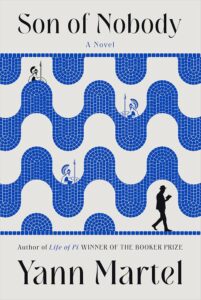
Son of Nobody by Yann Martel is available via W.W. Norton & Company.

Yann Martel
Yann Martel is the author of Life of Pi, the international bestseller that won the 2002 Booker Prize and was adapted to the screen in the Oscar–winning film by Ang Lee. He lives in Saskatoon, Saskatchewan. His latest book is Son of Nobody.