Writing While the Alphabet Burns: Ukrainian Literature to Help Understand the Ongoing War
Introducing a New Critical Series For the Curious Reader
Russia’s war on Ukraine is entering its twelfth year. As Ukrainians fight to defend their borders, many are also fighting to defend Ukraine’s language and culture. As literature scholars and translators, we are frequently asked to list books that help to understand Ukraine’s rich literary history. In this series, we will be presenting reviews of books, past and present, untranslated and translated, with the goal of creating an ongoing syllabus for the curious reader on Ukrainian literature. Over the coming year, we will be featuring reviews by writers and scholars of Ukrainian literature. We open with a survey of a handful of historical texts by Alex Averbuch—novels, epic poems, and short stories that reveal Ukraine’s rich multiethnic history.
–Amelia Glaser
*
Three Ukrainian Poets, Three Ways of Witnessing
_________________________________________________________
When Ukraine is in darkness, Ukrainian poetry brings light. Not a soft or reassuring glow, but a hard, sustained brightness that makes devastation legible. Recent books by Anna Malihon, Iryna Vikyrchak, and Lesyk Panasiuk demonstrate with striking clarity that in wartime, poetry functions not as a secondary cultural response, but as a form of survival, resistance, and ethical witnessing. Read together, these three volumes offer a comparative portrait of contemporary Ukrainian poetry under extreme historical pressure, showing how distinct voices, forms, and biographical positions converge around a shared task: to preserve the human amid systematic dehumanization.
What unites these books is not style but urgency. Each poet writes from a different position within the war’s geography and timeframe: displacement and exile in Malihon’s case, historical and intergenerational reckoning in Vikyrchak’s, and the raw immediacy of occupied and liberated Bucha in Panasiuk’s. Yet across these differences runs a common insistence that poetry remains capable of bearing witness at precisely those moments when other languages fail.
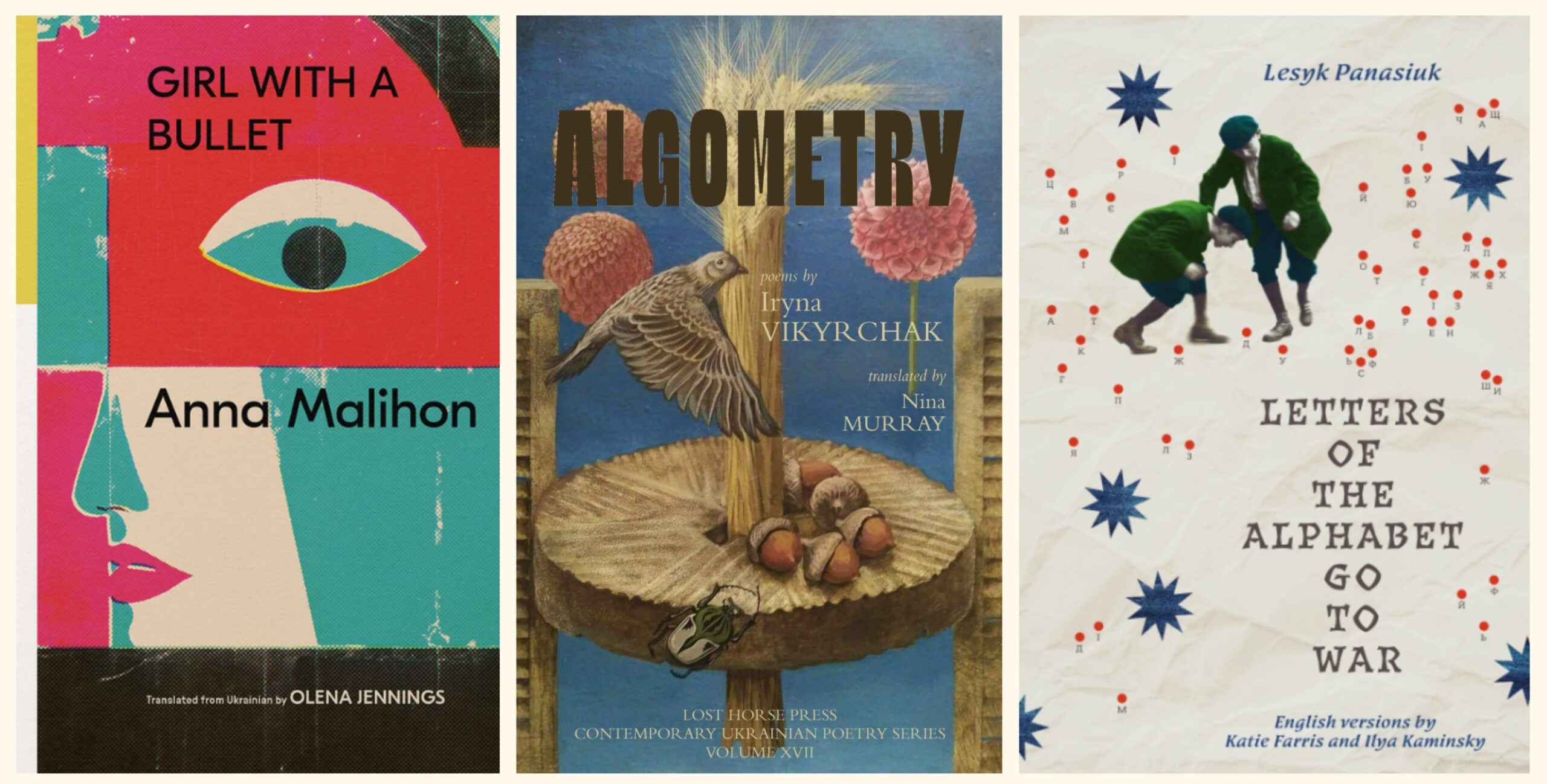
Anna Malihon’s Girl with a Bullet (2025, World Poetry Books, trans. by Olena Jennings) articulates survival through vulnerability rather than defiance. Her poems are inhabited by children, animals, wounded bodies, and fragile natural forms, all of which absorb the violence of war without becoming allegorical stand-ins. The recurrent and widely recognizable figure of the girl with a bullet in her stomach runs not toward safety but toward the forest, carrying both terror and life within her. Malihon’s lyric voice does not monumentalize suffering; instead, it registers how war enters the smallest gestures, domestic spaces, and physiological sensations.
Survival here is quiet, provisional, and deeply embodied: the capacity to go on speaking, loving, and perceiving beauty even after one’s language, home, and sense of continuity have been violently disrupted. Olena Jennings’s translations are integral to this effect. Her long-term commitment to Ukrainian poetry shows in the precision and restraint of the English versions, which preserve Malihon’s tonal shifts without smoothing their rawness.
Iryna Vikyrchak’s Algometry (2025, Lost Horse Press, trans. by Nina Murray) approaches resistance from a different angle, foregrounding the historical depth of silencing itself. Her work repeatedly returns to scenes in which writing is punished, appropriated, or erased: a grandmother tortured for a poem, a mother whose essay is stolen and published under the name of another—a man. By placing Russia’s current war within a longer genealogy of imperial and Soviet repression, Vikyrchak frames resistance as an act of naming and “signing” one’s own voice. Writing becomes a refusal to accept inherited muteness. Her poems insist that cultural survival is inseparable from historical memory, and that the present war cannot be understood without acknowledging earlier regimes of violence against language, authorship, and truth.
Nina Murray’s translations, shaped by her own work as a poet and her long engagement with Ukrainian literature, bring this layered temporality into English with clarity and ethical tact. Because Nina Murray has also translated other important Ukrainian works—such as Oksana Lutyshyna’s Ivan and Phoebe—her rendering of Vikyrchak can be read as part of a broader international exchange, even as Vikyrchak’s poetry remains grounded in quite specific historical experiences of repression.
Lesyk Panasiuk’s Letters of the Alphabet Go to War (2026, Sarabande Books, trans. by Ilya Kaminsky and Katie Farris) pushes the logic of wartime poetry further by making language itself the primary site of injury. Panasiuk lived in Bucha, and the book is suffused with the experience of occupation, massacre, and return. In his poems, letters lose limbs, words are mined, and grammar collapses under shelling. This is not metaphor for metaphor’s sake, but a deliberate diagnosis of what war does to meaning. When language is targeted, poetry must either fracture or lie; Panasiuk’s choice is obvious. His poems are acts of linguistic survival that refuse the false comfort of coherence. The English “versions,” explicitly presented as such, reinforce this ethos. The translators, Ilya Kaminsky—originally from Odesa—and Katie Farris, do not claim transparent equivalence; instead, they stage translation as an echoing, embodied response to catastrophe, allowing English to register rupture rather than prettify it.
*
These three books map different modes of poetic resistance. Malihon offers lyrical endurance—a poetics of wounded life that continues to feel. Vikyrchak provides archival resistance, standing up for continuity against enforced forgetting. Panasiuk delivers linguistic resistance, exposing how war attacks the foundations of speech itself. Together, they refute the expectation that wartime poetry must either inspire or console. Instead, they offer presence: a sustained attention to what is being destroyed and what stubbornly remains.
Read side by side, the books also demonstrate the collective labor that sustains Ukrainian poetry today. Translators are not auxiliary figures but co-witnesses, extending the reach of these voices without diluting their force. The result is not simply literature about war, but literature produced within war’s conditions and constraints.
Taken together, these books by Malihon, Vikyrchak, and Panasiuk should be read as essential works of contemporary poetry and as vital human documents. They remind us that poetry does not stop wars, but it does something nevertheless necessary: it keeps open a space where suffering is named, memory is preserved, and the human voice continues to speak from within devastation.
Alex Averbuch
Alex Averbuch, a native of Novoaidar, Luhansk region, Ukraine, is a Ukrainian poet, translator, and scholar. He is the author of three books of poetry and an array of over sixty selections of literary translations between Hebrew, Ukrainian, Russian, and English. His poems have appeared in English translation in Beloit, Manhattan Review, Copper Nickel, Birmingham Poetry Review, Plume, Words Without Borders, Sugar House Review, Constellations, and Common Knowledge, as well as in anthologies in English, Italian, French, Romanian, Hebrew, Finnish, Estonian, and Polish translation. His works have been twice nominated for the Pushcart Prize. Averbuch’s latest poetry book was a finalist for the Shevchenko National Prize, Ukraine’s highest award for culture and literature. He is currently an assistant professor of Ukrainian literature and culture in the Department of Slavic Languages and Literatures at the University of Michigan.