Writing the Books We Want to Write
Virginia Pye on Why She Keeps Writing What Excites Her, Regardless of Genre
On a rainy winter evening in Somerville, a group of women authors were eating pizza and bowling candlepins at Sacco lanes when the topic of branding came up. That is, how a writer can feel pegged or slotted by her publisher and made to write one type of book over and over. Several of the more seasoned and successful authors complained that they aren’t “allowed” to write anything not in their lane, an apt metaphor as we watched a ball wobble down the polished floor before sliding into the gutter. Those of us who would love to have agents and publishing houses dictating our next books feigned sympathy. It seemed a good problem to have: editors telling us that readers want another novel just like our last one. Wasn’t that a sign that our books are loved?
On the other hand, we had become writers to express something personal, something only we could write. To be constrained by audience expectations and bottom-line priorities can feel limiting. Shouldn’t a writer be able to write whatever she wants and get it published? We all agreed that seemed less and less likely in today’s market, especially when aiming for bigger contracts from larger houses.
In other words, publishers don’t want to take a risk on something that might not sell, so they stick with what already sold well, limiting the options for writers.
It’s widely accepted that changes in publishing have brought a reduction in the publication of non-genre, literary fiction. Back when there were dozens of large publishing houses, not just five, agents had more options to pursue for literary works. The consolidation to a handful of behemoth houses has created a preference for short term profit over a longer shelf life for books in search of a niche market by so-called mid-list authors.
In other words, publishers don’t want to take a risk on something that might not sell, so they stick with what already sold well, limiting the options for writers. Literary fiction now makes up only two percent of the overall market. And yet, some of us persist.
Maybe because it was my turn to bowl, the group turned to me, and someone zeroed in on the fact that I have a fifth book coming out that will be unlike my others. How had I gotten away with that? Was it because I was with a small press, as I had been for my previous books? Small presses, my friends suggested, seemed like a solution to many publishing problems. It’s true they are filling a gap by allowing more writers to be legitimately published. I know several authors who’ve always been with the Big Five until recently, when they’ve found themselves left with only the option of a smaller house. But wasn’t that a good thing, my friends wanted to know?
I explained that I’ve had only good experiences being published by smaller presses. I’ve worked with seasoned editors and publishers who are excellent at what they do. And the experiences have been generally pleasant, which I gather hasn’t always been the case for my friends at larger conglomerates. But the truth is, I can’t pretend that paying for one’s own marketing budget, setting up many of one’s own events, and forever angling for reviews and invitations feels great. But I let it go and rolled the ball down the lane.
On the drive home in the pelting rain, I returned to this exchange and how my friends and I had gotten sidetracked from what really matters: how writers today can and should get to write the books they want to write. Which led me to realize that my friends were right: I have been writing the books I’ve wanted to for years, mostly free of restrictions or editorial intrusion. No one has told me I had to stay in my lane. But that doesn’t mean my novels aren’t related to one another. Though disparate in subject matter and setting, they all revolve around several main concepts. Perhaps, I began to muse, branding is just a twenty-first century term for the idea of common themes that authors have always woven through their novels and stories.
My main theme, or “brand,” involves characters who, when faced with situations outside their depth, respond with naivete or hubris. Characters with class and racial privilege, often in leadership roles, yet who understand very little, or certainly not enough, about the people of color or working-class men and women they oversee. Characters who think they know more than they do, especially about people lower in the social order. In other words, clueless White folks.
My first two published novels, River of Dust and Dreams of the Red Pheonix, concern Americans in historic rural China, a place they try to convince themselves, to their peril, where they belong. These novels offer a post-colonial perspective—an understanding that, though these Americans may have done something positive in China by building roads or hospitals, their very presence, and certainly their perspective on their purpose there, is specious. They are well intentioned, “good” people, but they are, by their very choices, categorically wrong.
From the outside, these works of fiction might seem to have little in common, except my name on the cover.
My collection, Shelf Life of Happiness, consists of nine stories set in contemporary America about characters of all ages who try to master their circumstances with more or less success. They sometimes strain to accept their own good fortune, or sometimes they toss it away, spoiling any hope of resolution and joy. The stories may seem to have little in common with my historical novels, but I believe there is a strain of post-colonial introspection ever here in these slices of life of the present-day US, where a person or society that has been privileged is forced to take a good, long, hard look at itself and sees its own mistaken efforts. Happiness, when achieved, is necessarily tentative when felt undeserved.
My last novel, The Literary Undoing of Victoria Swann, is a Gilded Age story set in Boston and Cambridge about a romance novelist who sues her publishing house for underpaying her as a woman. Even as Victoria is being taken advantage of by her husband and her editor who essentially work her to the bone, she maintains willful ignorance about the lives of the working women around her. Eventually, she becomes a champion of those same women, and yet still strives to be included by her snobbish, mostly male, literary counterparts, in a closeminded bookish city. Class as well as women’s rights play major roles in this dime novelist’s life.
My forthcoming novel, Marriage and Other Monuments, set in Richmond, Virginia, during the summer of 2020, tells the story of two marriages that implode against the backdrop of the social justice protests and the fall of the Confederate monuments. Cynthia and Melissa are estranged sisters—one married to a white man of old Virginia stock, and the other married to a Black man of old Virginia stock—who end up entangled in that highly racialized moment. As their personal lives become more openly political, all four main characters—the two sisters and their husbands—come to better understand the roles they’ve been cast in by living in a city with such a difficult past.
From the outside, these works of fiction might seem to have little in common, except my name on the cover. But in each of them, the main character is defined by what he or she does with their privilege. Often it is their downfall. But sometimes, there is hope when they see their own weakness for what it is: a cultivated and unfortunate blindness. A way that they, in their lives of comfort, have been kept separate, or have kept themselves separate, from others.
Branding as a marketing term stems from the 1950s and ’60s, whereas the idea of themes in literature has been with us from the first study of stories. Perhaps my friends who feel constrained by always being placed on a particular shelf in the bookstore can think of their novels in another way as they use their assigned genre to explore the themes they want most to explore. Novels that seemingly share a repetitive style or subject can have a beating heart that expresses the writer’s most passionate concerns.
And in writing novels that at first blush seem unrelated, I will know that, like so many writers, I’m unspooling a single enduring story in just some of its many possible manifestations. The theme of the work is what matters, not a book’s placement on the bookstore shelves. Writers of all types can take hold of their stories and make them their own.
__________________________________
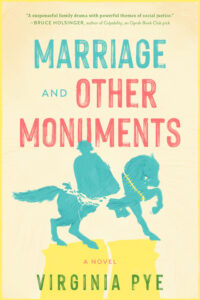
Marriage and Other Monuments by Virginia Pye is available from Koehler Books.

Virginia Pye
Virginia Pye is an author in Cambridge, MA. Her latest novel, The Literary Undoing of Victoria Swann, is available now from Regal House Publishing.