Writing is an Act of Faith, But Publishing is a Practice in Doubt
Reena Shah on Remaining a “Writer in Training”
On “the second pass” of my debut novel I was instructed to catch errors and make final line edits of the typeset manuscript. This was supposed to be the fun part. Some writers, I was told, don’t even read “2P,” in publishing speak. They whiz through, check this or that, and send the manuscript back. I applaud such confidence, which I don’t possess. I knew that lurking in “2P” were bad sentences, awkward phrases, and entire paragraphs I wished I hadn’t written. In a speculative version of this essay, those bad sentences, phrases, and paragraphs would be the work of disgruntled earthworms crawling across the pages leaving castings of errant adverbs and gestures that read like stage directions. Unfortunately, in this version, I can only blame myself. In fact, when I wrote the problem sections, I may even have liked them.
For weeks, I evaded 2P. I feared wanting to change or delete everything. In this way, the novel was a relic, a piece of the past being projected into the future. I’ve been told it is healthy to separate yourself from your novel as it moves through production, and, largely, I have. But last year, 2P lorded over me, the printed version giving me withering looks from my desk.
A week before the deadline, I began, at last, to read. Reviewing the first paragraph was not unpleasant, much like disassociating. For a few sentences, it was like reading someone else’s book. The first paragraph was fine. More than fine. Good. It was good. I could do this. I was doing it.
At the top of the second paragraph, the feeling evaporated and was replaced with foolishness. I put the manuscript down, drank a glass of water, made myself a spinach smoothie, wiped turquoise toothpaste stains from the bathroom sink, made yet another to-do list. But when I returned to 2P, the second paragraph, its first sentence, remained unchanged: “Ruchi scanned the parched sand.”
If another writer had written these sentences, I would perhaps bestow immense praise on them.
“Parched sand.” What is that? Or rather, what is “un-parched sand”? What is sand that is not parched? Isn’t all sand parched? Isn’t sand just sand? I took to Google and discovered that sand can be parched. However, this was not what I meant in this sentence. “Parched sand” was not dry sand, which itself is redundant, the status quo of sand. Parched sand is baked, hard, and fissured. Ruchi was not scanning “parched sand” on the Connecticut coast.
Okay. “Ruchi scanned the sand.” But she did not. The next sentence is about a party unfolding like playacting (the right comparison, I think, because it’s exactly how Ruchi feels). Ruchi was not looking at the sand at all. And she certainly wasn’t scanning it.
“Ruchi scanned the scene.” There, at last. Or just delete it all together. Even better. But this didn’t change the fact of the previous incorrect and inelegant sentence. On page one, paragraph two. The first sentence of paragraph two. The damn thing wasn’t hiding on page 145. It had survived 15, 20, 1000 readings of this novel, making it all the way to 2P. It was not my wonderful editor’s fault, nor my copyeditor’s. They are saints. “Scanned the parched sand” was entirely my mortifying creation.
I’m not trying to be self-deprecating. After encountering the “parched sand” being “scanned,” I read on and felt okay. Sometimes better than okay. I was surprised that these characters came from me. They are moving and frustrating and memorable, and the prose isn’t abhorrent. If another writer had written these sentences, I would perhaps bestow immense praise on them. Then a sentence or paragraph would pull me right up and I’d be reading in bed with a tense neck, sweating with anguish because—how? Am I terrible? Is it all terrible?
Thank goodness for 2Ps. And 3Ps and 5Ps and production editors and proofreaders. I’m grateful to them all.
I will always be a writer who must read her 2Ps. My early drafts are messy and thin. I’m not efficient. I often catch myself staring at whatever mundane object (trampoline, dead grass, my husband’s bedside table sporting several pairs of tangled, bright blue headphones) is in my line of sight. I’m highly, woefully distractable. I hate sitting still. All of these are marks against me, but they are my marks, and I’ve learned nothing if not acceptance.
Instead, I went ahead and failed in a different genre.
I think acceptance is different from satisfaction. I’m not sure I’ll ever be satisfied with my writing, and while that makes me sad, it also feels a little like hunger, which in small quantities isn’t terrible. The weekend I read 2P, I was reminded of a nonfiction book I wrote 20 years ago. It was a biography about the artistic life of my dance guru, Kumudini Lakhia, who passed away the previous Saturday. She would’ve been 95 years old in May. She was a fantastic, bold choreographer and I was enthralled with her.
My relationship with that book is complicated, as was my relationship with Kumiben, as I knew her. I was her student, had performed in her troupe, and had lived with her for several months. I was also 24 at the time and afraid to make her angry, which wasn’t hard to do. I wanted to write about the dance form I loved and to put into words the experience of performing and creating movement. I also wanted Kumiben to approve. The resulting book was too narrow, too careful, and therefore compromised. I spent a long time wishing I’d written it differently, more bravely. Or that I’d written fiction, because that was what I’d wanted to write but feared failure. Instead, I went ahead and failed in a different genre.
Occasionally someone writes to me, a dancer or a dance scholar, to tell me that they’ve learned so much from the biography and wished that they, too, could study with Kumiben. I’m grateful for these readers, and a bit nauseous from that feeling of having pulled one over on someone.
After Kumiben’s death, I revisited that book for the first time in years. I dug it out from under a stack. The jacket was dusty along the edge that hadn’t been pressed against another book. The binding cracked as I opened it. I skipped around and found passages that I quite liked that describe Kumiben’s creative life, her productions, her courage. I’m glad that this documentation exists. Overall, the book evades her complications and fails to communicate her character. And there’s nothing I can do about it.
When my book sold, I’d hoped that publishing a novel would help me feel less like a writer in training. Now, I hope I always feel like one.
On the same day, I reread Yiyun Li’s story “All Will Be Well” from Wednesday’s Child, which was sitting on my desk. In that story, the narrator has experienced a far more devastating event than doubts or regrets about a book, but I find the ending instructive for any painful situation. “All will be well, all will be well, and every kind of thing shall be well, yet I could not even write a lying note to console my children.” The line guts me every time, and it also lifts me up. I read the “all will be well” as both sincere and deeply sad and ironic. All will be well, and it will be impossible, and both are inevitable.
Being less evasive, along with acceptance, is my current work both in fiction and in life. It’s taken me some time to see how evasion is different from ambiguity. I’m in love with ambiguity and contradiction in fiction. But I tend to evade and often need other people—namely friends, mentors, editors, my agent—to point this out. I’m learning to not rush past moments that require the keenest attention. Stay longer is what I’ve been telling myself as I work on my next novel, and in staying longer, beautifully strange things happen. I’m less worried about making a mess and more aware of my tendency to polish, a tendency that probably led me to the pretty but meaningless “scanned the parched sand.” Polish is a trickster.
When my book sold, I’d hoped that publishing a novel would help me feel less like a writer in training. Now, I hope I always feel like one. It is the only way for me to keep a creative practice alive. Recently, I spoke with my friend and colleague Pathikrit about this aspect of writing, about having both faith and doubt. A magazine had just published his delightful translations of several Sukumar Ray poems. Pathikrit shared them with me saying, “I’m happy with how they turned out. Today, at least.” The poems are wonderfully absurdist and wry, and I don’t see any reason for my friend to ever be unhappy about them, but I understand the doubt. His job isn’t to be happy with his work forever. His job is to have enough faith to keep writing.
I’m learning that every story and book requires both an act of faith and a dose (healthy, not crippling) of doubt. As writers, we must be careful not to succumb to either. We must be careful not to be too careful, too narrow. Sometimes I will be an earthworm shitting about, a mess I’ll have to contend with later. Sometimes, I’ll “fail in public,” as my mentor Elizabeth McCracken says writers inevitably do, and it will feel awful. But at least these will be the failures of a writing life, the life I want, the one I have.
__________________________________
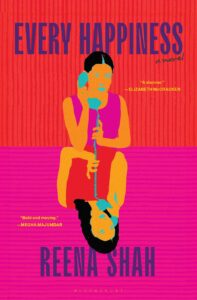
Every Happiness by Reena Shah is available from Bloomsbury.

Reena Shah
Reena Shah is a writer, editor, and teacher. Her work has been featured in the Masters Review, Electric Literature, Joyland, BBC, the American Prospect, National Geographic, and the Guardian, among other publications. She has been awarded fellowships and residencies from the Martha Heasley Cox Center for Steinbeck Studies, Millay Arts, Tin House, Sustainable Arts Foundation, Cuttyhunk Island Residency, and the Fulbright Foundation. She received an MFA in fiction from the Michener Center for Writers, where she won the Keene Prize for Literature. For many years she was a kathak dancer in New York and India. She now lives on Roosevelt Island, NY with her family and teaches in a public school.