Writing in the Interim Language: Jhumpa Lahiri and Chiara Barzini in Conversation
On Seeking Literature’s Third Spaces
“Everybody, that is, everybody who writes is interested in living inside themselves to tell what is inside themselves. That is why writers have to have two countries, the one where they belong and the one in which they live really. The second one is romantic, it is separate from themselves, it is not real but it is really there.”
–Gertrude Stein, Paris, France
*
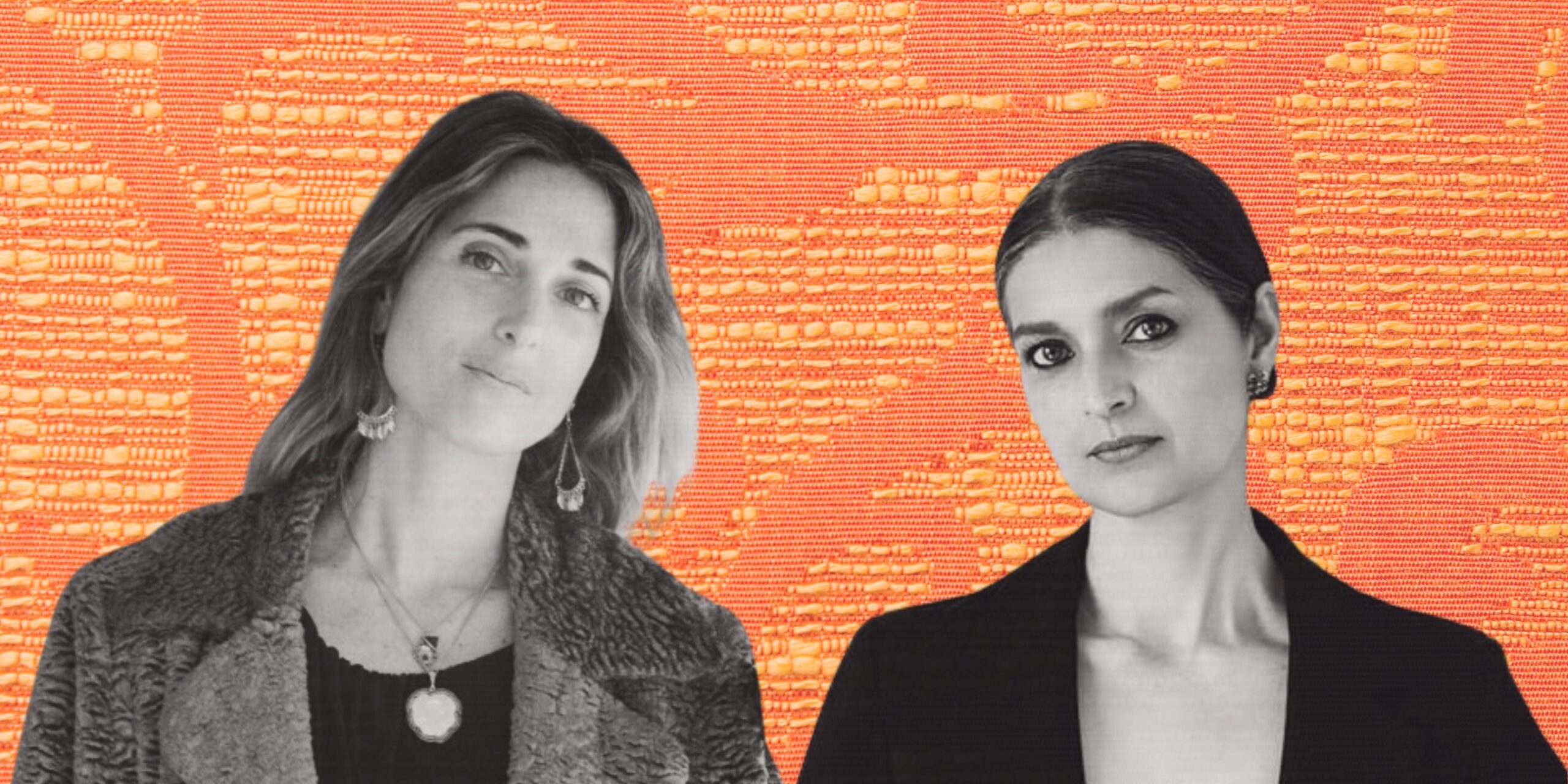
Jhumpa Lahiri and I have been talking, via text, email, and workshop banter, about writing outside one’s native language. What we found ourselves discussing was a new chapter of this “writing in another language” dossier: writing in the interim language. We have recently given ourselves to write first drafts in a kind of poly-language, a hybrid space where Italian and English coexist in the same text. What has been surprising is how much this has changed not only our relationship to the writing itself, but also to everything around it: editors, publishers, and the expectations of the market, which is still largely organized around the idea that a text belongs cleanly to one language. Jhumpa, for example, is currently at work on a novel that began in Italian, veered into English, and became a kind of double-language manuscript. She is now shaping a monolingual English version that she will eventually translate back into the other language, in this case Italian.
With my latest book, Aqua, the process was similarly tangled. It was commissioned in Italian, but I wrote much of it in a mix of English and Italian, translated that into a full Italian version, edited that version, and then carried those edits back into a different English version. So there are, at the moment, multi-language versions of our stories lying around our desktops. Part of what we explore in the exchange is precisely the idea of not treating these polylingual drafts as oddities to be corrected, but as works in progress, perhaps even as a new way of defining our voices.
–Chiara Barzini
*
Chiara Barzini: We met in Rome through a common friend Francesca Marciano in a small writing group composed of writers grappling with the codes of another language. Each one of us had a different reason to write in a language that wasn’t our own. For many years now we have been exchanging work, laughing about the fact that we were workshopping each other in “foreign languages.”
For a long time there was a dichotomy: English / Italian. But in the last two years something began to change in the work we were exchanging. I wasn’t aware of it at first, but then it slowly became more apparent. You had stopped refusing the English language, or feeling like you had to renounce it or make a choice (either / or), and I had stopped fearing Italian (I’ll get lynched by the Catholics if I reveal who I am). Timidly, without knowing exactly what we were doing or why, we started exchanging bits of multilingual writing. “I don’t know what I’m doing,” you told me when you first handed over your hybrid pages from your forthcoming novel. You thought you wanted to write it in Italian, then something changed along the way… What happened??
Jhumpa Lahiri: What happened was that I had reached a point beyond the binary, beyond the boundary between either and or that has more or less governed my life from its beginnings. Was I Indian or American? Did I prefer life in America or in India? Would I marry an Indian or an American? Did I like to speak in Bengali or English? People born into a culturally hybrid and/or bilingual reality are inundated with such questions, and asked to choose a side. And yet choosing a side is impossible, it would betray a fundamental part of us. Unlike Stein, I never have felt a sense of true belonging to any place. I replicated this condition of non-belonging, perhaps subconsciously, perhaps intentionally, when I moved to Rome, learned Italian and then began to write in it.
Once again the questions came. Why the change, why had I moved toward Italian, what was behind it, why did I prefer it? How could I, a writer, give up “my” language. Was my writing in Italian a translation? People wanted rational explanations that I could never provide.
English has never felt like “my” language. No language has, or ever will, occupy that role in my life. At first, as you know, I needed to maintain a clear boundary between English and Italian for pedagogical purposes. I needed to reduce the influence of English, which had dominated my life until then, and so I stopped reading it and spoke it as little as possible. Given that I was in Italy in the crucial phase, I was able to alter my linguistic center of gravity. But then, as Italian solidified within me, I realized that I had no fixed linguistic center of gravity, nor did I want one.
People began to ask when I would “return” to English, referring to it as my mother tongue. This made me question what a mother tongue is, and push back against the assumption that we all have one. Literally, Bengali is my mother tongue, and yet it falls short of the staggering role that most people associate with that construction: an all-inclusive existential package that contains, within it, language, culture, and place. The fact that I am now writing in English again is not a return; it is a new stage of the journey. So to answer your question of what changed to bring this about, it was a change in awareness of how to negotiate the limiting and repressive nature of normative cultural and linguistic identity.
CB: When I read the early pages you gave me, I thought to myself that you might have thought you didn’t know what you were doing, but to me it made total sense. I have started working on a new book set in Rome in the 1950s. The language of the book is Italian—the dialogue is often in Roman dialect, the names, places, and characters are all Italian but the wider ideas are coming in English. The fact that I can’t choose whose side to be on is making me so anxious that I refuse to call it a book and I am still living in a liminal space with it. So far it’s a notebook filled with notes in two languages. The inner monologue is: if I keep this in the form of notes, then I am allowed to shift from one thing to the next. I have yet to give myself permission to really see what form the narration will take.
JL: Giving ourselves permission is the key. Writing is full of gatekeepers. In the end, language—and for most writers, a single language—is the biggest gatekeeper of all. When a book is finished, it is classified according to the language of its composition. This determines everything: where it will be published, how it will emerge into the world, what language renders it “original” as opposed to foreign, what types of recognition it might be eligible for, and so on. But the fact of the matter is that many writers contain multiple languages within them and are able to inhabit different languages in their writing process.
People began to ask when I would “return” to English, referring to it as my mother tongue. This made me question what a mother tongue is, and push back against the assumption that we all have one.
Another question I am constantly asked is what language I “think” in; that, too, is an attempt to insist that one language governs the other, and also insists that the binary of either/or remains intact. A key figure for me has been Amelia Rosselli, who wrote in Italian, English, and French, sometimes incorporating all three languages in a single text. She didn’t do this to show off; this was who she was, this was her authentic self. I went on to discover a series of other writers—Etel Adnan and Leonora Carrington are just two—who moved back and forth between the languages they knew and felt connected to. Other women writers gave me permission to do what I’m doing now. But I would also mention Fenoglio, and Beckett, of course.
The question remains, however: what is the language in which we are obligated to present the book to the public? Will the reader tolerate the presence of more than one language in a text? Usually, in poetry, there is more freedom. To compose a linguistically hybrid text is natural and necessary for some writers, but then, when time comes to publish the work, again, fixed notions of language and the boundaries between them force us to make a choice. Most people want to reduce everything, including books, to a single point of origin.
CB: So this in between space is emerging. No more “either/or” but “both/and.” The time to align with a monolinguistic, and therefore accessible, recognizable, filled with shared codes that adhere to the editorial market, model seems to be fading. What matters now, maybe, is not making the writing immediately classifiable, but immediately true. The time has come to accept that one’s voice might be fractured, imperfect, cacophonous and a bit unhinged. Maybe we don’t know what we are doing, but it feels right for now. You are further ahead with this grappling feeling. You wrote a whole first draft in this new space and I am curious about your process. When did you give yourself permission to observe a new linguistic incursion.
JL: I’ll cite the French-Guadeloupéenne writer Maryse Condé who felt the conflicting expectations of writing in French and Créole and eventually said: “I write in Maryse Condé.” She liberated herself from the trap of either/or, and also, given that she is francophone, from the oppressive weight of a colonial language. Condé forged a French language of her own, a French she has interrogated, grappled with, and comes to identify with on her own terms. All writers must forge their own language and liberate themselves in this way. This notion of liberating ourselves from another strain of the binary—that which divides and defines what is native and what is foreign—lies behind what Proust says: that beautiful books are written in a sort of foreign language. Ever since I discovered James Joyce and Virginia Woolf I have been seeking my own language.
CB: I have been thinking about Modernism. We’ve noticed that where the writing is going isn’t necessarily reflected in the way it is being published, or in how the publishing world seems to function. Publishers appear to be clinging to an old model, cutting costs, trying to preserve a structure that no longer corresponds to the hunger of the writing itself. Meanwhile the writers feel increasingly experimental and deracinated. In writing about Gertrude Stein in My Year in Paris with Gertrude Stein, Deborah Levy says: “Every century needs an artist to dismantle coherence as we have been taught it and make a space for something new to happen.” She contrasts Stein with Virginia Woolf, who knew how to make something coherently incoherent from human consciousness. I can’t help thinking about the writers we often cite when we are workshopping our ideas about language, but I am beginning to feel like it’s more of a general unhinged energy we are feeling attracted to.
Maybe that’s why we love Samanta Schweblin’s surrealism and maybe also why someone like Leonora Carrington, whom you mentioned earlier, is experiencing such a revival. And I’d add Anna Kavan to the mix. She wrote in English, but lived across countries and psychic landscapes, and her fiction feels unattached to realism. None of these women were ever fully “at home” within the literary structures of their time. But as Maya Angelou said: “You only are free when you realize you belong no place—you belong every place—no place at all.”
JL: As I said, the third space, broadly speaking, is the only form of home I’ve known. We can define it as a mutable home, a mobile home. It is a home filled with draughts of alienation, currents of doubt. I don’t seek reassurance in the home of writing. The chair should be a bit uncomfortable. The fireplace, if there is one, should cast unsettling shadows on the wall. The purpose of literary art, at least for me personally, is to change the so-called iron-clad rules of language, all of which serve to enforce strict and painful barriers between native speakers and outsiders. Writing in Italian was liberating for me, but I was also aware of people wanting to nativize my Italian, make it sound more authentic, more conventional.
What matters now, maybe, is not making the writing immediately classifiable, but immediately true. The time has come to accept that one’s voice might be fractured, imperfect, cacophonous and a bit unhinged.
This, by now, is of little interest to me. I want to be understood in whatever language I choose to write in, but I also want to challenge patterns of understanding, to have permission to play. The point of migrating into a new language is to embrace your role as you move through it, to be unsteady on your feet and lost at times, but not pretend that you belong. As I said, I have felt the pressure, all my life, to belong to a specific place, to choose a side. Today, thanks to my work as a writer and translator, if there is one thing I am aware of, it is the fact that I don’t belong, and that I am an outsider wherever I go.
CB: When we were discovering this embryonic space together, passing pages back and forth, we began talking about Homi K. Bhabha and his notion of the “Third Space.” What moved me about his idea is that the third space is not a compromise between two identities, but a site of negotiation. There is friction and newness there. It’s a space that emerges precisely because two structures fail to contain experience. In some sense we can think of it as a Modernist space, a departure from the conventional binaries we are discussing. And it makes me smile that we thought of calling this conversation The Third Language. Because what we are really doing, in our emails, our marginal notes, in the little asides, feels like we are building that space in real time. Like a secret workshop. There is something mischievous and tender about it. As a poet Leonard Cohen believed in the Constitution of the inner country. It feels like we are indeed making up an inner country. What is the constitution of your third language?
JL: I like the idea of an inner country, given that I have no proper allegiance to an external one. Recently, during a conversation with some Indian journalists, I said that the only place I can possibly belong is in that room full of people who are unable to answer the very basic but maddening question of “where are you from?” The inner country and the third space are obviously connected. Without an inner country the third language can’t emerge or make sense. I was born into an inner country that was neither India nor the England of my birth nor the Unites States of my upbringing. it was a friction-filled space, and only writing about it enabled me to understand it and map its coordinates. Without writing about it, I would have remained atopos, without a place, even an invented, inner one. Locating the inner country was a crucial step. Translation, too, is a kind of third space. It is neither the language of so-called departure nor that of so-called arrival, but the space and all the uncertainty in-between: an ongoing site of negotiation.
The translator is keenly aware of inhabiting this space. Those of us who write across languages carry the ongoing negotiations and tensions inherent to translation inside of us. As I’ve said elsewhere (see Translating Myself and Others), I was really a translator before I became a writer. So this third space has always been home, in fact, it’s the only home I know. My current project, which began in Italian, has now shifted largely into English, but still contains filaments and elements of Italian. This is because I write according to what I hear, and there are certain things I hear first in Italian. The ear is the principal part of my body that serves as the conduit to writing. Sometimes when I am drafting things quickly the same sentence can accommodate both languages. But this is also how my brain is wired in general. I will probably want to translate the book back into Italian in order to make sense of what it is now doing in its English state.
CB: In my case, as you know, it is still mostly notes. Notebooks filled with two tongues leaning against each other. I tell myself that as long as it remains in that provisional state, I am safe. The moment I open a Word document and allow the languages to coexist on the page, I feel I am committing a kind of betrayal: of the market, of clarity, and allegiance. And yet maybe that betrayal is precisely the metamorphosis we seek. It is no coincidence you’ve been working on Ovid for the past few years.
JL: Without betrayal no real change can come about. In Ovid, every transformation involves the loss—which we can also think of as an abandonment, or a betrayal—of a prior state or condition. Ovidian metamorphosis is a perfect manifestation of the third space in which either/or is replaced by hybridity and, as Calvino says, indistinct borders. What I’m working on now has migrated from hand-written notes to a Word document. I like the fact that I can easily translate something in a footnote.
CB: Sometimes I think we are writing three books at once: the hybrid original that feels most true to the way we think; then its Italian incarnation; then its English one. Three negotiations. Each version has its own forms of adaptation and limits. So it’s three times the work, three times the voice, three times the insecurities. But also three times more authentic? Is this multiplication exhausting to you? It is to me, but I can’t seem to live without it and I hope it’ll get easier in time.
JL: It is exhausting, and rather overwhelming. I wish the hybrid original, as you beautifully call it, would suffice, but we both know, if we want to reach a broader readership, that it can’t. That said, I love the fact that the path of ongoing negotiations frees us from the restrictive notion of a definitive text, and allows us to keep questioning, elaborating upon, and altering what we write. This is the power of translation as well. It can always be revisited and reworked. I don’t know if the process will get easier, but I don’t think we really have a choice in the matter.
CB: How does the publishing world react, in your opinion, to this third language? My latest book, Aqua, was commissioned by an Italian publisher. I told them I’d have to write it in English first. I remember sensing an almost invisible eye roll—as if they were politely thinking, yes, but don’t expect us to pay for a translation. It wasn’t treated so much as an interesting challenge as it was a delay in the usual machinery of how things work. They knew it would take a long time, and they also knew that my first draft in Italian would inevitably contain what I’ve begun to identify as traduttese, that strange hybrid language that appears in the in-between stages. In the end it didn’t feel like a playful experiment at all. At one point I received a rather terrifying phone call from my editor telling me that the English version was much better than the Italian one and that the Italian needed to be just as good. I remember crying that day. I felt like such a failure, as if I hadn’t succeeded in having two versions that could be equally good. What it really meant, of course, was that the work needed time.
That early hybrid stage—the work in progress, the third language itself— frightened them therefore any fully translated version that could be born out of that freakish hybrid was worrisome to them. But once we allowed the text the privilege of time, things began to fall into their proper place. I had to return to the Italian version, edit it carefully, reread it, inhabit it again until it could truly stand. Of course the same work then had to be done with the English version of the book, which was revised on the basis of the edits I had made with the Italian publisher. So even there there had to be a period of distance before I could return and reshape certain linguistic elements. And then, inevitably, there are further adjustments, UK English, US English. The process can feel endless.
JL: I think the experiment you are referring to is the best way to edit one’s own work. Self-translation is the acid test for one’s writing. Editors should have patience for those of us willing to submit our writing to such a rigorous process. Not all editors may be on board but I would like to think that some will be eager to support the diverse linguistic paths a book can take: a bilingual genesis perhaps, or initial drafts that shift back and forth. Obviously, it is simpler to have someone else translate your work. I have experimented with that path as well as with self-translation. Each has its advantages and disadvantages.
When I first published a self-translated story called “The Boundary” in The New Yorker, the editors wanted to say that it had been written by me: By Jhumpa Lahiri. But another part of me had written the first version of the story, “Il confine.” It was the part of me that writes in Italian, so I insisted that the byline read: “Translated, from the Italian, by the author.” There was some back and forth but eventually they agreed. They agreed to acknowledge the double layer if work I had done, and the act and experiment of self-translation. They agreed to acknowledge the third language and the third space.
________________________________________
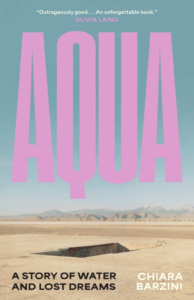
Aqua by Chiara Barzini is available via Unnamed Press.

Chiara Barzini
Chiara Barzini is an Italian author and screenwriter. Her work has appeared in Bomb, Noon, Harper’s, ZYZZYVA, Freeman's, Vogue, T Magazine, Vice, Rolling Stone, Interview Magazine, and others. She is the author of the story collection Sister Stop Breathing (Calamari Press, 2012) and the novel Things That Happened Before The Earthquake (Doubleday, 2017). She lives in Rome.