Words Between Worlds: Creative Writing in Sarajevo
Stacy Mattingly on Place, Literature, and the Wounds of the Recent Past
1.
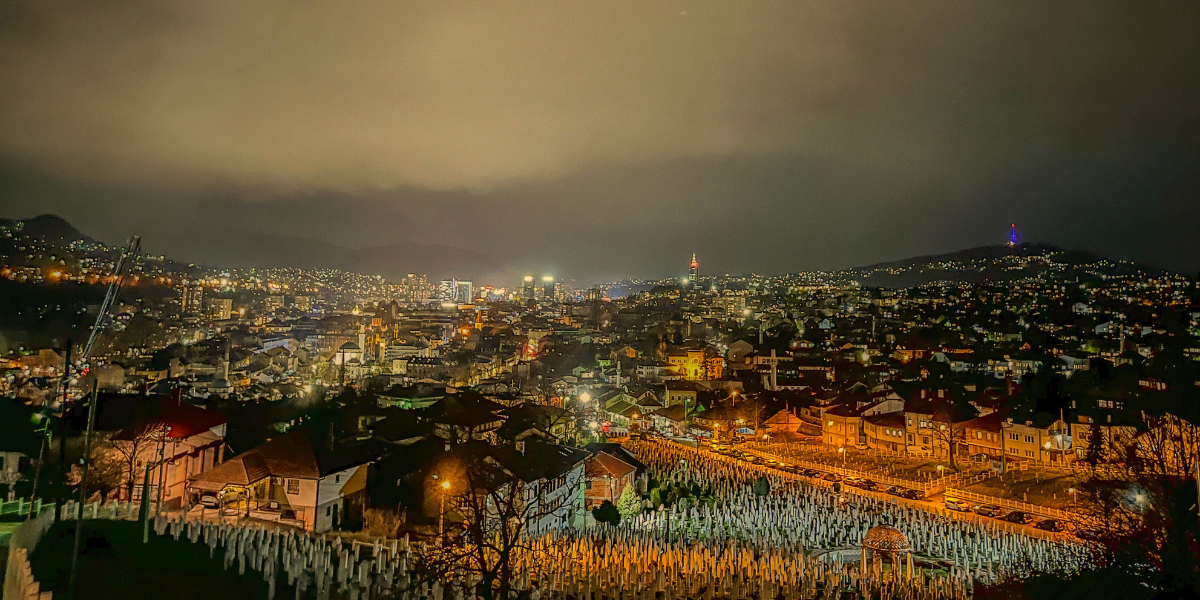
On the evening of 27 December, I couldn’t find a free taxi to take me from my apartment in Grbavica to Sarajevo center. I called several companies. Imate li nešto? Ne. Nothing. After nearly half an hour of trying, I started on foot in a panic. The workshop I’d led all semester was giving its public reading at the Museum of Literature and Performing Arts of Bosnia and Herzegovina. I would be late for my own event. Once I crossed the footbridge over the Miljacka River and approached the city’s main road from behind the National Museum, I saw the reason. A snarl of traffic the likes of which I’d never encountered here. Gužva. I called the taxi companies again. Not a chance, they said, so I started running. I knocked on the windows of a couple of trams along the way, but they were only going as far as Skenderija and were stuck besides. I ran on past the SCC mall and the cafés of Marin Dvor. Once I crossed the intersection at Skenderija and made it over to Obala Kulina bana, the road parallel to the river, I didn’t see a single car—traffic had been diverted. Fog, magla, draped the city. The silent road in its eerie murk. Šta je tu je, it is what it is, I told myself, and ran the rest of the way nearly to Baščaršija, dodging the few pedestrians and patches of ice, pressing through the magla, the dark, the strange quiet.
When I opened the heavy door of the gallery from the museum courtyard, I saw my students standing in huddles, practicing their texts. Of the nine in our workshop, not all had arrived, likely caught in the gužva. No one in the room seemed particularly bothered about time. I spread out a copy of our event poster on a table. The workshop had decided to call the reading Words between Worlds: Creative Prose in Progress. The poster included a photograph I’d taken in the garden of the National Museum: a section of a stećak, a medieval headstone, the likes of which can be found all over the country and the region. Visible on some stones are pictorial narratives and symbols—words between worlds. What we had been groping for in our work. What art aims for consciously or unconsciously—that boundary between mystery and what can be known, between the hidden and what can be seen.
2.
I’d arrived in the city in September thanks to a Fulbright U.S. Scholar award, an opportunity to build on many years of collaboration with writers in the country, this time at the University of Sarajevo’s Faculty of Philosophy. I joined the department of Comparative Literature and Information Science, planning to launch a transnational creative writing workshop for students and a public conversation series with writers, editors, and translators from both Bosnia and Herzegovina and the U.S.
My colleague and literary critic Andrea Lešić-Thomas, now president of PEN Bosnia-Herzegovina, sent a note once I’d got settled in my Grbavica apartment. She and her daughter, Lara, a Fine Arts Academy student, invited me for tea.
I entered their flat for that first visit in mid-September on an evening about to turn cold. The dominant feature in their home: two walls of floor-to-ceiling shelving lined with books that Lara had recently organized.
Andrea would publish a book of criticism in English by the time I finished my project in December, and we began an ongoing conversation about its premise—her argument that much contemporary Bosnian art and literature seems to circle in a loop of tropes about the 1990s war rather than explore fresh approaches to addressing the past and its trauma. She’d titled her book Constructions of Hope and Hopelessness: War and Traumatic Memories in Contemporary Bosnian-Herzegovinian Literature and Culture.
Andrea told me she located more hope in some work produced during the war than in much post-war literature and art. As an example she offered Nenad Veličković’s Konačari (Lodgers, translated by Celia Hawkesworth), a novel written during wartime and one Andrea remarks for its humor and complexity; she devotes a chapter to it in her book. When we met, she and Lara had just been to the National Theatre for the first performance of a stage adaptation, which she found darker than the novel, affirming her sense of the country’s culture in current times. The production also happened to star her mother, Kaća Dorić, an actress with a long career and now in her eighties. Andrea’s late father, Yugoslav literary critic Zdenko Lešić, cofounded PEN Bosnia-Herzegovina during the nearly four-year siege of the city.
I asked Andrea if she’d read the work of my friend Ismet Prcic, a writer originally from Bosnia and Herzegovina and now based in Los Angeles, who writes in English and uses wild, ranging humor in his experimental fiction to crack into war trauma and “transmute it,” as he says. I’d scheduled Ismet as an in-person guest in the public conversation series, and I told Andrea I would soon have his two novels in hand once a shipment of books arrived from the Boston area—a mini-library for the workshop that I would ultimately leave with the Faculty of Philosophy.
In the weeks following our meeting, I met my other close colleague, poet Adisa Bašić, for what became a periodic tea or coffee during the semester. Adisa would also publish a book by year’s end, a documentary novel called Knjiga o Almiru (A Book about Almir). Adisa’s novel, her first, delves into her brother-in-law’s life, his death during the war, and the complex silences, questions, and wounds that have shrouded his memory.
Adisa and I usually shared tea in her office amid the book towers on her desk. She told me about the complicated process of researching Knjiga o Almiru, the delicate experience of interviewing her husband’s family members and his brother’s friends in an effort to take a subtle instrument to a personal story of the war, trauma, grief, and aftermath. Our exchanges about the book extended to a drive to the airport to pick up literary translator Ellen Elias-Bursac, my first guest in the conversation series at the faculty. A translator of work from the region, former president of the American Literary Translators Association, and a longtime friend, Ellen happened to be at a residency in Zagreb and made the trip to Sarajevo. On the ride from the airport back to town, Adisa shared about her book project and told us a story.
A writer from elsewhere in the region, she said, had commented on how many buildings in the country still show evidence of wartime, how society should fix these damaged structures so that people are no longer visually reminded of the violence.
It’s not so easy to just clean things up, Adisa explained to Ellen and me. For example, the front door of her apartment building, a metal door, is marked with two shrapnel holes. She said her father had been on the other side of that door when the shrapnel from an artillery shell penetrated and that his leg had been injured. Now her parents are gone. Those holes remain in the building’s front door, evidence of her father, of their lives, a fixed memory.
I thought about the different ways Andrea and Adisa approached art and literature in relation to the shared collective trauma of the 1990s. If Andrea longed for literature that would venture away from realist accounts of the war and push into realms such as fantasy, science fiction, and other genres, “daring to look elsewhere” for healing, as she writes in her book, then Adisa’s investigation into her brother-in-law Almir’s life and death went right into the complicated territory of the war to carefully uncover what remained submerged and bring it out in the open—like the shrapnel holes in her door.
Our discussions prompted questions that threaded through my engagement with the writers in the workshop, the public conversations we hosted, presentations I gave, and my own creative projects: Why do we write what we write? Do we choose our material, do we consciously choose its form? Do these things choose us?
3.
The semester began in early October. The nine writers in our workshop were passionate, present, curious, rigorous, and, as a group, well-read across several languages. They would grow enormously during our months together. Aside from two of them, none had known each other beyond passing acquaintance before we began, a fact that became more startling to me over time as they formed a band of their own.
A regular scene: the writers standing in a ring outside the faculty in the evenings after workshop or an event, some smoking, debriefing, carrying on from where we’d stopped.
This was the real workshop meeting, I told them.
Meanwhile, I’d restarted my language lessons in Bosnian/Croatian/Serbian (BCS) with my teacher and friend Sandra Zlotrg. A PhD candidate in linguistics, Sandra directs a school in Dolac Malta, a twenty-five-minute walk from my apartment. I’d taken online classes with Udruženje za jezik i kulturu Lingvisti for years; this was my first visit to the office.
Zvuk je svijet, I often said to my friend Ismet. Sound is a world.
Sandra made us black coffee, imperative for my brain during language lessons, and we sat down with big sheets of white paper and pencils. Sandra wanted to guide us into grammar issues through conversation rather than use a textbook. In a country where many schools are segregated along ethnic lines, which textbook one chooses—even what one calls the language—can become a complicated, political decision, she explained.
Though I started our sessions with a B2 proficiency, I still had big gaps in my knowledge after years of coming and going. During our first meeting, I heard myself weave in one of my favorite phrases, mrkli mrak, pitch dark, which I often use metaphorically. Mrkli mrak is what obscures my path forward, it is where I must go to pull out what needs examining in my work—in my life.
You’re right, Sandra exclaimed. You can use mrkli mrak, but you can’t talk in detail about where you’re from. We’re going back to the beginning.
Over the months of these sessions, I heard myself using words I didn’t realize I knew, expanding my skills through interesting configurations and syntactical arrangements that simply came out when I opened my mouth. Like creative work, the process of gaining language is a walk through the pitch dark. We don’t fully know what’s in us, or what needs to emerge, until we move forward, and even then, our knowledge is partial.
During the workshop’s first meeting, we gathered around the long table in our ground-floor seminar room, Sala 8, and shared aspirations. While we would work in prose, several of the writers were poets. We’d planned for them to write in English, but I wanted them to feel free to use or include other languages—to write as they wished.
As an exercise, we did some freewriting to see where a simple prompt might lead, an entrance into the mrkli mrak, a way for them to stumble on clues to their most potent material. Through the fall, each writer would create two pieces of prose—fiction or nonfiction. A couple in our group were acolytes of horror, another took up comic detective fiction, some explored the surreal, others wrote voice-driven realist pieces. The work covered illness, poverty, mental health, family relationships, among other subjects. One story examined characters living through wartime and aftermath. We discussed the texts, read a range of literature for insight, and considered how the writers might develop their unique visions. We populated Google drive with multitudinous folders of resources and revisions. I caught playful flack for the proliferation of folders.
Once the shipment of books arrived from my local Boston-area bookstore, Brookline Booksmith, which partnered with me to curate and send the collection, the writers made weekly requests, and I carted volumes by the armload along Vilsonovo, the river walk, to the faculty. In Sala 8, the writers would slide the books they’d finished across the long table and offer impressions. After workshop, they’d go outside to mingle and smoke, and I would carry the books they’d read back down Vilsonovo in the dark, the Miljacka River rushing along beside me, slowing my nervous system the moment I entered that soundscape.
Zvuk je svijet, I often said to my friend Ismet. Sound is a world.
4.
Ellen Elias-Bursac launched the conversation series our first week. Adisa and I got approval for the poster I designed, and we taped up copies around the faculty. So many people came to hear Ellen—students and professors from the MA in translation, the workshop writers, translators working outside the faculty, and others—that we had to change rooms.
Expectation pulsed. I saw the faces of people I knew from different periods of my life in the city—there was Sandra, my language teacher. Mirza, the friend and translator I’d collaborated with for ten-plus years. Nihad, a novelist I’d known as long. Daniela and Selma, members of my original 2012 workshop. Lara, Andrea’s daughter, who would become our series photographer. And still others. I felt a surge of energy as I looked out at these friends, a sense of life-strands converging.
After Andrea introduced us, Ellen shared insights that had governed her work translating some of the most significant writers from the region—Dubravka Ugrešić, David Albahari, Karim Zaimović, among many others. She introduced a quote from translator Susan Bernofsky’s essay “Translation and the Art of Revision” that went on to guide my creative thinking across months and borders:
“Every sentence is a journey that begins with a particular phrase or image and takes the reader somewhere. So what does the itinerary of a particular sentence look like, and where does it lead?”
While Bernofsky applies this metaphor to translation, it struck me as true for generative writing. We start with language, the phrase, the sentence, and we follow it into the labyrinth of creative possibility, much as I opened my mouth to speak BCS, following the thread of words.
One of our workshop readings was Stuart Dybek’s “Pet Milk,” a short story that tracks with an adult narrator’s associations from the evaporated milk in his coffee, back into childhood and young adulthood, a line of memory that carries him, and the reader, to a moment of mystery and longing, a feeling of being both alive and aware of life’s passing.
In thinking about the story through Bernofsky’s lens, I found myself asking, What is the itinerary of a particular storyline, image, memory, or phrase, and how do we follow it out to the farthest reaches of meaning?
Back in the workshop, we tried to get closer to our material by moving across language borders. On Zoom we hosted bilingual poet Selma Asotić, another longtime friend, who grew up in Sarajevo and attended the faculty before moving to the U.S. to do a poetry MFA at Boston University. In 2022, she published her award-winning debut collection, Reci Vatra, in BCS; Archipelago Books released the English version, Say Fire, this fall. Selma joined us from Massachusetts.
One workshop writer, Dženeta, also a poet, drew attention to Selma’s piece in English called “My Father’s Skin Looks Like the Surface of the Moon” and posed a series of questions about the language choices in both versions. Selma took us through BCS and English passages, explaining specific decisions, changes she made between versions, and her work across languages—translating, rewriting—as a way to solve issues in both of the poems.
Here was one writer pushing the boundaries of language and form, discovering new modes of expression, and doing so in order to unearth wartime trauma and its aftermath, break silences, reframe his own narratives through fiction, heal himself, save his life, and open that possibility for others.
Later we decided to try self-translation as an exercise to see if it might unlock insights into our own work. Almasa noted that a passage from her horror story, originally written in English, became more precise in BCS, and she realized she needed to address word choice in that passage. Luka worked on a BCS poem and explained in his post to our Google folder that translating the piece into English prompted him to return to his word choices in the original, what he later described in an email as a process of “discovering shades of meaning between synonyms or directly translated words.”
I translated a passage from a novel-in-progress and found my BCS sentences—given my proficiency level—more direct, so I thought I would play with that in the English, cutting away my usual circuitous routes.
Once he’d arrived in Sarajevo, Ismet Prcic, who writes in an English that at times includes swaths of BCS, visited us for a workshop meeting and introduced another kind of self-translation—in his case, carrying over into English a punk idiom from the streets of 1990s Tuzla, his hometown. When Ismet and I later co-led workshops at the University of Tuzla’s Faculty of Humanities and Social Sciences, a colleague of his generation vouched for his success in evoking that Tuzla punk-culture sound in his work.
Sound is a world.
Still other writers whose texts hold multiple languages joined our conversation series. Jonathan Escoffery, who Zoomed in from Oakland, discussed using Jamaican patois in his Booker Prize-shortlisted If I Survive You, a linked story collection. Bosnian-American novelist Aleksandar Hemon talked with us on Zoom about the accumulation of languages in his self-described “refugee epic,” The World and All That It Holds. We considered in several of these conversations the ways plurilingual writing, a term I’d learned from a Fulbright colleague in Spain, could help reflect consciousness more authentically, especially, as came up in Hemon’s session, the lived experience of migration and displacement.
5.
Ismet titled his public conversation “Writing to Save Our Lives,” what became the first in our transnational tour as a duo—we held our last gig at Brookline Booksmith in the Boston area. At the faculty in Sarajevo, we spoke in a room packed to the gills with students, writers, scholars, and others.
Ismet presented his new book, Unspeakable Home, a novel addressed to comedian Bill Burr in letters that serve as connective tissue between the chapters. A work of experimental autofiction, the book explores the trauma of wartime and an aftermath in the U.S. of alcoholism and divorce. Ismet gets at his material using different personas and styles, fracturing time and the self.
He described his creative process as a means to uncover layers of trauma, to dig out what’s buried, to write from “inside the wound” in order to give readers an experience of what it felt like. In his early days as a writer, he said, he’d corresponded with Aleksandar Hemon, who urged him to find a unique language and form for his material. Having escaped the war with a theater troupe and migrated to California at eighteen (see his first autofictional novel, Shards), Ismet writes in an English he learned partly through comedy, movies, TV, and idioms. His original, multi-toned voice explodes on the page.
I felt Ismet’s work could hold within it what both Andrea and Adisa sought in the country’s literature and art. Here was one writer pushing the boundaries of language and form, discovering new modes of expression, and doing so in order to unearth wartime trauma and its aftermath, break silences, reframe his own narratives through fiction, heal himself, save his life, and open that possibility for others.
When I suggested we may need to end the session for the evening due to time, Adisa protested: “Why?” The room remained rapt.
The same questions hummed along like a current during this period: Do we choose what and how we write, does our material choose us?
Several weeks later we hosted Bosnian poet and novelist Faruk Šehić, who explained he hadn’t wanted to write about the war in his genre-bending novel, Cimetna pisma, dijamantna stvorenja (Cinnamon Letters, Diamond Creatures), only to have it show up as the voice speaking in the first chapter. During our workshop debrief about his talk—as I recorded in one of our Google docs—Iman remembered Faruk’s saying, It’s silly to try to escape yourself: form finds you.
Once we arrived at Aleksandar Hemon’s conversation, which we’d titled, thanks to Ismet, “Finding Language, Finding Form,” workshop writer Ajla H. posed a question about the role of intention in creating literature.
A lot is made of inspiration, she noted, but Hemon had spoken of his obsessions, of being a maximalist, of all the material he sought to explore and include in his most recent novel, The World and All That It Holds—a title, I remarked, that could refer to his protagonist’s inner world as much as to the book’s vast outer world with its cultures, languages, characters, stories, and borders.
Could he say more about agency in art-making? Ajla H. wanted to know.
Hemon attempted to break down the complex chemistry that drives the creative process, and in our workshop debrief, as I recorded, Ajla H. said he’d articulated a balance between inspiration and intention.
Perhaps this is where we arrived in considering how we discover our material, our work’s language and form. We seek. We grope. We follow the thread until we find. We find insofar as we can know. But also, we are found. Form overtakes us. The story emerges. This is the mystery.
6.
At the Museum of Literature and Performing Arts, a capsule of repose from the cold city and the gužva, I sat in the front row, mesmerized by the workshop writers’ energy as they read publicly from their works-in-progress. I could hear their revisions, how their art and thinking had evolved, even as they had done during our time together.
Our work is in progress. We are in progress.
Words I’d spoken to an audience during my own presentation at the faculty.
In the alley afterward, we debriefed about the experience, the changes the writers had made to their texts, the future. Most would go on to finish coursework in January and take February exams. Iman had said she might learn Swedish over the winter. I couldn’t bear to leave them. Several of us lingered on the corner in the wet dark, talking. Some smoking. The equivalent of the after-workshop real workshop in front of the faculty. Finally, they turned to leave, our last leave-taking, as I would fly back to Boston soon.
I walked the opposite way and met Andrea, Lara, and another friend at Hotel Europe for our own debrief. We are going to Europe, Andrea had announced wryly when they left the museum, and I found them in the hotel’s elegant cafe. As Lara organized a batch of images from the event to send me on WhatsApp, Andrea said she had felt delighted listening to the writers, some of whom were her students in comparative literature. None of the pieces read aloud had taken on the war, she noticed, and she’d begun to think about what PEN could offer young writers in the way of mentorship. I sipped my coffee in the adrenaline cloud. I reread a message from Adisa about being stuck in the traffic—also a goodbye as we wouldn’t have a chance to meet again before I left town. Once we’d finished our beverages, we set out into the Sarajevo murk, but rather than part ways—I couldn’t bear that, either—we headed toward the Miljacka River, continuing our conversation, and crossed to a sushi restaurant on the other side.
___________________________________
Some of the workshop writers contributed excerpts adapted from the texts they read at the Museum of Literature and Performing Arts of Bosnia and Herzegovina.
Dženeta Zaklan, “Nice Girls and Other Tragedies”
I keep my tongue pressed to the roof of my mouth as I listen to my mother’s friend talk about how violin classes are paying off for the doe. She might get offered a scholarship in France. She might join the local orchestra as the youngest member. She might give me her old phone, once she gets a brand new one. Soon enough, she will learn what they all do—that craving to feel necessary.
Almasa Muslim, “How Valerie Died Twice before Her Death”
The droplets traced slow, deliberate paths down her skin, slipping into the hollow of her neck like tiny specters. The grotesque charade didn’t seem to belong to this world. Nothing did. It was as though she were a dream made into flesh—something broken, something wrong.
Luka Bošković, “Salvatore”
I never knew what he wanted from me. Was it comfort? Was it acknowledgment of his fleeting existence? He always seemed to be like someone pushed to the background, a memory nobody wants to see, but a memory that always lingers, attracting those curious to look behind the veil of this world.
Dunja Dervišbegović, “On Identity”
English skies are dreary—banal, I’m aware—but the greens are more vibrant than I knew to expect. This place has existed within me for so long that for years it has enjoyed an undefinable, unreachable, orb-like status, like a deity or a pen-pal. I guess one has to experience the eternal drizzle to internalize its existence.
Ajla Velagić, “The Collision of Skin and Soil”
She had been poked and prodded relentlessly, to no avail. They had torn through her flesh and stitched it back up as if her skin were nothing more than cheap fabric, and yet her heart continued to slow. She had downed putrid concoctions and swallowed pills the size of cockroaches and lathered her decaying skin with rare ointments imported from faraway lands. It was of no use, for the serpent prevailed.
Iman Delibašić, “The Waning”
A dozen little fires danced around the room, their light reflected in my father’s eyes. The candles looked like peaks of high mountains, their melting wax imitated persistent climbers. If you stare long enough into the blazing heart of a fire, you can see a choir of flies swirling around its warmth.
Ajla Hasanbašić, “Justin Case in the Dearly Departed”
On this particular fine morning, which smiled sunnily at me while simultaneously pinching at my cheeks with vengeful freshness like some good-natured old crone, I found myself delivering the newspapers to the quaint but unmistakably rich Cranberry home on Brock Street. I had done this errand in place of my good, poor cousin, who had at the time come down with a nasty case of flu, and an even nastier case of a tendency to blackmail.
Stacy Mattingly
Stacy Mattingly is a writer living in the Boston area. She was a 2024-25 Fulbright U.S. Scholar to Bosnia and Herzegovina, where she has collaborated with writers for more than a decade. She teaches at Boston University and Berklee College of Music and has led workshops for the Elizabeth Kostova Foundation and the International Writing Program. Her recently completed novel manuscript is set in present-day Sarajevo.