
Why We All Hate the Word
“Moist” So Much
Valerie Fridland on the History of Our Least Favorite Word
Nineteenth-century philologists are far from the only ones who have spent time pondering the great mysteries that drive our speech. Everyday folks think about language-related questions all the time. They might not be tackling the big ones like its ancient beginnings or how Latin “p”s relate to English “f”s, but a lot of people would be satisfied resolving more minor linguistic concerns, like how to stop the word moist from making our ears bleed. In the public’s interest, I feel compelled to delve a bit deeper into this most pressing question.
If you are not among the estimated 20 percent of the population that despises hearing the world moist, consider yourself lucky. Moist aversion is so intense it often ranks first in various surveys of words that should be excised from the English language. Jokes about moist—and the repulsion it inspires—have become a comedy staple. Tonight Show host Jimmy Fallon, for one, declared it the worst word in the English language. The popular Amazon Prime show The Marvelous Mrs. Maisel jokingly listed it as one of the words mental asylum visitors were prohibited to say in front of a mentally fragile patient. And ad execs representing Dove’s Deep Moisture Body Wash leaned into some “moist” humor in a commercial with the new marketing tagline “So moist!” making a hilariously big fail in a faux focus group.
Still, there are those who rally around moist’s softer side (like making baked goods delicious) and they might hold out hope that the right kind of publicity could reframe its image. But, as pointed out on Epicurious, the go-to website for foodies, the word elicits substantial reader backlash even when employed to describe chicken and cakes. The real outstanding linguistic mystery is why we hate the word moist so much. A
fter all, if linguists have been able to explain the first sounds we utter and the complexities of how they change over time, why can’t we explain why we have such a visceral reaction to the sound of a simple little word? It turns out we can—and it has a surprising connection to a theory on the origins of language our German friend Max Müller came up with well over a century ago.
Moist didn’t always inhabit such a precarious position in our psyche. The word certainly had an innocent enough beginning. It was during the medieval period when our modern moist was borrowed into English by the Anglo-Normans from Middle French moiste, which, according to the Oxford English Dictionary, had the mean-ing of “slightly wet or damp.” Used in fairly neutral or even positive contexts, it was regularly called upon to describe something fresh, as opposed to stale. This might explain why Chaucer was much fonder of the word than we are today, using it several times to describe a hearty drink, as in “A draghte of moyste and corny ale” from “The Pardoner’s Tale.” And if good beer and Chaucer are involved, surely it can’t be all bad.
Still, in what might come as a surprise to most moist haters out there, it’s not until the 1950s that an association with women’s vaginas and sexual arousal comes into play.
Yet even before it was a pariah at dinner parties, moist was poised for problems because it became more and more intertwined with our bodily functions. In its least offensive early physical references, it was sometimes used to describe eyes filling with tears, as by Shakespeare in Henry IV when he writes, “Haue you not a moist eie.” More often, the word was used in scientific and medical writings in reference to other bodily fluids, i.e., to describe blood as “hoot and moyst” in a text from 1475, or to discuss the body’s production of wet by-products like pus.
This is, of course, where the ick factor starts to come in, with medical descriptions like “Scabies, the itch: ’Tis of two sorts, moist and dry,” or to elucidate the properties of “moist gangrene.” Still, in what might come as a surprise to most moist haters out there, it’s not until the 1950s that an association with women’s vaginas and sexual arousal comes into play. And, of course, once it started to appear in descriptions of panties, it was a bridge too far.
In the world of language, there are certain trends in terms of words that frequently co-occur in phrases or sentences together, some-thing called collocation. This can be fun and common pairings like cake and ice cream, salt and pepper, or good and evil (known in the linguistic biz as frozen binomials because they are rarely reversed in the order they appear). Even more subtle examples are nouns like, say, immigrant, and the adjectives that we often use to describe them (e.g., illegal) that may become linked—to negative or positive effect—in our minds. As a result, we can become conditioned to react a certain way to that word more generally based on its memorable collocating word friends. When it comes to words that seem like they should be neutral at worst, our disgust toward them might stem from how we have been trained to associate that word with something we don’t like (like gangrene and underwear) rather than something we do (like beer).
This leads us to the question of how sound symbolism might help explain the heebie-jeebies we get around our not-too-popular friend, moist.
Science backs up this idea that our feelings about moist stem from a place of semantic uneasiness. In a series of experiments trying to get at what, exactly, characterized the disdain for moist, psychologist Paul Thibodeau discovered that people found moist more aversive when it was preceded by sexual words (like the f-word) and less aversive after food-related words (e.g., chicken). Association with an unrelated positive word (like paradise) or negative word (like murderer) also seemed to influence how people felt about moist, rating it more unpleasant when following a positive word but less so when following a word associated with something negative, likely due to being contrasted with those words’ positive or negative senses. The researchers also found that being young, female, and well educated increased the odds that someone would be moist averse, as did being disgusted more generally by bodily functions.
Moist may be the seminal example, but there are certainly other words that people get grossed out by. Many words that have to do with our bodies or the things emitted by them, e.g., anus, vomit, pus, or phlegm, don’t get a lot of love. Indeed, in the same study, the researchers found that the more related to bodily functions a word was—or the more similar in meaning to moist a word was (say, wet or damp)—the more likely it also was rated high on aversive scales by the same people who found moist unpleasant.
Our problem, it appears, is really in how such words relate to cultural beliefs and social taboos about body parts and their associated by-products. These words then take on guilt by association because of the things we have been socialized to find unpleasant, uncomfortable, or disgusting. For moist at least, a long history as a word associated with bodily discharge coupled with its more recent use as a sexualized word positioned it as one that makes young modern women squirm more than men.
While moist’s related meanings certainly might drive our dislike, Max Müller’s ding-dong theory, known now as sound symbolism, provides an alternative, suggesting it instead (or also) might have something to do with the specific sounds that are in the word. Maybe just hearing the sounds that make up “m-o-i-s-t” annoys us, sort of like phonetic nails on a chalkboard.
As we already know, sound symbolism posits that the relationship between sound and meaning is not always arbitrary. Instead, sounds themselves can help convey meaning, an idea so old we find it discussed in Greek antiquity (as naturalism in Plato’s Cratylus) and one that we all embrace when we use words like meow, pitter-patter, or thump. Unlike onomatopoeia, where words mimic the sound of things they describe, the idea more broadly is that iso-lated speech sounds sometimes carry inherent meaning because of the way they are articulated (for instance, with rounded lips as in English “oo”) or owing to other properties like their pitch or length (e.g., saying “soooo loooong” with drawn-out vowels when asked how long one’s been waiting). The essence is that the sound resembles a concept in some way.
This leads us to the question of how sound symbolism might help explain the heebie-jeebies we get around our not-too-popular friend, moist. To answer this, we need to consider the vowels and consonants that make up that word.
Vowel sounds are made by the position of the tongue in either the front of the mouth (as in words like he or hay) or the back of the mouth (as in boat, boot, or, as it happens, moist). A substantial amount of sound-symbolism research suggests that front vowels appear more often in words that evoke concepts like happy or small, such as glee or teensy, while back vowels evoke sadness or largeness (e.g., mope, humongous). Since the main sound in the “oy” vowel in the word moist is a back vowel, we might be predisposed to have it conjure up something sad or less pleasant.
And the reason we might have developed this happy versus sad vowel association in the first place? It has been hypothesized that back vowels use the same muscle that we use to frown (the orbicularis oris muscle), while front vowels contract the opposite muscle (zygomaticus major), the one involved in smiling, and, as a result, we embody these emotions. Not surprisingly, this smile-like countenance is the reason we say cheese rather than moist when we pose for a picture, especially if a look of disgust was not our hoped-for photo vibe.
So, in the end, it looks like moist has been the victim of both its phonemic constitution and its robust use to describe disease states and bodily fluids over several centuries.
Another sound-meaning correspondence frequently noted is that certain sounds appear more often in basic word categories, like those associated with body parts, even across unrelated languages. For instance, nasal sounds (linguist speak for sounds like “m” and “n” made with air flow through the nose) tend to appear in words for nose more often than other consonants across languages—e.g., nose in English, nez in French, and hana in Japanese. Since both “m” and “n” definitionally involve the nose in how they are made, it’s easy to see how a sound-concept mapping might develop from this shared proboscis property.
Likewise, when babies nurse at a mother’s breast, they tend to make bilabial (two-lipped) smacking sounds, a sound-symbolic association that seems to explain the preponderance of bilabial consonants like “m” or “b” in words for a breast and its secretions around the world. In English, we have the primordial mama, of course, but also mammary, mammals, and milk, as well as breast, bosom, and boob, which all start with a similarly bilabial “b.”
The gist here being that these types of recurring sound-body correlations may spur or reinforce the associations of moist with bodily functions that have developed over time—potentially increasing the yuck factor. This would also explain why other words like hoist or joist that sound similar to moist don’t make us cringe to the same extent. They may involve back vowels, but not paired with the nasal consonant—or the culturally acquired semantic baggage—that makes anyone saying moist such a tremendous hit at parties.
As a caveat, though, it is important to note that sound symbol-ism is generally a statistical tendency across languages, rather than something speakers of a particular language would consciously no-tice. Sound symbolic tendencies are also not necessarily consistent within a single language’s vocabulary (and, in fact, English is not as iconic a language as, say, Japanese). Even still, the rising tide of research recently devoted to the topic does find it is turning out to be, as my teen would say, “lowkey a thing.”
So, in the end, it looks like moist has been the victim of both its phonemic constitution and its robust use to describe disease states and bodily fluids over several centuries. Given this, the bigger question is why the word hasn’t been shunned by the remaining 80 percent of us.
Probably because a lot of both sound symbolism and socio-semantic training takes place when we are young and impression-able. Sound symbolism has been posited as a tool in language and word acquisition for children, who start with more of a blank slate. Sound symbolic connections might help kids or non-native speakers “guess” at meaning in ways that are not completely arbitrary, but the more exposure one has to additional semantic assists (like a word’s contexts of use, or other known words that it co-occurs with) the more we might shift toward using those clues instead to fine-tune our understanding.
It also seems there is some variation across individuals in levels of squeamishness, since the more we have developed an aversion to bodily functions, the more moist use disturbs us. Those of us less compelled to hate the word might simply have been exposed to moist in more positive contexts or heard it used more often to describe cake rather than pus. The benefits, one might hazard, of having a good cook versus a medical professional for a parent or of having gone to a high school where the dampness of under-garments was not the stuff of locker room banter.
But, for the other 20 percent who cringe at its every mention, learning to reimagine their relationship with moist might be a big ask, though People magazine was on to something when they created a “sexy men say-ing ‘moist’” video. Can picturing a shirtless Ryan Reynolds sultrily saying “moist” in front of a luscious piece of cake turn things around? I, for one, am certainly willing to give it a try.
__________________________________
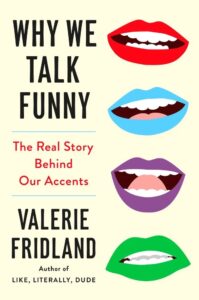
From Why We Talk Funny by Valerie Fridland, published by Viking Books, an imprint of Penguin Publishing Group, a division of Penguin Random House, LLC. Copyright © 2026 by Valerie Fridland.

Valerie Fridland
Valerie Fridland is a professor of linguistics in the English Department at the University of Nevada, Reno. She writes a popular language blog on Psychology Today called “Language in the Wild,” and is also a professor for The Great Courses series.