Alone on a Mountain in Wyoming Far From Home and Looking for Answers
Alexandra Oliva Goes the Extra Mile to Research the Science in Her Novel, The Radiant Dark
I’m standing in a rocky clearing by an observatory 9600 feet above sea level. My chest feels tight as my heart pumps against the elevation, though some of this sensation may simply be awe. I’m surrounded by rippling mountains, and I’ve slipped away from my group so it’s just me and the wind out here watching specks of starlight peek through the twilit sky.
Between deafening wind gusts, the silence is so thick the crunches of my footsteps feel like they’re echoing. I live in the suburbs of Seattle, where there is always a passing car, a whirring leaf blower, a lawnmower, a barking dog or a plane passing overhead. I also have a four-year-old son at home. It feels as though I haven’t experienced a silence this complete in years.
Laramie, Wyoming is a speckling of lights in one direction, but if I turn my back to the small city, I can pretend man-made lights don’t exist, cars don’t exist, that I’m exploring a world on which mankind has yet to make a mark.
With my next crunching step, I startle a shadow. There is just enough light for me to see a tiny puff of white move in a zigzag pattern. A rabbit’s tail. I was wrong to think I was alone out here. Of course I’m not alone; on Earth life is everywhere. Microbes thrive in the volcanic vents of the ocean floor. I shouldn’t be surprised to see a rabbit at elevation.
Whatever other eyes are watching me, I’m glad they’re not human. I don’t know how long I’ll have this silence to myself. I’m atop Jelm Mountain as part of the week-long Launch Pad Astronomy Workshop, in which professional astronomers help writers and other creative folk learn the ropes of their field. The astronomers’ goal is to get more accurate science into popular culture. My goal is to make the science in the novel I’m working on—a family saga that spans fifty years as Earth exchanges messages with a faraway alien civilization—as accurate as I can.
With every breath I take, it feels as though there’s another star in the sky, not popping into existence, but being revealed.
I had awoken in the early hours of the workshop’s first morning with the worst case of pink eye of my life. (A parting gift from my son, I believe.) It was around 3am. A 39-year-old woman using a dorm room sink, I soaked my eyes with a warm washcloth until I could see, then googled “Laramie WY Urgent Care.” I didn’t want my fellow writers to see my eyes before I was diagnosed and got my eye drops. Classes started at ten. The local hospital’s urgent care opened at eight and was about a half-hour walk away. I could make it.
A few hours later, after some fitful sleep, both eyes monstrously red and stinging, I tugged on the warmest clothing I’d brought and set out through a sea of whipping, wet snowflakes. Despite my embarrassment, I couldn’t help but laugh as I walked. I was a grown woman with pink eye, far from home, hustling through a snowstorm she was ill-dressed for so she could get medication and not be late for astronomy class.
By the time I left urgent care, prescription in hand, the snow had stopped. There was no accumulation. If I’d slept to a decent hour, I might never have known it snowed at all.
The nearest pharmacy was part of a small grocery store, and it didn’t open until nine. The urgent care had been so efficient I had time to kill. I got coffee and a banana, some extra hand sanitizer. Once the pharmacy’s metal shutter slid open, it took about fifteen minutes for my medication to make it into my hand, which left me just enough time to hustle back to campus, drip some antibiotics into my demon eyes, and make it to class.
Though not as high in elevation as the observatory, Laramie was still more than 7,000 feet higher than my body was used to. As I hurried back to campus, I began to feel it. Light-headedness, shortness of breath. Instead of taking it easy my first morning at altitude, I’d hustled nearly four miles before breakfast. You won’t believe the morning I just had, I joked to the other writers as we gathered in a hall and waited for someone to unlock our classroom. I emphasized the snow, using humor to preempt the disgust I feared. Everyone was kind, understanding.
One of the workshop organizers later asked why I didn’t call them for a ride to the hospital, and I didn’t have a good answer. I said something about assuming people would still be asleep, which was true, but really it was more about a deep-rooted need to take care of it on my own. Because if I could take care of it on my own, that meant it wasn’t a big deal. It wasn’t a rational thing; asking for help has always been something I’ve struggled with.
Now, three days later, atop Jelm Mountain with The Wyoming Infared Observatory (WIRO) at my back, my eyes are feeling better. The lingering pink tint could be allergies or a hangover, and you can’t see the color of my eyes in the growing dark atop this mountain anyway.
With every breath I take, it feels as though there’s another star in the sky, not popping into existence, but being revealed. Starlight is always there, we just can’t see it during the day because our sun—just another a star, special only because it’s ours—drowns it out. Now that the planet beneath my feet has rotated me away from our star, I can perceive these others.
A deep, loud grinding sound startles me; I whip around to see the great doors of the observatory’s dome closing. A massive thunk sputters through the dark and I’m grinning at my startled, beating heart.
For the first time in my life, I’ve identified the North Star without help.
It’s an emotional thing, being here. I want so badly to get this the book right. And while I am so grateful to be a part of this workshop, there is also a sense of guilt about being away from my son, about enjoying being away from him. No one else in the workshop has young children. Earlier, people were showing each other pictures of their pets. When someone politely asked to see my kid, I made sure to choose a photo that also included my dog. I remember how I felt before giving birth, how little I cared about other people’s babies. It’s a wide divide I’ve crossed in recent years, and often an isolating one.
I turn away from the observatory, toward the west, where the faintest remnant of sunset still clings, and find the Big Dipper, one of the easiest constellations. I learned a trick two nights ago, and I want to try it. I ball up my left hand, then extend my thumb and pinky fingers and raise my arm to the sky, lining up my hand with the outer edge of the Big Dipper’s bowl. And there, at the tip of my thumb, it is: Polaris.
For the first time in my life, I’ve identified the North Star without help.
Such a simple, powerful thing.
It’s cold this high up, and the wind is cutting through my autumn-weight jacket. Earth is rotating me farther and farther from our star’s direct light, and without that light’s heat I’m beginning to shiver. I need to go inside and warm up before everyone else comes outside for our group stargazing event.
But not yet. I’m greedy for another few minutes of this gorgeous aloneness. No chitchat in my ear. No preschooler suctioned to my side. No dog barking at the door. I huddle into my own embrace, thinking about how much I’ve learned, and about how much I still don’t know. How much I will likely never know.
In about twelve hours, our final morning in the classroom, we’ll start learning the outlines of cosmology. About how the universe has no center; how we can estimate its age, but no matter what direction we look in, the expansion and age of the universe is the same. The Big Bang marks the beginning of time as we know it, but cannot be pinned to a physical location. The universe is expanding from everywhere, toward everywhere, all at once. We can date the Big Bang, but we cannot place it. As far as we can tell it cannot be placed.
As our instructor that morning will put it: If you’re confused, that means you’re starting to get it.
No one knows how this is possible. At least not yet.
Yet will soon seem to me the defining word of this experience. Knowledge in this field is increasingly rapidly; ideas that were wacky theories when I was a kid are now fact. Spacetime is a provable thing. A network of radio telescopes that by working together essentially form a telescope the size of Earth took an image of the photon ring around a massive black hole for the first time in 2019, and the black hole at the center of our own galaxy was confirmed by the James Webb Space Telescope just days before this workshop started in 2022. I remember seeing headlines about these events and thinking that I should be excited, but clicking through to articles and not understanding enough to actually feel that way. But now my mind is blown,
Not long after I identify Polaris, the observatory dome behind me moves again. The sound is a deep, fascinating churn—they’re aiming the hatch. The astronomy students working inside took spectrographs of eight quasars last night, and our shared instructor is hoping they’ll get more tonight. The real work of modern-day astronomy is starting. That isn’t my field. My field is stories. Ideas. Contradictions and relationships. Fiction. But one of the characters I’m working on—this will be her field. And I’m beginning to feel like I might actually be able to write her the way I want to.
For the final few minutes before the cold drives me inside, I continue to avoid looking down at the lights of civilization. Instead, I look up at far, far older lights. Lights I’m just starting to understand, to appreciate for more than their beauty. Photons from tens, hundreds, thousands of years ago collide with my eyes. History that we can see.
By the end of the workshop, I’ll have taken eighty-two pages of handwritten notes. I’ll have learned the answers to very specific questions that I brought with me, details I couldn’t figure out on my own but wanted to nail for my story. I’ll also learn things I hadn’t expected, including the basics of our sun’s solar cycle, which will become integral to a fringe belief system I’m writing into my book’s world, and what it’s like to directly observe an element’s spectrum through a spectrometer. (The answer: really, really cool.)
I could not have written my novel The Radiant Dark without this trip, this experience. And yet I remain, firmly, not a scientist. As hard as I worked, as many questions as I asked, I know I probably still got something wrong. This haunts me more than I know it should.
But as I prepare for this book to be released into the world, I’d like to put aside that worry, to take a moment to remember the awe I felt atop Jelm Mountain. And to hope that—beyond the science, the facts and calculations—some small fraction of that sense of awe and wonder also made it into the book. And that it’s all tied together with the messy, fraught and sometimes ridiculous experience of being human. Not to mention the joy. How all these things come together to create experiences, memories. A full and varied life, the details of which one can never fully predict.
Like the experience of trudging through a snowstorm with pink eye, and, days later, standing atop a mountain and using those same eyes to absorb the light of so many stars.
_______________________________

The Radiant Dark, by Alexandra Oliva, is available now from Zando.
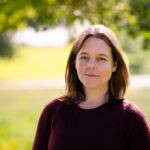
Alexandra Oliva
Alexandra Oliva is the author of USA Today bestseller The Radiant Dark, Forget Me Not, and The Last One, which was selected as a Best Book of 2016 by The Seattle Times and was translated into twenty-five languages. Ali grew up in a tiny town in New York's Adirondack Mountains and received her BA from Yale University and her MFA from The New School. She now lives in the Pacific Northwest with her family.