Why So Many Women Are Writing About Bears
Trina Moyles on Challenging a Canon Long Dominated by Men
As a daughter of a wildlife biologist growing up in the Canadian wilderness, I’ve been fascinated with bears since I was a child. When I was only five years old, my father brought home an orphaned cub for a night before he brought it to a zoo. I grew up reading the canon of bear literature the same way a black bear, or grizzly bear, gorges on berries before denning up for the winter. That nearly all of my favorite bear books were written by male authors was something I never questioned. I unconsciously accepted that only men wrote about bears. Women seemed more apt to write about less threatening species, including weasels (take Annie Dillard’s “Living Like Weasels”) and bighorn sheep (Ellen Meloy’s Eating Stone: Imagination and the Loss of the Wild) and goshawks (Helen Macdonald’s H is for Hawk).
In my adolescence, I remember pulling a hard bound copy of Andy Russell’s Grizzly Country, published in 1967, off our family’s bookshelf, mesmerized by the author’s close-range encounters with this mythical predator. Bear Attacks: Their Causes and Avoidances by Stephen Herrero was another cult classic, published in 1985, the same year I was born. There are passages describing specific bear attacks—images of scalped heads and disembowelment—that haunt me to this day. But it was one of the first books to make a deliberate connection between unmanaged food sources and problematic bears, and for that reason, it remains ‘The Bible of All Bear Books’ today.
And who could forget Barry Lopez’s powerful, introspective chapter about the polar bear—“a creature of arctic edges”—in Arctic Dreams, released in 1986. “To encounter the bear, to meet it with your whole life, was to grapple with something personal,” Lopez writes. His writing tunnels into the psyche of polar bears and Inuit hunters who understand what it means to follow in their dinner-plate-sized tracks.
I loved these books and they remain on my shelves today. But where were the voices of women?
In that same vein, Doug Peacock penned Grizzly Years: In Search of the American Wilderness, a lyrical memoir about his experiences observing the cyclical nature of grizzly bears, while healing from the trauma of fighting in the Vietnam War. “I found it easier to talk to bears than priests,” Peacock wrote.
In 2002, Charlie Russell—the son of Andy Russell—released Grizzly Heart: Living Without Fear Among the Brown Bears of Kamchatka, detailing the years he spent rehabilitating orphaned grizzly bear cubs into the wild. An unforgettable image from the book’s prologue: Russell’s arm delicately, intentionally, cradled in the jaw of a female grizzly bear on Canada’s northwestern coast. It was just one of the many ways Russell tested the boundaries of the human-bear relationship.
The 2000s brought Nick Jans’ The Grizzly Maze, which painted a layered, nuanced portrait of Timothy Treadwell, a man who lived alongside coastal brown bears in Katmai Alaska for thirteen summers before being mauled by a bear in 2003. Treadwell of course, was immortalized as “The Grizzly Man” in Werner Herzog’s award-winning documentary of the same name.
I could keep going, but you get the point.
I loved these books and they remain on my shelves today.
But where were the voices of women?
Maybe there’s an exception to the rule: Marian Engel’s novel Bear, published in 1976, which won Canada’s prestigious Governor General’s Award for Fiction the same year. Admittedly, I only learned about Bear for its controversial scenes that depicted bestiality—and not because Engel was considered an authoritative voice on bears. A shame, really, because the sum of the book possesses much more depth than its exotically sold parts. At its core, Engel’s Bear is about a return to land and our animal instincts, building empathy with the bear.
Looking back, we also might consider how Mary Oliver knew a thing or two about Ursus americanus, a species who surfaced frequently in her poems, including “Spring” (I think of her / her four black fists / flicking the gravel / her tongue / like a red fire / touching the grass, / the cold water), or “Snow Moon: A Black Bear Gives Birth” (Out of the black wave of sleep she turned, / enormous beast, / and welcomed the little ones, blind pink islands / no bigger than shoes).
Maybe women’s voices on bears existed, but they were far less celebrated.
But as I worked on early drafts of my own book, Black Bear, from 2019-2024, I realized that I wasn’t alone. On the contrary, there seemed to be an upswell of women choosing to tell stories about bears in books, articles, essays, and radio and film documentaries.
In early 2019, Eva Holland, a journalist from Yukon, Canada, published an essay in Outside Magazine, called “When a Fatal Grizzly Mauling Goes Viral,” which exposed the international media frenzy that had ensued after a woman and her infant were killed by a grizzly in northern Yukon, Canada. As a local writer, Holland wasn’t sure she wanted to take on the story. “I was torn: I didn’t want to add to the noise,” she wrote. Of the husband who survived the encounter, she didn’t want to “intrude on his agony.”
We can change for the sake of bears.
Holland felt protective of her small community in northern Canada, she wanted to “shield” them from prying journalists, including a New York Times reporter who arrogantly described the Yukon as “desolate”. To me, Holland’s take was badly overdue. Bear attacks are largely over reported, and often sensationalized, in the media, escalating our fear of bears. Holland’s essay probes at this very question: “For people outside bear country, was reading about this tragedy really anything more than voyeurism?”
Later that same year, journalist Molly Segal teamed up with The Narwhal to launch“Undercurrent: Bear 148,” an investigative podcast about a well-known grizzly bear in Banff, Canada, that, after being relocated, was shot by a trophy hunter, sparking major public outcry. “People use the term coexistence,” Segal wrote. “But what that term means off paper and in action is confusing and complex.” The podcast draws from in-depth conversations with artists, biologists, and government officials about the story of Bear 148—and what her death can teach us about better living with bears.
In 2020, Sarah Elmeligi, a scientist and conservationist, published What Bears Teach Us: The Push and Pull of Coexistence. “Every moment of every day, a bear makes a decision based on its learning or the present circumstances and its estimation of what may happen next,” writes Elmeligi. She writes about the “complex rulebook” that individual bears have for people—and their ability to enforce it through behavioural cues. She points out that “managing ourselves is much easier than managing bears” when it comes to coexistence. We can change for the sake of bears.
Gabriela Osio Vanden, a Toronto-based filmmaker and director, has “chosen the polar bear” over the last decade. In 2021, she co-directed a short-documentary film called Nuisance Bear, which depicts polar bears around the town of Churchill, Manitoba, as they wait for the ice to freeze on the Hudson Bay. Through Osio Vande’s lens, bears encounter tourists and garbage dumps, all while trying to evade conservation officers. She and co-director, Jack Weisman, have since expanded Nuisance Bear into a feature-length film, broadening the narrative to include the perspective of Mike Tunalaaq Gibbons, an Inuk Elder from Arviat, Nunavut. Nuisance Bear recently premiered at Sundance Film Festival and took home the Grand Jury Prize in the U.S. Documentary competition.
In 2023, climate journalist, Gloria Dickie awed the bear world with Eight Bears: Mythic Past and Imperiled Future, a thoroughly researched, comprehensive opus to the world’s eight species of bears. Dickie impressively traveled to eight different countries to study human-bear coexistence. At the heart of Eight Bears is the story of climate change, habitat loss, and the people working to protect bears. “Without bears, our woods and our stories would be empty,” Dickie writes. Eight Bears is a cry for conservation, particularly for bear species in the Global South, who are at risk of extirpation.
The number of women adding their voices to the canon of bear literature and media continues to rise.
Julia Phillips followed, soon after, with Bear, a novel about two sisters, caring for their dying mother, and their sudden, contrasting relationships with a lone male grizzly bear that swims ashore their island, off the Oregon coast. The protagonist, Sam, fears the mysterious bear, while her sister is magnetically drawn to him, edging dangerously close. Descriptions of the bear—“a mouth opening vastly, yellow teeth…black lips curling back and tongue spilling forth”—provoke the senses. Phillips travelled to Greece to volunteer at a bear rehabilitation centre, observing bears at close-range. This experience shows in Phillip’s visceral descriptions of the sisters’ hair-raising encounters with them.
In March 2025, Claire Cameron released How to Survive a Bear Attack, a stunning memoir that focuses on the author’s “obsession” to unpack the events behind a rare, fatal bear attack that occurred in Algonquin National Park in the late 90s. Cameron weaves this story with the fear of being diagnosed with a rare, deadly type of skin cancer that swiftly changes her life as an adventure guide and paddler, as suddenly she must hide from the predatory force of the sun. The same disease killed her father, years earlier.
What intrigues me most about Cameron’s memoir, however, is that it isn’t the first time she’s written a book about the fatal attack in Algonquin. In 2007, she published Bear, a novel about two young siblings who find themselves on a remote island with a rogue black bear who killed their parents. Was it fair to paint the bear in that light, Cameron asks, in her latest memoir. She searches for facts about the bear, not to demonize him, but to better understand the animal in the context of his ecology and the human threats and pressures he faces on the landscape.
Half a century after Engel’s Bear won a Governor General’s Award for Fiction in 1976, Cameron’s How to Survive a Bear Attack was honoured in the non-fiction category.
A win for bears and for women writing about them.
This is, by no means, a complete list. The number of women adding their voices to the canon of bear literature and media continues to rise. With the recent release of my own book, Black Bear: A Story of Siblinghood and Survival, I’m honoured to contribute my voice.
Many of the titles authored by men over the century feature the bear against a remote, pristine landscape. Andy Russell, Barry Lopez, Doug Peacock, and Charlie Russell all travelled into “bear country.” Their voices carry a tone of bravado and voyeurism in their pursuits for close proximity. In a way, their books are about male ego. How close can you get to the bear, a species that could, if it wanted to, kill you? They tend to be diabolical in nature. Man vs. Bear.
But women’s voices are widening the lens to consider bears, not in isolation of people, and certainly not from a place of individual ego, but within the wider scope of culture and community.
I’m reminded by the words of a veteran bear-viewing guide, Brad Josephs, who confessed to me that he thought women made better bear guides then men.
“Why?” I asked him, and he paused for a moment, considering.
“With women, it’s less about ego,” he said. “So they’re more able to fully meet the bear where it’s at.”
Is that what these recent works, articles, and films have in common, when driven by a female-lens? Is it about meeting the bears where they’re at on the page, screen, and imagination?
With climactic changes abreast and habitat loss due to human encroachment, there are few places left in North America where a bear will live out its life and never encounter a human. The bear is no longer an abstract symbol of the wilderness. An extension of human ego. The bear is here, now, interwoven into our individual and collective lives, literally and metaphorically.
Herrero’s biblical Bear Attacks may have evangelized the concept of “mutual avoidance”, keeping people away from bears and bears away from people, but women writers today are focusing on the grey, nuanced spaces where humans and bears are increasingly overlapping on the landscape.
Women are choosing the bear, in more ways than one.
__________________________________
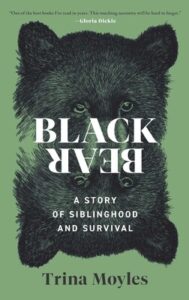
Black Bear: A Story of Siblinghood and Survival by Trina Moyles is available from Pegasus Books, a division of Simon and Schuster.

Trina Moyles
Trina Moyles is an environmental journalist, creative producer, and author. Her debut book, Women Who Dig: Farming, Feminism, and the Fight to Feed the World was a finalist for the High Plains Literary Awards and is currently being adapted into a documentary film. Lookout: Love, Solitude, and Searching for Wildfire in the Boreal Forest, a memoir about her work as a fire tower lookout in northwestern Alberta, won a National Outdoor Book Prize. In 2022, Moyles received the Lieutenant Governor of Alberta Emerging Artist Award, the province's highest honour for the arts, for her dedication to writing. She lives in Whitehorse, Yukon with her partner and their three dogs. Read more at www.trinamoyles.com.