Why Regency Romances Are the Best Type of Romance Novels
Sarah E. Ladd on How the “Rules” of the Period Make It the Most Inspiring to Read and Write
“The loss of virtue in a female is irretrievable—that one false step involves in her endless ruin—that her reputation is no less brittle than it is beautiful—and that she cannot be too much guarded in her behavior towards the undeserving of the opposite sex.”
–Jane Austen, Pride and Prejudice
*
The Regency Romance.
Le sigh.
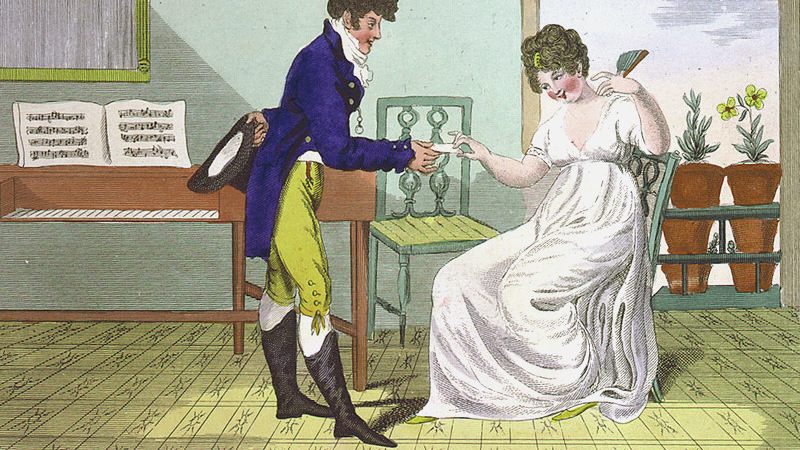
The mere mention of the genre sets the imagination soaring: Elegant balls. Graceful ladies clad in exquisite high-waisted gowns of dainty printed muslin. Distinguished gentlemen boasting dashing Hessian boots and tall beaver hats.
As both a reader and an author of Regency romance novels, I have long been a fan of the genre. I must admit, however, that my opinion of the genre has shifted over time. In my younger days, I’d have told you that Regency romance novels were a charming escape into a glittering, restrained world with witty manners and strict morals. I still believe that Regency romances are a worthy escape, but years of research and study of the time period has expanded my viewpoint.
To truly understand the true force and power of the Regency heroine, one must understand her world.
While the Regency Romance can be a rewarding glimpse into a world of ancient manor houses full of witty banter, they shine a light on an aspect much more significant: The heroine herself. Now when I’m asked why Regency romances are so popular, this is the answer: Readers love to read tales of other women succeeding in a society determined to subdue them.
That statement, on the surface, seems heavy and a little dark, but in reality, it celebrates the tenacity of the Regency heroine.
To truly understand the true force and power of the Regency heroine, one must understand her world, which can do by answering these three questions:
*
Question #1: What was the Regency Era?
In 1811 King George III of England was declared mentally ill and unfit to rule, so the Regency Act was passed. Consequently, his oldest son, George, ruled in his stead as the Prince Regent. This “Regency Era” lasted until 1820 when George III died and George IV officially became England’s king. Sometimes the term “regency era” refers to the broader Cultural time period from about 1795 until 1837 when Queen Victoria ascended the throne.
Question #2: Why was the Regency Era so consequential?
The Regency Era lasted less than a decade, but it forever changed the world as England knew it. During these years, England was involved in different wars, the British Empire was expanding globally, and the Industrial Revolution was in full swing. Not only that, but the population was booming, the extreme opulence of the upper class contrasted sharply against the harrowing poverty found in the slums, the Romantic movement was flourishing, and the middle class was emerging. The entire era was marked by significant and impactful change.
Question #3: What were a woman’s rights during the Regency Era?
During the Regency Era, women had very few rights. Young girls knew from an early age that their best chance for a secure future was to marry well. Marrying well did not mean marrying for love—it meant marrying for financial security and stability. Keep in mind that women could not vote. Their education opportunities were very limited, their occupation options were slim, and thanks a common law called coverture, all a woman’s legal rights transferred to her husband once she was married, making it impossible for her to sign a contract, own land, or even have a legal right to her own children.
I believe that it is a Regency heroine’s courage, determination, and her hard-earned success, that keeps readers coming back for more.
When you look at the Regency Era from the perspective of a woman’s rights, it doesn’t seem that appealing, does it? Yet I argue that it because of these constraints that this genre is so sought after. Readers love we see a heroine staring these challenges down and formulating a path to overcome them, especially when it is set against the opulence and wit of the Regency Society.
So, what is it about the Regency heroine that makes her shine even if she is facing adversity, and why do we root so hard for her?
The Regency heroine is fully aware and realistic about the world she lives in. She acknowledges that the men in her life hold the reins in many aspects of life, but she has the courage to sidestep the established path. It is dangerous, risky, and leaves her extremely vulnerable. Even if she’s born into wealth, she’s constantly one small decision away from irreversible destitution. Every decision she makes and word she utters has repercussions. She must rely solely on her wit, intelligence, and fortitude to not only survive but to prevail. It is this very tension—her desperate attempt to make the constructs restraining her work in her favor—that makes the reader cheer.
It is this fortitude that makes the Regency heroine resonates so deeply with the modern reader. While reading a Regency romance, the social rules a woman was forced to live by seem almost silly to our modern sensibilities. Subconsciously, however, a modern reader cannot help but examine herself and consider how she would react under the same seemingly ludicrous constraints. As an author, I find it intriguing that even though societies and expectations have changes throughout history, emotions have not. We feel anger, joy, mirth, grief, jealously, ambition, mistrust…just like a Regency Era woman would have. The rules of the game were different, but how would YOU act in a Regency Era situation if you were stripped of your modern rights?
I love to read a good ballroom scene that includes stolen glances across a chamber. I adore the details of empire waist gowns, delicate fabrics, and dancing slippers. And who doesn’t relish the gothic details of an ancient manor and grumpy yet uniquely attractive duke that owns it? But it is not these elements alone that make the Regency novel stand out. I believe that it is a Regency heroine’s courage, determination, and her hard-earned success, that keeps readers coming back for more.
__________________________________
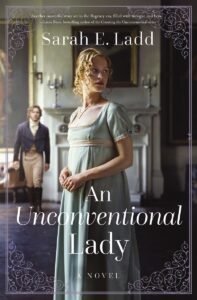
An Unconventional Lady by Sarah E. Ladd is available from Harper Muse, an imprint of HarperCollins Publishers.

Sarah E. Ladd
Sarah E. Ladd is an award-winning, bestselling author who has always loved the Regency period—the clothes, the music, the literature, and the art. A college trip to England and Scotland confirmed her interest in the time period, and she began seriously writing in 2010. Since then, she has released several novels set during the Regency era. Sarah is a graduate of Ball State University and holds degrees in public relations and marketing. She lives in Indiana with her family. Visit Sarah online at SarahLadd.com; Instagram: @sarahladdauthor; Facebook: @SarahLaddAuthor; X: @SarahLaddAuthor; Pinterest: @SarahLaddAuthor.