Why Pope Leo quoted Gandalf in his response to the rise of AI.
In a moving message this weekend, Pope Leo XIV spoke out against the rising tide of AI and urged his followers to recommit to a radical humanism.
The message—delivered in the form of an encyclical letter, periodic for popes—calls for “safeguarding the human person in the time of artificial intelligence.” Broken down into five lucid chapters, the letter argues against a robotic future, and for a socially just one.
Though I am one of the more fallen heathens you might come across, this document feels radical—in more ways than one. First, there’s the unflinching political courage. Contra to many prior popes, this See is not afraid to weigh in on the lopsided powers granted to the billionaire class, or an undemocratic state.
Take this tasty excerpt:
In the past, it was largely up to the State to guide and direct innovation. Today, however, the main drivers of development are private, often transnational, parties that are endowed with resources and the capacity to intervene that surpass those of many Governments. Technological power thus takes on an unprecedented, predominantly “private” aspect, which makes it even more challenging to discern, govern and direct such power toward the common good.
Leo goes on to call for a holistic consideration of AI, noting that the challenges the tech raises are not “purely technical…when [AI] enters processes that affect people’s lives, it touches on rights, opportunities, status and freedom. Important and sensitive decisions—concerning employment, credit, access to public services or even a person’s reputation—risk being fully delegated to automated systems that do not know ‘compassion, mercy, forgiveness, and…can therefore give rise to new forms of exclusion.'” He’s firm on the headline here: “We cannot consider AI to be morally neutral.”
Going on to compare AI to the tower of Babel, the people’s pontiff breaks down our current social conditions in language you’d be more likely to find in a Benjamin seminar.
He touches on the social conditions for hope, and the principles of solidarity and social justice. Tying these things expressly to the church’s social doctrine, he finally urges his audience to avoid “idolatry of profit that sacrifices the weak.”
The online leftists are snapping. Meanwhile, my grandma’s Concave would never.
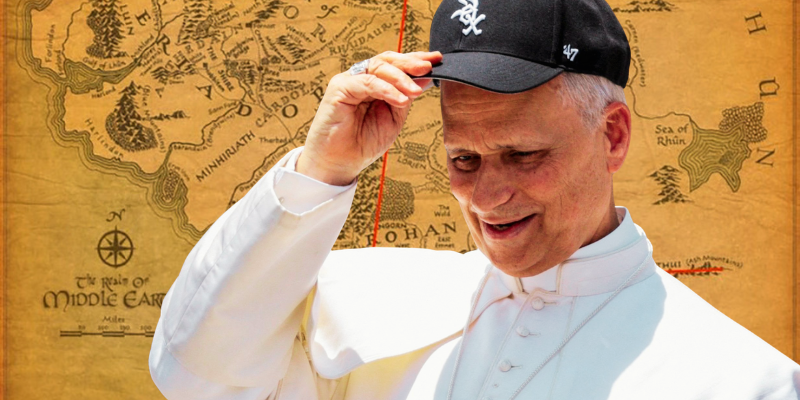
But perhaps my favorite flourish? The people’s pontiff has enlisted a certain (arguably) secular influence to make his emotional case. Specifically, a Gandalf quote from J.R.R. Tolkien’s Return of the King.
The twentieth-century Catholic author J.R.R. Tolkien, in the words of a protagonist in one of his novels, described our responsibility in this way: “It is not our part to master all the tides of the world, but to do what is in us for the succour [sic] of those years wherein we are set, uprooting the evil in the fields that we know, so that those who live after may have clean earth to till.”
IYKYK of course, but Gandalf drops this wisdom in the midst of a penultimate showdown, when all looks bleak for the world of men. Which makes this decades-old literary quote a terribly apropos citation for these times.
To paraphrase two wise, robed men: All we get to decide is what to do with the time that is given to us. And, you know: down with thoughtless industry.

Brittany Allen
Brittany K. Allen is a writer and actor living in Brooklyn.