Why Ghosts Are Haunting Us in 2026 (For Real)
Tara Badstubner on Our Fascination with the Spectral Realm
Several years ago, when COVID was still a bruising force in our lives, scaring us spitless, I took a COVID test, got the requisite negative result, and trekked to upstate New York for a writer’s retreat. I had no more than a seedling of an idea for my novel—a young widow overcome with grief. Barely a seedling. A small cohort of peers gathered for the event—an engineer, a professor, a teacher, a published author/mentor, a poet, and me, the stay-at-home mom. I arrived late afternoon on Monday, turning off the main road to a large stone house. It had a dark aspect. This is not a dramatization.
If I were to show you a picture, I promise you’d agree. A house of the Victorian era with carved wood, stonework, and stained-glass windows—the variety found in cathedrals that often depict red-faced devils and the flames of hell. I wish I could say that upon entering the house its first impression improved, but it didn’t. I felt as if we were submerged in the murky depths of the ocean—all shadow, with the occasional shift of colored light overhead. Several of the writers commented on the creepy nature of the house, but we soon found a couple rooms that had a degree of hominess—the kitchen and the dining area—where we spent most of our time discussing and reading from our work.
It was on Wednesday night when things went sideways.
I should explain—two of the women were participating from the West Coast on Zoom, unable to attend because of prior commitments, but four of us were seated around the dining table. On this night, we were all enjoying the gift of camaraderie and laughter, denied us for months. We may have been boisterous, but who was to mind? It was in one of these peals of laughter that a woman seated across from me suddenly shushed us. Listen, she said, and pointed above. We all went silent. Each of us heard it—the heavy tread of feet overhead, but then it was gone. And like those predictable horror movies where the heroine is naively glib about all indications she should run, run for her life, we forgot about the noise. In no time, we were back to talking and laughing. This time, it stopped all of us mid-laugh—the sound of furniture, heavy furniture, being dragged across the floor directly above us. Someone yelled out, asking if there was anyone upstairs. No one answered, but the sound became more emphatic.
The spectral are getting louder, more insistent, more prevalent, and our literature, our cinema, reflect this
Do you know what you’d do in the case of a haunting? Neither did I, but I do now. It was as if I couldn’t commit to an emotion, zigzagging between unhinged laughter and hysterical crying. Dear reader, I was the untethered woman who is slapped in the horror movie, the first one sacrificed to whatever evil presence needs feeding. Not a proud moment. Somewhere in all this, we learned that our two companions on Zoom were both trained by shamans and, for a moment, our interest in this bit of trivia superseded our fear. A shaman? No, two shamans? One of them mentioned that maybe, just possibly, all the laughter had upset a spirit in the house. They both hypothesized that an elderly ghost was disturbed by our raucous behavior and suggested we find something “rose” to placate her. Rose, as in the flower. I remembered my rose-scented perfume upstairs in my bedroom, on my bureau.
Imagine: three grown women—three because the fourth, our mentor, had gone to her house a few miles away to get her dogs and return with eager canine force to sniff out our poltergeist. Three women walking in a tight cluster up the long stairs, down the hallway, to my bedroom and retrieving the perfume, then walking in this same tight circle, spritzing as they go, choking on clouds of rose perfume—and that one dimwit still crying/laughing hysterically. Meanwhile, the two Zooming shamans were texting each other privately so as not to alarm the rest of us: Do you see the ghost? Yeah, I see it, too. It was around this time that our mentor and her three dogs arrived. Let off leash, they ran through the house, roaming and sniffing, jumping on our beds, looking for snacks. Our noises came to a screeching halt. Later, we learned that the house was known to the locals for hauntings and that it had once been used for an elder care home.
And with that haunting, my novel took on a new shape, one in which a husband lingers as a ghost grieving all that remained unresolved, unfinished in his marriage, while watching his wife struggle to re-start her life. A wave of recent books and movies reveals that I am far from alone in my preoccupations. These days we are surrounded by ghosts and gossamer visions vying for our attention, trying to tell us something vital—or as mundane as to shut up already, like in my case.
Have you noticed, too? The spectral are getting louder, more insistent, more prevalent, and our literature, our cinema, reflect this. Ghosts have gone more mainstream than vampires, no longer grouped with the other weird freaks— the zombies and the werewolves, that paranormal genre once ascribed only to lovers of the macabre.
Of course, we have always dabbled in hauntings: Hamlet, Wuthering Heights, A Christmas Carol. More recently, Toni Morrison’s rightfully exalted Beloved, the name taken by the dead daughter of an escaping slave haunted by her unthinkable act, or Alice Sebold’s bestselling The Lovely Bones, in which her young protagonist, Suzie, is a ghost recounting her murder and striving for closure. But in this moment there is a decided upswing in apparitional visitations. It’s as if the floodgates of the departed have opened and they are now populating our minds and, by extension, our stories.
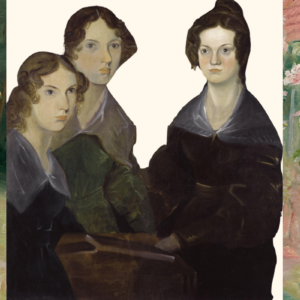
One recent three-month period saw the release of three film adaptations of acclaimed novels in which ghosts played a starring role. The latest dramatization of Emily Bronte’s classic gothic romance, Wuthering Heights, hit theaters on the heels of The Thing With Feathers, based on Max Porter’s award-winning novella, which depicts a provoking crow haranguing a widower to inhabit his grief. In the same month Netflix released Train Dreams, the film version of Denis Johnson’s revered short novel about a logger whose deceased baby daughter visits him in the form of a wolf.
In the same week that the Pulitzer Prize for literature was awarded to Daniel Kraus for Angel Down, in which an injured angel appears to soldiers on a battlefield, Siri Husvedt’s memoir Ghost Story was published, a recollection of her long marriage to novelist Paul Auster, her grief at his death so intense that she experiences his ghostly return to their Brooklyn brownstone. Anne Michaels’ most recent novel, winner of the Giller Prize, makes a suggestion that might connect all of these aforementioned works: Held opens with the story of a shellshocked photographer who has survived WWI and reopens his studio, soon discovering that his sitters’ beloved dead hover in the backgrounds of their developed portraits. Held’s narrator wonders, “Perhaps the most important things we know cannot be proven.” Could this explain why so many of our most reputable creatives are exploring what was once peripheral, spoken of with disbelief, and envisioning it as another possible dimension of existence?
One of our most admired contemporary novelists, George Saunders has returned to the exploration of the liminal space between death and the afterlife not once but twice. In his fantastical romp Lincoln in the Bardo, he imagines the days following Willie Lincoln’s death and internment in Oak Hill Cemetery, a forlorn place full of every variety of ghost plagued by unfulfilled desires. His new novel, Vigil, tells the story of an angel tasked with helping a billionaire feel a degree of remorse for his actions before crossing over. In an homage to Dickens’ A Christmas Carol, ghosts trek through the billionaire’s bedroom, each pushing him to reckon with his deficits. These two novels are just a sampling of recent portrayals of this surreal land of limbo, but there are many more.
Why now? What in the zeitgeist lends itself to this burgeoning fascination with ghosts and the afterlife? I can think of several forces conceivably at play. One may be as simple as these magical technological times we live in. For the layman among us (and let’s be honest, that’s most of us), technology defies understanding. Imagine Thomas Watson hearing his boss, Alexander Graham Bell, summon him through a rudimentary phone, his voice untethered to any human form yet still conveyed, and conveying urgency: “Mr. Watson, come here. I want to see you.”
The phone, the radio, the television, the fax, the cell, texting, video calls, AI—who among us truly grasps its underpinnings? Yet there are unobservable “clouds” packed full of “data” and invisible lines of communication crisscrossing this small, blue world. And it is ever-changing, the horizon for technology continuing to move. If all this is possible, why not communication between the deceased and the living?
It’s as if the departed will no longer be ignored.
We are discovering connections not just on a global technological level but also on the most micro, even cellular level. In 2018, we learned that new medical technology revealed a vast landscape within the body: the interstitium, a network of interconnected fluid-filled space supported by a collagen mesh just below a person’s skin. This may be the latest organ discovered, a medical advance made possible by live imaging. Though our understanding of its purpose is still in its infancy, we do know that the interstitium serves as a shock absorber, a source of lymph and may be a major conduit for cancer. In 2026, hitherto unobservable communication within a body is now observable.
Technological and medical progress offer one of the more clinical components to this rise in mysticism. The cascading fallout from COVID and our modern-day decline in formal religiosity are possibly two other factors. COVID placed the specter of death front and center. Images of hospitals overwhelmed with the sick and dying flooded our consciousness. Cherished relatives died alone in hospital rooms surrounded by sterile machines and an ever-rotating set of masked medical personnel. Formal rites for the dying, already limited, were further truncated or skipped entirely.
The as-old-as-Adam questions—why are we here and where do we go after death—gained a heightened piquancy during COVID. Those who still practiced formal religion learned out of necessity how to live a more independent spiritual practice. While churches were closed to their parishioners, other doors opened: search engines and podcasts remained accessible to the seeker. What was once fixed and irrefutable no longer applied, leaving room for dissonance and inquiry. Metaphysical and existential questions gained traction in our mainstream culture and spread everywhere. Most importantly, where there is a vacuum, in walks art. Literature. Cinema. Music.
Have you seen a ghost? Not so long ago, such inquiries belonged among the woo-woo subsect of our social dynamics and our literature. Not anymore. It’s as if the departed will no longer be ignored. They too want a place in the human narrative, and we’ve crossed over from horror to genuine curiosity, even regard.
In that stone house in upstate New York almost four years ago, I felt the strange liminal quality of life and death. It shook me to my core, gifted me the heartbeat of my novel, made me laugh and cry without restraint.
Maybe that is a fitting response, after all, to the things that haunt us.
__________________________________

Every Room Remembers by Tara Badstubner is available from Sibylline Press.

Tara Badstubner
Tara Badstubner was a Writer-in-Residence at Craigardan (2022-2023) and is an alum of Bookgardan. She received a Continuing Studies Novel Writing Certificate from Stanford. More recently, she was an artist-in-residence of Hewnoaks where she worked on her upcoming second novel. She lives outside of Philadelphia with her daughters, husband,and dogs. This is her debut novel.