Why Does Contemporary Fascism Fetishize the Classics?
“...martial power, imperial grandeur, regimented hierarchy, stoic obedience...”
Having acquired a hundred acres adjacent to the royal residences in Castelporziano in 1906, the House of Savoy commissioned an archeological dig on their new land. From the sandy soil displaced during the excavation of a villa built during the Emperor Hadiran’s reign emerged a startling object—a life-size sculpture of Carrera marble, a nude male figure whose lean and taut body is posed in the second before throwing an object, apparent even though the statue is missing an arm and its head. Despite those anatomical absences, scholar Lodwick Pollak was able to identify the sculpture as a second-century marble copy of the celebrated Discobolus, the original cast in bronze by Myron four centuries before the Common Era.
A classicist and antiquities trader, the Prague-born Pollack was also Austro-Hungarian, Czech, and a Jew (in that order). In fin-de-siecle Italy, Pollak’s faith was little impediment to his reputation as director of the Museo di Scultura Antica Giovanni Barracco. In his 2021 Pollak’s Arm, novelist Hans von Trotha imagines Pollack being motivated by a belief that “order or harmony, even completeness is possible.” A Viennese artist and Pollak’s contemporary described how the Discobolus exemplified this “wonderful combination of the most glorious physical beauty with a brilliant mind and the noblest soul.”
That critic was Adolf Hitler.
In October of 1943, the then elderly Pollok, his wife, and their son and daughter were packed into boxcars with Rome’s other Jews and sent to Auschwitz, where the whole family would be murdered a few weeks later.
As a cipher, the Discobolus can either represent Pollak’s humanistic ethos of a cosmopolitan society or the idolatries of Hitler’s blood-and-soil fascism. Nazi architect Albert Speer was an avowed Neo-Classicist, and his proposed Volkshalle for the New Germania to be built on the ruins of Berlin (and which would have featured the world’s largest dome) was supposed to embody an Augustan imperial triumph, yet the white-painted iron dome on the U.S. Capitol was equally meant to express Greek democracy and Roman republicanism. From ancient sources philosophers and poets, democrats and demagogues, found justification for everything from anarchy to fascism, and there are reasons for both justifications.
Fascists have long been attracted to classical antiquity’s martial power, imperial grandeur, regimented hierarchy, and stoic obedience.
Fascists have long been attracted to classical antiquity’s martial power, imperial grandeur, regimented hierarchy, and stoic obedience. Mussolini, at a 1922 event which marked the anniversary of the ancient republic’s mythic founding, intoned that “what was once the immortal spirit of Rome has risen again in Fascism.” There was a certain logic in Mussolini’s use of a legendary past, for at least Italians have a credible claim to descent from the Romans, whereas Hitler’s mania for all things classical was odder, considering the role that Germanic tribes played in the fall of the empire, albeit that was a reality which Der Führer was embarrassed about, saying in private “It’s bad enough that the Romans were erecting great buildings when our forefathers were still living in mud huts.”
Regardless, or maybe because of that previous observation, Speer’s New Germania was effectively to be a New Rome, the imagined monuments of Nazi victory recalling the imperial memorials of the ancient city. There were, maybe predictably, convoluted pseudo-histories promulgated by theorists such as Alfred Rosenberg that designated the Greeks as a “Germanic” people, and Rome as an “Aryan Empire” (despite the ancients having no contemporary sense of race, and Rome itself most certainly being a pluralistic and multiracial polity).
Johann Chapoutet writes in Greeks, Romans, Germans: How the Nazis Usurped Europe’s Classical Past that the regime concocted “their own biography of an Urvolk ennobled by the prestige of Augustus.” How uncanny then the example of that first-century statue of Rome’s first emperor, the Augustus of Primo Porta, holding his arm aloft in a regal salute as carved from the pristine white of marble, an irresistible image for fascists, even if two millennia ago the sculpture would have been painted in vibrant colors (and with Caesar’s complexion no doubt a tinge swarthier than the Nazi theorists would have been comfortable with).
For every Pollak that offered a rejoinder to the fascist appropriation of Greece and Rome, there were apologists and collaborators who gladly excavated the ancients for the purposes of modern regimes. In Italy, academics like Ettore Romagnoli organized an authoritarian spectacle to celebrate two millennia of Horace, the priest Vittorio Genovesi wrote encomiums to Italian imperial ambitions in Rome’s Mare Nostrum, and the Latinist Luigi Illuminati who penned an epic dedicated to Il Duce.
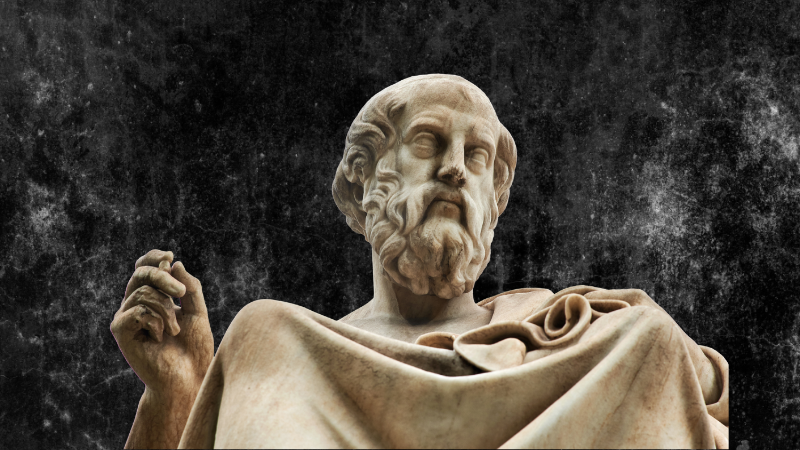
After all, it was Plato—implacable opponent of democracy—who claimed that “liberty causes disorder.”
Nazi Germany didn’t have a shortage of classicists either, including Helmut Berve, Wilhelm Weber, Josef Vogt, and of course the Nazi philosopher Martin Heidegger (still venerated by many) who claimed in On the Way to Language that “Our thinking today is charged with the task to think what the Greeks have thought in an even more Greek manner.”
The mania for ancient Greece and Rome is in ample display among the current descendants of the Nazis, the alt-right more than happy to cosplay their fantasy of classical masculinity and racial exceptionality. Curtis Dozier, in his disturbing new book The White Pedestal: How White Nationalists Use Ancient Greece and Rome to Justify Hate, enumerates examples of fascist appropriation of the classical past, from influencers who use pictures of Greek sculpture as their online avatars to the laurel wreath used in the symbol of the Proud Boys, the white supremacist who goes by the name “Based Spartan” to the pseudonymous blogger with the nom de plume “Bronze Age Pervert” (the last of these has disturbingly become an influential Court Philosopher among the MAGA set).
Villainous weirdos like Bronze Age Pervert, Curtis Yarvin, or Jack Donovan who populate the ranks of far-right intellectuals are obsessed with their own fabulism about antiquity, reminding one of the murderous gaggle of privileged college kids in Donna Tart’s 1993 campus novel The Secret History. Though Tart’s classic isn’t often spoken of in this way, The Secret History is a prescient foreshadowing of how elitism, pretension, and a Latin dictionary can act as catalysts to a kind of individual nihilistic fascism based in that hard belief that “Beauty is rarely soft or consolatory. Quite the contrary… Beauty is terror… we quiver before it,” with the results being a Dionysian irrationalism.
Meanwhile, Bronze Age Pervert, most likely a failed philosophy academic named Costin Vlad Alamariu, writes that in ancient Greece and Rome “men had life and force… I see the spirit returning surely in our time,” with such a sentiment being the play-acting of boys, the kind of thinking expressed in Zach Snyder’s 2006 adaptation of Frank Miller’s hard bodied and homoerotic graphic novel The 300. That film advocated a juvenile ethos of being “baptized in the fire of combat… never to retreat, never to surrender,” the sort of thing you could see Stephen Miller tweeting after watching too many episodes of HBOs Rome.
Reading the exquisite verse of Homer and Virgil, considering the sublime arguments of Epicurus or Lucretius, examining the subtle beauty of the Discobolus—it can be easy to see fascist enthusiasm for the classical past as ill-educated misinterpretation of the past. But worryingly, could it be that when it comes to their classical antecedents, the fascists might know more than we think they do?
“Greco-Roman antiquity’s reputation… has eclipsed the fact that some of the most widely admired figures in ancient literature and philosophy endorsed ideas that modern white supremacists share,” writes Dozier, whereby the politics of the ancient world provides models “for political systems that contemporary white supremacists would like to establish.” Even fabled Athens was only briefly a democracy, and that even then every third person was enslaved. After all, it was Plato—implacable opponent of democracy—who claimed that “liberty causes disorder.” Mussolini appropriately kept a copy of The Republic on his desk in a spartan office maintained in the Palazzo Venezia.
Irony then that modern fascists have chosen to target the writings of Plato, in this particular case with Texas A&M University reprimanding a philosophy professor who happened to teach about the discipline’s most foundational figure. A banning not because of the anti-democratic sentiments in The Republic, but rather because passages in Plato’s Symposium were deigned as promoting whatever “gender ideology” is supposed to be. Plato, the immaculate writer who would exile the poets from his ideal Republic, would nonetheless observe in The Symposium that “For one touched by love, everyone becomes a poet.” A contradiction perhaps, or evidence that Plato is as divided as the bifurcated souls he described in his work now banned in Texas.
A genuine humanist’s appraisal, for as Terrance wrote, we are human and let nothing which is human be foreign to us.
Nothing is every wholly one thing or the other; for as Heraclitus said, “Everything changes and nothing stands still,” as true of the classics as anything else. Fascists do not possess an aptitude for such change nor the entirety of antiquity—they don’t even possess all of Plato. There are, for those who read against the grain, moments of resistance and liberation and protest and freedom in ancient works. Of that great Cynic Diogenes telling Alexander the Great that the only thing he could do was get out of his light, or Cleisthenes leading the Athenian Revolution and expelling the oligarchs which held that city in bondage, or the enslaved Roman gladiator Spartacus who led his rebellion against the decadent and tyrannical ruling lords of the empire, of whom Marx wrote possessed “noble character, [a] real representative of the ancient proletariat.”
For those who wish to find justification for inequity, injustice, and immurement in the writings of the ancients, there are sources to be cited; yet for those who wish to imagine and fight for a better world, there are also our forerunners in Athens and Rome. The Nigerian essayist and photographer Teju Cole has often written about classical antiquity, describing the “strange power of these works” when considering the ancient canon, while concluding elsewhere that when it comes to the difficulties of antiquity, “I’m happy to own it all.” A genuine humanist’s appraisal, for as Terrance wrote, we are human and let nothing which is human be foreign to us.
That was the expansive sense which motivated those classicists who rejected the fascist filching of the past, of the philosopher Benedetto Croce who refused to swear allegiance to the Italian state, or Piero Gobetti who framed his arguments against the far-right in the language of Thucydides, and the Greek writer Angelos Sikelianos who during his nation’s resistance against the Nazis framed his anti-fascist poems in the idiom of the ancient myths. Of Ludwig Pollak, whose work, his very existence, demonstrated that the inheritance of the classics belongs to those who love them, not those who merely exploit them.
The same year that Pollak correctly identified Discobolus, he made his most important discovery. Laocoön and His Sons, an exquisite marble sculpture of the legendary Trojan priest writhing in agony as he’s attacked by sea-serpents, was first unearthed in the early sixteenth-century, the only missing piece his right arm. Restorers had long assumed that in its original, Laocoön’s arm was held out stiffly at a degree which uncannily recalled a Nazi salute. The reality was rather different. Pollak had discovered the missing appendage at a Roman building yard in 1906, the actual arm not stiffly raising upward at a thirty degree angle, but rather falling backwards behind the figure. A pose that wasn’t hard, but soft; not regimented, but human. From a different past entirely.

Ed Simon
Ed Simon is the Public Humanities Special Faculty in the English Department of Carnegie Mellon University, a staff writer for Lit Hub, and the editor of Belt Magazine. His most recent book is Devil's Contract: The History of the Faustian Bargain, the first comprehensive, popular account of that subject.