Why Clearing Stormfall
With a Chainsaw is a Lot Like Writing Prose
Claire Thompson Considers the Unlikely Physicality
of Writing (on a Good Day)
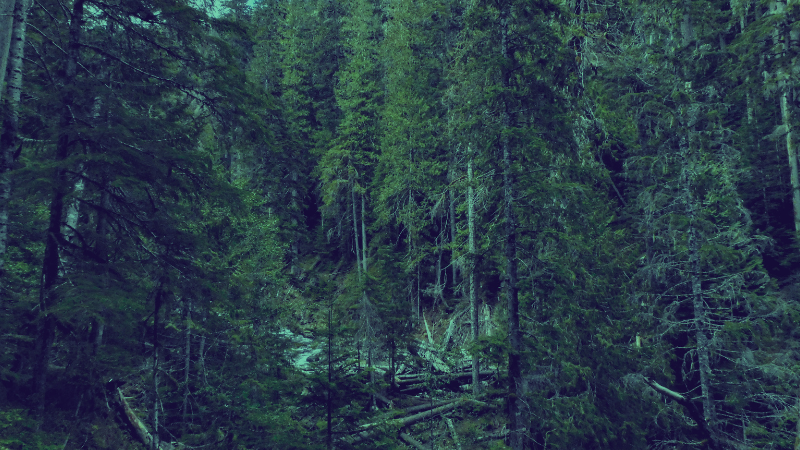
The forest had fallen sideways.
The trees piled horizontal across the trail, tangled in brush and each other. This forest, on the eastern slope of Washington’s Cascade Mountains, had burned seven years before, and now, right on schedule, its skeleton remnants were coming down in droves.
As a trail crew, it fell to us to buck up the logs and clear the pieces out of the way, unearthing the trail from under the tumbled woods. The sight of so many logs in one place—a jackstraw, we called it—made my body sag with anticipatory exhaustion. But it also thrilled me. The jackstraw presented a puzzle to be solved, raw material from which to excavate a way through. I was eager to jump in and tackle it, one log, one cut, at a time.
I started the chainsaw and stepped forward into that particular kind of flow state where you’re thinking and doing at the same time: one level of your subconscious staying a step ahead of the motions of your body, which demands its own layer of attention to the task at hand. Like skiing a steep pitch or waiting tables during the dinner rush. Like writing.
*
For over a decade I cleared trails in the summer, and wrote—or tried to—in the winter. From May to October, I filled journals, letting the words that had built up in my head all day as I worked spill onto dirt-smudged pages at camp at night. In the winter, when I wasn’t serving drinks or baby-sitting or stocking groceries, I’d sit down to my laptop and try to make shape and sense of it all.
I thought of these two halves of my life—the outside, physical part and the inside, intellectual part—as yin and yang, a balance between the life of the body and the life of the mind that I craved, that kept me whole. There’s a long, romanticized tradition of writers making a living in blue-collar occupations, especially outdoor ones, and I claimed this legacy as my own, identifying with the likes of Norman MacLean and Gary Snyder. But as I’ve gradually shifted my life away from the woods and more toward writing, I’ve started to wonder if it’s the similarity of both forms of work, not the difference, that accounts for the way some people gravitate to both.
*
In The Triggering Town, Richard Hugo urges writers to free words from the rigid boundaries of their utilitarian functions, to “give up all worry about communication.” Instead, he says, “Focus on the play rather than the value of words. … Depend on rhythm, tonality, and the music of language to hold things together. … use words for the sake of their sounds.”
Hugo’s advice is directed primarily at poets, popularly perceived as the dreamiest of writers, those who dwell in the gauzy realm of symbol and metaphor, not story. But to the extent that poetry severs words from the cushion of the paragraph and often, too, the sentence, putting that much more emphasis on the stripped-down essentials of each syllable—their sound and rhythm and arrangement on the page—it is also, maybe, the most tactile version of the craft, the closest to basic carpentry. For us prose writers, the sounds of words themselves are too often regarded as the finish work, the gloss that makes the story shine. For poets, they’re the foundation, the frame.
When I started to see the labor of writing as not a contrast but a parallel to the work I did outdoors, it became less ephemeral, more accessible.
“This is what I mean when I call myself a writer. I construct sentences,” says Don DeLillo. “The words typed on the white page have a sculptural quality. … They match up not just through meaning but through sound and look. The rhythm of a sentence will accommodate a certain number of syllables. … I’ll consider altering the meaning of a sentence to keep the rhythm, the syllable beat.”
Hugo frames this focus on “the music of language,” over the meaning, as play. But it gives me something to work with. When I’m in doubt, focusing my efforts at the level of words can make the pages accumulate faster.
On a good day, writing feels physical: not a magical-shivers kind of sensation, but a sense of actual bodily engagement. Whatever I’m working on becomes a project that, at some point, I’m in too deep to walk away from: a log under tension with one side half-cut, a rock step still wobbling in the hole I’ve dug for it. I’m holding all the pieces of something in my hands, and I can’t put any one of them down until I figure out how they fit together. I’m moving toward something, excavating something else, building, joining, repairing. Find your own metaphor, but there’s a reason they call it craft.
Like DeLillo, Annie Dillard describes writing as something sculptural, a process of excavation. “When you write, you lay out a line of words,” she says in The Writing Life. “The line of words is a miner’s pick, a woodcarver’s gouge, a surgeon’s probe. You wield it, and it digs a path you follow.” Trail work, then, is an almost perfect real-life representation of Dillard’s metaphor: you wield tools, cutting logs and digging dirt, to make a literal path forward.
When I started to see the labor of writing as not a contrast but a parallel to the work I did outdoors, it became less ephemeral, more accessible. I remind myself that I’m not at the mercy of a mercurial muse; I just need to gather my tools and start chipping away at the project before me.
*
Ever since I was a kid, my family’s favorite corny Christmas movie has been The Homecoming, a 1971 TV movie that was the pilot for the show The Waltons, about a large family living in rural Virginia during the Depression. It has that combination of low-budget goofiness and real tenderness that can’t be found in Disney or Hallmark.
“I was trying hard to fill my father’s shoes that winter,” fifteen-year-old John Boy Walton, the oldest of seven kids, narrates. It’s Christmas Eve and his father, who works several towns away, hasn’t made it home yet. No one knows why; no one has a telephone in the rural Blue Ridge Mountains, so John Boy sets out into a winter storm to find his daddy, having various escapades with the quirky residents of their backwoods community—a Black preacher, a pair of old-lady bootleggers, a turkey thief—along the way.
Underneath the plot runs tension over John Boy’s ambivalence about his father’s expectations. John Boy locks himself in a bedroom to scribble his thoughts about trains and oceans and whippoorwills in a Big Chief tablet, telling no one in the family about his secret dream of being a writer, until his mother finds the notebooks and confronts him. She stares at him as if seeing him for the first time. “I do vow,” she drawls. “Well, if that’s what you really want, couldn’t you still try?”
“I couldn’t disappoint my daddy. I know he has his heart set on me taking up a trade.”
“He just wants you to know how to make a living.”
“Well, I sure never could do that scribbling things down in a tablet.”
I always laugh-cried at that line.
*
A couple of years back, I traded (temporarily, it turned out), field-based trail work for a desk job at a regional environmental nonprofit. My modest white-collar salary was twice what I’d been paid at any previous job. But my days felt both hectic and aimless, a sloppy collage of sitting in Zoom meetings, responding to a self-replenishing firehouse of emails and Slack messages, and making endless tiny tweaks to our volunteer management system.
Meanwhile, the entire West was on fire, trails already choked with deadfall from decades-ago blazes even as new ones torched millions more acres every season. There was so much work to do. Yet somehow, my time was worth twice as much tinkering on a computer all day than it was performing the strenuous skilled labor the forest desperately needed.
I quit my “real job” after less than a year, went back to hiking a saw into the woods. I had thought I’d be able to handle a desk job; I was used to spending winters writing and studying, after all. It was only later that it clicked for me: at the nonprofit, I hadn’t been making anything. Writing may not be literally physical, but in that it involves building things out of tangible parts—constructing sentences, mucking about, laying out a line—it feels much more like manual labor, with its satisfaction of craft and creation, than a computer job does.
A “trade” is defined by the act of putting in effort to create something that makes the world a better place—whether that’s a trail through the forest or words on a page, strung together in just the right order.
This past February, only a year after being back at the Forest Service, I was abruptly fired, along with almost the entire recreation staff of my ranger district. About six weeks later, after multiple lawsuits, we were reinstated, but warned that more legally defensible layoffs were likely coming. We could take our chances, or we could accept a deferred resignation offer, under which we’d be placed on administrative leave and paid our normal salary through the end of September. Feeling backed into a corner, I accepted the offer. Maybe, I thought, it was a blessing in disguise. I could use the time and the funds to focus on writing.
Instead, without the work that gave me a deep sense of both physical and moral purpose—but paid little more than my state’s minimum wage—I spiraled and raged. The DOGE blood-money paychecks, as I thought of them, started to feel less like an unexpected bonus and more like long-overdue back pay for years of undervalued labor.
And here I was, thinking I could use the modest extra support to put more effort into writing: another abysmally underpaid profession. Everything I’d devoted my life to, it seemed—vocations I had stuck with because they offered work I was both good at and believed in—apparently had little value to society, if such value is quantified, under capitalism, as the amount of money one can be paid to produce something.
*
At the end of The Homecoming, John Boy’s father finally makes it home. He’s quit the job that kept him away from his family and spent his last paycheck on Christmas gifts for each of them: a doll for his youngest, flowers for his wife. John Boy unwraps his: a stack of Big Chief tablets.
“I wonder how word got all the way to the North Pole you wanted to be a writer,” the elder John Walton quips, as John Boy tears up.
“I don’t know a thing about the writing trade, son. But if you want to take it up you got to give it your best.”
The Waltons may be a romanticized version of white rural life, a bygone era of brutal poverty seen through rose-colored glasses. When Mrs. Walton frets over what the family will live on now that her husband has quit his job, he replies, “Love, woman.” As unrealistic a prospect as this may be, in the context of today’s times there’s something almost radical about what the film’s ending suggests. That a family being together physically is a priority over anything else. That a pot of flowers or a handful of notebooks can be a more meaningful gift than something more expensive or practical. That a “trade” is defined by the act of putting in effort to create something that makes the world a better place—whether that’s a trail through the forest or words on a page, strung together in just the right order. And that whatever your trade, it’s worthy of devotion.

Claire Thompson
Claire Thompson is a former longtime seasonal trail worker for the U.S. Forest Service, a teacher at Wenatchee Valley college, and an MFA student in Nature Writing at Western Colorado University. Her work is published or forthcoming in Qu, High Country News, Parabola, Out There Outdoors, Camas, The Thalweg, and Terrain.org, among others. She is working on a book about the impacts of climate, political, and economic change on public-lands stewardship. Claire calls the mountains of North Central Washington home.