Who Deserves to Be a Citizen?
Daisy Hernández on the Post-9/11 Obsession with Birthright Citizenship
This obsession with citizenship, which began in the 1990s, surged after the terrorist attacks on September 11, 2001, and the subsequent War on Terror. Politicians charged that there were now citizens and terrorists, good and evil. The border had to be patrolled for Muslim men who would kill us. The Muslim men were never us and had to register with the federal government if they were older than sixteen and came from one of twenty-five Muslim-majority countries, or else face deportation.
In early 2003, the journalist Maria Hinojosa reported for CNN from the border, the one with Canada. Pakistani families were fleeing the United States, asking Canada for asylum because some of the men registering with the federal government were being detained for weeks or months and were even being thrown out of the country. The only way to stay together as a family was to leave together.
At the Library of Congress, meanwhile, the staff bought almost three thousand books in English on the subject of citizenship in the first decade after 9/11. The authors of these texts examined citizenship in the Arab world and in modern China and in the global cities of the Western world. They analyzed citizenship in public health and in American literature and in ecological philosophy. They looked at how citizenship had once been imagined and considered how it was being reimagined.
I never thought it strange that as a child I was acutely aware of my papers.
Among the titles were Becoming a Citizen, Americans in Waiting, and Composing the Citizen, all of which suggested that citizenship was a red-tailed hawk, a feathered beast in motion, not a fixed entity but one that moved and changed and flitted out of reach.
A few weeks after 9/11, I traveled to an artists’ community in New Hampshire. I was to live there for a month with composers, mixed-media artists, and other writers, all of us working on creative projects while the United States began dropping bombs on Muslim families in Afghanistan and then in Iraq. On the television in a nook of the shared house, we watched the news from New York City, where workers moved slowly among the ruins where the towers had stood.
A white artist, a woman in her sixties, turned to me to complain about a story she’d read. In Chinatown, people were posting the American flag upside down on the windows of their apartments. The woman was furious. They don’t even know how to hang the flag! she growled.
I had already seen the upside-down flags. At the time, I still lived with my parents and an auntie in New Jersey, and I had come home one day to find that my tiá had taped a tiny American flag to our front door upside down. It was a paper flag. It didn’t move. Tía had affixed it to the door with layers of transparent tape.
It is what I imagined millions of mothers in many languages had whispered to their children for years: You were born here—you’re American.
It was, as far as I knew, the first flag of any country ever displayed at our home. I don’t know if my auntie wanted the neighbors to know that we were not terrorists. We were not criminals. We were Americans. We were citizens. On paper, we were citizens. Or maybe this was not it at all. Everywhere we went, the flag had popped up: on lawns, on trees, on supermarket windows. The stores on Bergenline Avenue were selling U.S. flags perhaps for the first time. Maybe Tía understood the surveillance of her citizenship and mine by our neighbors, or maybe she only wanted to signal that we shared in the grief of those days.
I never thought it strange that as a child I was acutely aware of my papers. I figured every child knew this fact about themselves. Every child born in the United States was surely told over and over again by their mothers: Nacistes aquíeres Americana. It is what I imagined millions of mothers in many languages had whispered to their children for years: You were born here—you’re American.
In today’s legal world, citizenship springs from one of two sources: the soil or your blood—the land on which you were born or the citizenship of your parents. Birthright citizenship is based on the principle of jus soli, Latin for “right of the soil.” Years before the Civil War, Black Americans claimed this citizenship at political conventions and in Black newspapers.
“Birthright citizenship was a fully formed idea by the early 1850s,” writes the historian Martha S. Jones in her book Birthright Citizens: A History of Race and Rights in Antebellum America, in which she chronicles how Black people in Baltimore engaged in the practices of citizenship by traveling between states, suing in court, and gathering in public to discuss politics and religion. After the Civil War, in 1868, the Fourteenth Amendment made jus soli the law of the land in the United States.
The other kind of citizenship comes from the principle of jus sanguinis, or “right of blood,” meaning that your nationality is based on that of your parents. It has nothing to do with biology but with the papers your parents have. It is a practice unfamiliar to most Americans since the United States, Canada, and every country in Latin America except for the Dominican Republic and Colombia offer birthright citizenship.
At least two professors have warned that the Dominican Republic serves as a harbinger of what could happen in the United States. In 2010, the Caribbean country began denying birthright citizenship to the children of undocumented immigrants, and then the country’s Constitutional Court made the law retroactive to 1929, stripping birthright citizenship from several generations of children whose parents didn’t have papeles, the vast majority of them Haitian.
Colombia, my mother’s homeland, recognizes only a blood-bound citizenship. In other words, being born in the country does not automatically grant you citizenship, and this offers another type of caution. In 2019, Colombia found itself home to twenty four thousand stateless babies, all of them the children of Venezuelan immigrants. They had no constitutional right to the soil of Colombia until a law was passed making a temporary exception for them.
Surely, the Supreme Court did not mean to extend the right of this soil to the newborns of people without papers.
In the United States, Republicans tried to eliminate jus soli citizenship in 1995, a year before Congress passed the Latino Exclusion Act. They proposed changing immigration law to deny birthright citizenship to anyone whose parents were not citizens or legal residents. Hearings were held, and the Justice Department’s top constitutional scholar testified that aside from the legislation being “unconstitutional on its face,” such a move would create “a permanent caste of aliens, generation after generation after generation born in America but never to be among its citizens.” The bill failed to pass, but the Republican Party included the idea of eliminating birthright citizenship in its platform for the 1996 election.
More than a decade later, in 2011, Representative Lamar Smith, a Republican from Texas, took charge of the argument. In an op-ed for Roll Call, he explained that the great men who drafted the Fourteenth Amendment had not intended to include the children of undocumented parents.
He knew this because one of those men, a senator, had said in the 1800s that birthright citizens did not include “persons born in the United States who are foreigners.” If this wording sounds incomplete, it’s because Smith omitted the rest of the sentence, which clarifies that the senator was talking about children born on this soil to foreigners “who belong to the families of ambassadors.” In other words, an ambassador’s wife could give birth here but not necessarily to a U.S. citizen.
Representative Steve King of Iowa introduced a bill in 2011 that would have changed the Constitution so a person born in the United States could only be a citizen if one of their parents was a citizen, had a green card, or was serving in the military. He introduced the bill every year until he left Congress in 2020, having lost his seat to a fellow Republican after he told a reporter that he didn’t know why the term white supremacist was offensive.
The reasons for dismantling the Fourteenth Amendment have grown more elaborate in recent years. Yes, “all persons born or naturalized in the United States, and subject to the jurisdiction thereof, are citizens of the United States,” but according to former vice president Mike Pence, the Supreme Court never ruled on the phrase “subject to the jurisdiction thereof.”
The reasons to eliminate jus soli citizenship run on a loop in my mind.
The court actually did rule on this in 1898 in United States v. Wong Kim Ark, declaring that a child born in this country to Chinese immigrant parents was a citizen. However, Michael Anton, the director of policy planning in the State Department for Donald Trump’s second term, pointed out in a 2018 op-ed for The Washington Post that the parents in the 1898 court case had papers. They were legal residents.
Surely, the Supreme Court did not mean to extend the right of this soil to the newborns of people without papers.
After the 2024 election, Judge James Ho of the U.S. Court of Appeals for the Fifth Circuit proposed that children born in the United States might not be citizens if their parents were trying to take over the country. “Birthright citizenship obviously doesn’t apply in case of war or invasion,” he told the libertarian magazine Reason. “No one to my knowledge has ever argued that the children of invading aliens are entitled to birthright citizenship.”
Ho was born in Taiwan. His first citizenship came to him by blood; Taiwan does not recognize citizenship bound to the land. Brought to the United States as a child, he grew up in the wealthy suburbs of Los Angeles and became a naturalized citizen of this country. He is now on a short list of nominees for the Supreme Court if Trump has the chance to appoint another justice. By several accounts, he hopes to be the first Asian American on the court.
The reasons to eliminate jus soli citizenship run on a loop in my mind: You cannot have a right to this land because you are not subject to the laws of the United States, because your parents don’t have papers, because your parents are invading the country, because your parents were not slaves.
Yes, Republicans have contended that Congress only intended to grant birthright citizenship to Black Americans. The Fourteenth Amendment, Amy Swearer, a legal policy analyst at the Heritage Foundation, told Politico in 2018, “was intended primarily to guarantee citizenship rights for newly freed slaves, not to create a universal right for anyone temporarily or illegally in the country, and therefore not subject to the complete jurisdiction of the United States.”
We killed one another over the origins of citizenship, and more than 150 years later, we are fighting about it again.
The white men who drafted and debated and approved the Fourteenth Amendment were quite aware that its impact would extend beyond Black Americans. In 1866, one of Pennsylvania’s senators pointed this out, complaining that the amendment would grant birthright citizenship to the children of “Gypsies” and the Chinese. Perhaps the concern over birthright citizenship in the last thirty years springs from the numbers. There are now close to sixty-four million Latinx in the United States. If we constituted our own country, we would rank among the twenty five most populated, with more residents than Spain, Italy, or Canada.
It is worth pausing to consider that the only reason we have a constitutional amendment on birthright citizenship is that we went to war over citizenship for Black Americans. The amendment was not the result of civil discourse, of compromise, of long negotiations into the night. The Supreme Court’s decision in Dred Scott declared that Black people could not be citizens of the United States, not even if they were free, and this accelerated the start of the Civil War, which led to the creation of the Fourteenth Amendment, since that was the only way to undo the Dred Scott decision.
We did not reason our way toward birthright citizenship. We killed one another over the course of about 1,343 days. We killed one another over the origins of citizenship, and more than 150 years later, we are fighting about it again.
__________________________________
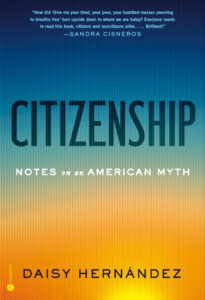
Citizenship: Notes on an American Myth by Daisy Hernández. Copyright © 2026 by Daisy Hernández. Published by Hogarth, an imprint of Random House, a division of Penguin Random House LLC. All rights reserved.

Daisy Hernández
Daisy Hernández is a memoirist and journalist who writes about the intersections of race, immigration, class, and sexuality. She is the author of several books, including The Kissing Bug, which won the 2022 PEN /Jean Stein Book Award and was selected as an inaugural title for the National Book Foundation’s Science + Literature Program. Her journalism work has appeared in the New York Times, The Atlantic, and National Geographic. Hernández is an associate professor in the English Department at Northwestern University.