Who Are You When You Lose Your Job? And Other Questions You Can Answer by Making Art
Hugo dos Santos Goes to Work at a Desk in the Basement
After I was laid off, I found myself haunted by the line “Had a dream I was Bartleby.” It had come to me very much like a dream, not thought so much as arrived. I wrote it down on the first piece of paper within reach, a pink Post-it, in the quick scribbles I am known to leave around the house.
For days, the line wouldn’t let me go. It followed me into the kitchen. Out into the yard. Down the street and across town on whatever minor errand I was running. It was there in the produce aisle, stuck between the impulse to buy mangoes and the need to remember we were out of apples. It was there at the gas pump, in the numb nothing of watching the numbers tick upward. The pink Post-it was still on my desk in the basement but the line had gotten loose. I did not understand why it wouldn’t let me go.
I think I understand now, at least a little. Someone who has just been laid off is someone in the process of disappearing, and they know it, even if they can’t say so. The routines that informed the self are gone. Gone are the title, the inbox, the calendar invites lining up the days. What remains is the stubborn question underneath all of it, the one the routines were so efficient at keeping quiet: Who am I when no one is paying me to be anything?
The part that knew, even in the worst days, there was something worth saving that a job title could not name.
The line I wrote on the Post-it was my answer before I even knew the question. Though maybe it wasn’t really an answer, more like a refusal to let the question be the last word.
I still have more questions than answers about Bartleby. About what he was holding on to, exactly, in that famous refusal. It’s easy to read him as a defeated man so hollowed out by the machinery of work that he can’t pull away from it. But I keep coming back to another possibility, which is that the preference not to was, in its own way, a kind of preservation. That somewhere underneath the paralysis lies something that will not allow itself to be consumed. The idea resonated with me then as it does now. Not so much the paralysis, because I was still moving and doing and reacting, but rather the instinct beneath that. The part of me that reached for a Post-it before it reached for LinkedIn. The part that knew, even in the worst days, there was something worth saving that a job title could not name.
Within hours of losing my job, the messages had started to pour in. Friends, colleagues, LinkedIn endorsements, links to newsletters for the unemployed. People were generous, genuinely so, and I was aware enough of their generosity to know that my inability to properly receive it was a problem of its own. Their grace was happening around me more than it was happening to me. I said all the right things, I sent the replies, but I was watching myself from a great distance, which is a strange and frightening place from which to watch yourself.
In those days, I found myself retracing the steps of my career. I was trying to understand, I suppose, how I had become the version of me that could be so thoroughly undone by losing a job. I thought about the younger me who had walked around the Rutgers-Newark campus with books in his messenger bag wearing the absolute conviction that he would make a living from his pen. I blush now, writing this, not because it was wrong to want it but because of how I traded it in, gradually, without any great battles to mark its going.
One compromise, then another, each of them reasonable on their own, each of them more costly than I realized at the time. My bylines in the Star-Ledger’s Newark This Week section, the graduate program that was going to turn me into a writer; I had left it all behind, like some kind of alternate life, while still in my 20s. I had gone into both of those opportunities with so much conviction, so much urgency to tell the stories of my Newark and the people who lived there. When I came out the other side, it was all gone. In the years that followed, there were moments along the way when I thought that maybe I could double back, find my way to being a writer, but I never did.
There are no perfect conditions for making art.
What I told myself, during those years of not writing, was that the conditions weren’t right. That I needed more time. More quiet. More distance from the ordinary demands of a life. That the writing would happen once things settled. Things never settle. What I was really doing was building a structure of permission so elaborate that I couldn’t find its door. And somewhere within that structure, I had stopped thinking of myself as a writer and started thinking of myself as someone who had, at one point, desperately wanted to be one. That is a thing which can happen slowly, and then wholly, and you don’t notice until you’re on the other side of it, standing in the supermarket with a line of poetry in your chest as you tell yourself that you’ll write it down later.
I went back to the Post-it.
I have written and rewritten that line more times than I can count. It became the opening line of the first poem I wrote for my collection. It became the opening line of the book. And working on that poem, and the poems that followed, I started to understand what I had cost myself with all those years of waiting for conditions that were never going to arrive.
There are no perfect conditions for making art. I know that now in my body the way you know things that have been learned at some expense. The art happens in the margins between obligations, between the work day and the start of dinner, in the twenty minutes before the house wakes up. Or it doesn’t happen. The desk in the basement is not a retreat from life. It is inside the life. The line that follows me to the supermarket is not a distraction from my real work. It is the work, asking to be let in.
In the end, the layoff did not give me time or clarity or any of the gifts we imagine that crisis delivers. Instead, it gave me the removal of the last excuse. No inbox. No meetings. No title to hide behind. Just the question, and the refusal, and the pink Post-it note still sitting on my desk.
I’m looking at it right now.
__________________________________
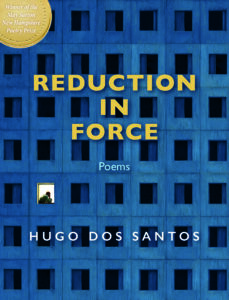
Reduction in Force by Hugo dos Santos is available from Bauhan Publishing.

Hugo dos Santos
Hugo dos Santos is an award-winning writer and translator. He is the author of Reduction in Force (Bauhan Publishing, forthcoming 2026), winner of the May Sarter New Hampshire Poetry Award, and Then, there (Spuyten Duyvil, 2019), a collection of Newark stories. His translations include Homecoming (Arquipélago Press, 2024) and A Child in Ruins (Writ Large Press, 2016), a staff pick by The Paris Review Daily.