Chang-rae Lee on Channeling His Immigrant Childhood Into Fiction
Jane Ciabattari Talks to the Author of A Tender Age
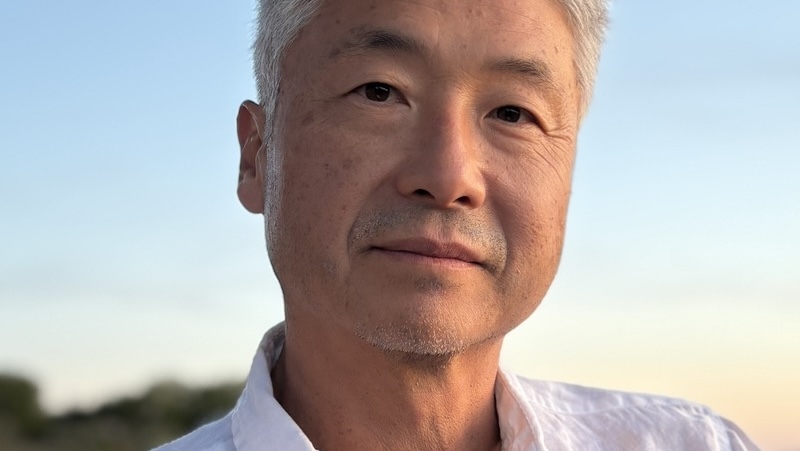
Chang-rae Lee’s family history influences most of his novels, especially his latest, A Tender Age. Lee was born in Seoul, in South Korea; his father’s family was from Pyongyang, now North Korea’s capital. He came to the U.S. at three and grew up in Westchester County, went on to Exeter and Yale, and soon found himself in a writing program at the University of Oregon. His thesis became his celebrated first novel, Native Speaker, a spy-for-hire tale in which a first generation Korean-American, Ed Park, is hired to gather intelligence on a Korean-American politician. Native Speaker won the PEN/Hemingway Award. Lee has continued to turn out impressive novels while teaching creative writing at Hunter, Princeton, and, currently Stanford. My favorites to date are On Such A Full Sea, a dystopian vision set in the former Baltimore (B-mor), and The Surrendered, which I called a “harrowing and elegiac novel about the anguish and cruelty of war” in my Boston Globe review. The Surrendered won the Dayton Literary Peace Prize and was a finalist for the Pulitzer Prize.
A Tender Age is a coming-of-age novel with Lee’s inimitable emotional nuance, impeccable language and flair. It features the distant perspective of a grown-up Jeon-Gi, as he traces the year leading up to the summer he turns eleven, in 1976, and begins to make the transition from beloved son in a closely connected family where his Korean immigrant parents seem infallible to the complex universe of adulthood in a second language.
Lee begins with a retrospective chapter, the adult Jeon-Gi: “…we can’t help but keep going back to the old times, futilely scratching at a spot,” he writes. “It doesn’t matter how significant a certain event or instance was, sometimes the barest irritation will draw incommensurate attention and the skin can go raw before you realize it. Lately, I can’t seem to help but linger on this time or that, those tender ages rife with curiosities, and go over in serial fashion what I might have done or said to defuse a tricky situation or take a more principled stand or else assuage my frustrated heart.” Then he dives into the visceral point of view of “a mere boy” who is emotionally isolated, bullied, frustrated, exploring, until he impulsively acts in ways that shock everyone around him.
What motivated you to write this new novel? I asked Lee. “Perhaps it’s my own not-so tender age, but I’d been musing a lot about my family’s early years in America, and my own adventures in the ‘wilds’ of suburban New York City,” he explained. “It was a time when we were learning so much about making a life in our bustling tenement, a place so rich in events and personages, and I wanted to capture something of those energies before it was lost to me.”
*
Jane Ciabattari: Why focus on the summer Jeon-Gi turns eleven?
Chang-rae Lee: For me that particular age was one when I knew that I was still very much a child, emotionally and physically, while also being on the verge of an adult knowingness, if not quite adult-level intellection. There’s a visceral, gut-level clarity Jeon-Gi has that in certain situations doesn’t square with how he thinks things should be, which in a story can make for captivating episodes.
JC: How difficult is it for a young boy of immigrant parents to find his way through a world in a second language, in a place that is unfamiliar to his parents? What are the options? How much does Jeon-Gi’s universe reflect your own experience?
CL: All immigrant children know how complicated this “new world” is, and that no matter how much their parents may try to ride herd, they are essentially traversing this realm solo. It’s a journeying full of excitement and fright, and laden with a startlingly heavy burden of responsibility, given that they are often the ones necessarily leading the way. I certainly felt so, wanting to do the right thing by us all but never knowing if we were heading in a good direction or towards some maelstrom.
All immigrant children know how complicated this “new world” is, and that no matter how much their parents may try to ride herd, they are essentially traversing this realm solo.
JC: The dual morality of Jeon-Gi’s parents ‘s expectations versus the customs and behaviors of the culture he’s growing into is stark and troubling. This creates tension throughout the novel. Does it seem to you to be unresolvable?
CL: Probably, yes. Any given culture is immensely powerful, it seeps into the deepest parts of you, and it feels almost impossible to recast yourself into a fundamentally new shape in the face of another, differing culture. We live in such a narrow slice of time and space. But I do think that in examining the various intersections and clashings we are also, if very finely, re-forming the culture, pushing it with our efforts and presence along a slightly altered path.
JC: Your narrator’s interior world is in many ways more vivid than the external world of his immigrant parents, his sister, the boys he encounters on the derelict playground, at his school. Where does that perspective come from?
CL: The narrator, like all narrators, is seeing/thinking/feeling from a place removed from the tumult and noise of his boyhood life, which gives him the psychic space to slow things down, to calmly and methodically explore notions and feelings that had at the time overwhelmed him. I surely wanted the narrator to capture in full the roiling emotions of Jeon-Gi but stay atop the deluge of those sensations in order to recreate them in detail and thereby understand them anew. That understanding for the narrator is one tinged with mourning for the boy who endured but also the suspect boy who was always there, even before all the unfortunate happenings.
JC: There are scenes of intense cruelty in this novel, especially those between rival boys. Were these difficult for you to write?
CL: Not as difficult as I expected, even as they cut close to the bone. I’ve written much more intense scenes in previous novels, and it’s always the same for me. You write with a bit of nervousness, like the butterflies in your chest before some big event or game, but then suddenly you’re so far inside the fictive moment that you sort of let go and feel the sheer pull of it, and there’s nothing you can really do but hang on, simply focusing on the word that’s coming next.
JC: The prison tour is seen from an angle of innocence being ripped apart, as the inmates expose some of the most common sadistic elements of prison life, to encourage these teenage and pre-teen boys who are getting into trouble to take a different path and avoid prison. What sort of research was involved in writing these scenes? To what extent do you think including Jeon-Gi , not close to being a teenager, in this cohort is an adult mistake that could haunt him?
CL: When I was young I remember watching a TV documentary about a “scared straight” prison visit program like the one I portray in the novel, and I was able to find a few online links and videos. I also recall thinking back then how scary and cool it would be to participate in something like that, as happens to Jeon-Gi, but of course it’s a terrible error and oversight that he’s included in the visit, which affects him in ways that he can’t fathom.
I do think that in examining the various intersections and clashings we are also, if very finely, re-forming the culture, pushing it with our efforts and presence along a slightly altered path.
JC: Jeon-Gi’s parents hope to give him a better sense of belonging by sending him to a Korean church camp, which sets him up for some moments of joy and disastrous actions. How did you create the realities of this camping experience—the storms, the cooking, the choosing of bunks, the interactions between boys and girls, especially Jeon-Gi and Susan, who is special to him, even the witnessing of adult sexual behavior?
CL: Going to such a camp is drawn from my youth, when I attended a church-sponsored Korean camp for many years. So I know those camping details intimately. I still can taste the “camper’s stew” we made back then while overnighting, and that Jeon-Gi helps make in the novel. Some of the other stuff I describe is both as remembered and semi-fictionalized, but I won’t specify more than that.
JC: Jeon-Gi’s chief rival at church camp is Dickens. “His self-assurance filled me with loathing and envy…He somehow sensed my own feeling that I ought to be punished for my failings, his nose for someone’s tender spots a capacity I realized I wished I had more keenly. This is what they mean by keeping your antagonists close; you think you are learning how to deal with a foe, anticipating their tactics, their antagonisms, rehearsing all the ways of defending yourself, but what happens is that you begin to see certain concordances, reflections of the contours of who you might be.” The complexity of their connection from the first day of camp is visceral. How did you develop this relationship? Were you able to draw upon any of your own life experiences, from boyhood on, at university, in academia?
CL: Those camps days are still so vivid for me and my friends. I still see a handful of them from time to time and we’ll talk and laugh about some odd moment or person like it was last summer, here almost 50 years later. Some tough things happened to me that I use as material—the episode with the Dickens character is one example—but mostly it was all silly and joyous and fun, a time when we felt the sort of natural communion that rarely occurs in adult life. I cherish those days.
JC: Occasionally you jump forward and give us a sense of Jeon-Gi’s future (his reconnecting with Susan, for instance). This adds to the suspense. At what point did you add this element to the narrative structure?
CL: I don’t think I ever “added” in those reports from the future/present, rather simply feeling the need at certain points for the narrator to re-appear for us and do some contextualizing. I suppose it’s always like that with me and the writing, more just feeling my way through and sensing when I need a pause or hard break in the rhythm.
JC: What are you working on now/next?
CL: I’ve been making notes on a new novel about a youthful romance, so maybe you could say it’s another coming of age story. It’s a happy story and a sad one, too, and drawn a bit from my own life. So maybe I’m on a run of telling self-stories.
_______________________________
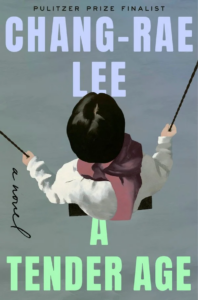
A Tender Age by Chang-rae Lee is available from Riverhead Books, an imprint of Penguin Publishing Group, a division of Penguin Random House, LLC.

Jane Ciabattari
Jane Ciabattari, author of the short story collection Stealing the Fire, is a former National Book Critics Circle president (currently on the Advisory Board ) and a member of the Writers Grotto and Page Street. Her reviews, interviews and cultural criticism have appeared in NPR, BBC Culture, the New York Times Book Review, the Guardian, Bookforum, Paris Review, the Washington Post, Boston Globe, and the Los Angeles Times, among other publications.