When a Californian Moves to Montana and Gets Pushback From the Locals
Cassidy Gard on Embracing the Heavy Weather in Life
“I wanted so badly to lie down next to her on the couch, to wrap my arms around her and sleep. Not fuck, like in those movies. Not even have sex. Just sleep together, in the most innocent sense of the phrase. But I lacked the courage and she had a boyfriend and I was gawky and she was gorgeous and I was hopelessly boring and she was endlessly fascinating. So I walked back to my room and collapsed on the bottom bunk, thinking that if people were rain, I was drizzle and she was a hurricane.”
–John Green, Looking for Alaska
*
I am the hurricane.
If you’re not sure whether you are one, then you probably aren’t. Hurricane Women know. We don’t try to be this way. We were born into it. Emotional weather systems with tempers, intuition, sensitivity, and something wild in our blood. Once we were little baby thunderstorms. Emotional outbursts. Quick to cry and just as fast to collapse into laughter. We were told to “calm down,” to “take it easy,” to “stop being so sensitive.” And we tried. God, we tried. I used to apologize for it. Tried to quiet it. I was told, more than once by a man I was dating, to “just be easy and breezy.” Certain women were born to be easy and breezy, and it comes naturally to them. I think for a long time I tried to water down the parts of myself to be more like that, but it made my chest feel hot and claustrophobic.
I’ve been called intense. Dramatic. In Montana, I started to see it in the context that I am a cowboy at heart. I’m a force. And eventually I stopped trying to shrink myself into a palatable draft. That last time a drizzle man told me to be easy and breezy, I looked him dead in the eyes and said, “I’m windy and complicated.” And I meant it.
Montana cracked something open in me. It was the land that first pulled me in. The big sky. The horses. The sacred silence. But it was also the resistance. The tension. The pushback from locals who didn’t want outsiders like me arriving with license plates from California. It was subtle at first, then not. Cars keyed. Passive aggressive signs. Glares at the gas station.
Certain women were born to be easy and breezy, and it comes naturally to them. I think for a long time I tried to water down the parts of myself to be more like that, but it made my chest feel hot and claustrophobic.
A neighbor gave me grief about the land I bought. He didn’t know me, didn’t know my name, my job, or how long I’d been working to build a life I could call my own. All he knew was that I was from California, and that was enough to rile him up. A local realtor had given him the scoop. A single lady. From out of town. Buying up land.
He came at me with that puffed-up small-town entitlement some men wear like armor. But one thing about being an investigative reporter, you can’t fuck with me. I’ve sat across from accused murderers, made cold calls to grieving families, held my own in rooms that most people would tiptoe out of. I’m not going to shrink just because someone calls himself a local.
I asked him plainly, “Were you born here?”
He hesitated.
“Nah,” he said finally. “I’m from Maryland. Moved here in the eighties.”
I nodded. “And how old were you when you moved?”
“Thirty.”
“Well, I’m thirty. So, it looks like we came at the same time, just in different decades.”
Silence.
I didn’t say it to be clever. I said it because I was tired of the mythology. As if being born a few zip codes over gave you more of a right to belong. As if this place, this piece of land, this open sky, belonged more to him than it did to me.
I wasn’t going to be sweet about it. I had found a piece of heaven, and I was going to fight like hell to protect it.
After my car got keyed, I installed cameras. I felt exposed, like I was trespassing, even though my name was on the deed. I had every legal right to be there, but I could still feel the suspicion in the air. I had been one of the first to relocate to the valley during COVID, and the locals didn’t hide their stares. Their silence wasn’t quiet. It was loaded.
They had guns. I had cameras.
I’m a news reporter. Surveillance is my armor. It’s how I protect myself. The entire property is under twenty-four-hour watch. I do not flinch when someone tries to intimidate me. I have footage. I have timestamps. I have evidence.
The land was vast, open, wild, and I loved it. I did feel uneasy at times, alone in that cabin at night, the wind howling like a warning. I wasn’t going to let that fear shrink me. I had claimed that patch of earth with every fiber of my being. And I would defend it with everything I had.
I understand the frustration about Airbnbs in small towns. But that business saved my life. It gave me the freedom to stop accepting newsroom assignments that drained me. It gave me a real shot at sovereignty. And I guard it fiercely. It was real estate investing that allowed me to stop chasing hustle and start living with intention.
It taught me something I never would’ve learned if I had waited for a man to handle it. The repairmen tried to take advantage. The contractors talked down to me. Men underestimated me until they didn’t. I learned to hold my ground, to negotiate with clarity and calm authority. I walked the property like I owned it because I did.
I had been too scrappy for too long, too careful with every dollar, to get taken for a ride. I wasn’t going to throw thousands of dollars at a repair I knew should cost $300.
And still, Montana tested me. The undercurrent here is unmistakable. Misogyny runs deep, quiet, local, and sharp as barbed wire. It isn’t just women in power they resent. Out here, a woman claiming space is a quiet rebellion. And I was done shrinking to soothe someone else’s discomfort.
I am windy and complicated.
And I have Montana to thank for giving me permission to lean all the way in, without apology, without softening the edges, without asking for permission.
It made me feel like I belonged to the land as much as it belonged to me. When I named the property Cosmic Goodness, and the neighbor scoffed, “What the hell is that?” I just smiled. He’d never get it. I’m a hurricane. He’s a drizzle man. Of course he wouldn’t understand. This wasn’t a place you named after something practical. It was a place you named after something sacred and ineffable; the kind of thing you feel in your bones but don’t waste time explaining to men who demand definitions.
_______________________________________
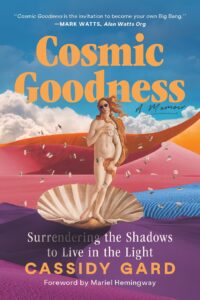
Excerpted from Cosmic Goddess: Surrendering the Shadows to Live in the Light by Cassidy Gard. Published by Post Hill Press. All rights reserved.
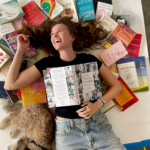
Cassidy Gard
Cassidy Gard is an Emmy Award–winning TV producer, author, and entrepreneur. A graduate from Hunter College, she rose quickly through the high-stakes world of morning television before a pandemic-era awakening led her to Paradise Valley, Montana, where she bought a cabin and named it Cosmic Goodness. Her work explores healing from childhood trauma, perfectionism, motherhood, and the quiet synchronistic winks that guide us to the miracles awaiting us. She lives between New York City and the Hamptons with her partner, their two sons Golden and Indigo, and fifteen-year-old Maltipoo, Hazel. Through her radical honesty and spiritual clairvoyance, Cassidy invites readers to tune to the frequency of their own inner knowing to tap into the cosmic goodness already within them.