When a Book Cover Designer Writes a Book, Who Designs the Cover?
Oliver Munday and Chris Brand Discuss the Process Behind Head of Household
As a book cover designer, I never imagined the tables being turned and finding myself in the position of an author awaiting cover designs. But after selling my first work of fiction, Head of Household, I did, and an urgent question was asked by nearly everyone: Will you design your own cover? My editor ultimately decided against granting me special treatment because of my profession, and I was extremely relieved to hear this. I’m far too close to the material to imagine the perfect cover; even my initial, private attempts at doing so were as fruitless as they were daunting.
I had only one designer in mind for the job, and that was Chris Brand. Chris is the creative director at Crown, where he’s worked for 15 years. He has designed myriad iconic book jackets over his career—for US presidents and debut novelists alike (he is also a friend with whom I shared a studio space in Midtown Manhattan when we were in our early 20s). Chris has a unique ability to pair gravitas with delicate wit, and for nearly two decades I’ve been jealous of, and inspired by, his skill.
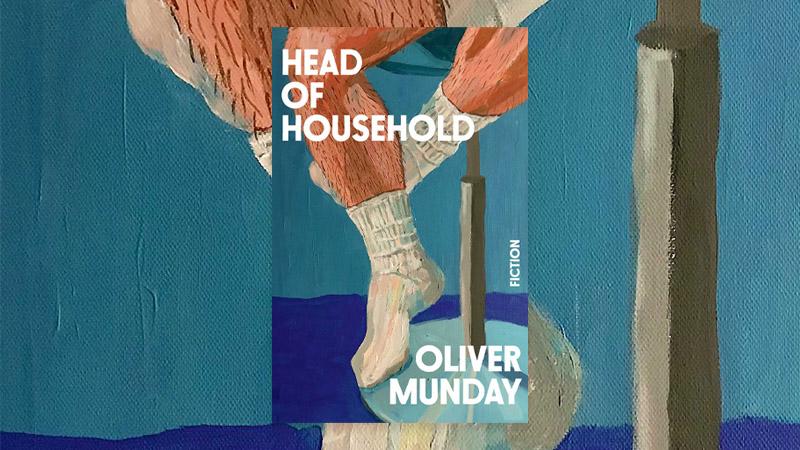
When I first opened the email with his preliminary ideas for the cover, I was floored by the range on display across 24 different designs. Each one was more arresting than the next. More importantly, though, I remain awed by how perfectly his final cover distills the narrative into a single image. (Those legs!) It telegraphs so much about the book, with a deceptive simplicity that reveals more meaning the longer I spend with it. The cover feels both surprising and inevitable. All of this is to say: I could never have imagined it.
It’s entirely possible that Chris made this look easier than it was, so I figured I would ask him about the particulars of his process. Below is our Q&A, lightly edited for clarity.
*
What was the first image, or idea, that came to mind when you received the cover brief for Head of Household, before reading anything?
Without any context, the first thing that came to mind for me was a tax-form—that box you have to check as you select your filing status. The title suggested a retro patriarchal trope to me. Once I read the stories though, I realized quickly that the title is ironic. The book can be funny at times and the characters are all deeply flawed people who are struggling to get by and do things right. As I started to think about what the cover might look like, I felt that the art had to underscore the irony of the title.
After viewing the many designs you initially sent, I felt spoiled for choice. Do you always design so many options when working on a cover? Do you think making more leads to better solutions in the end?
I looked back at the email, and the first round that I put together included 24 designs. This is pretty typical for me. I end up designing a lot of different covers in order to explore—partly because I don’t know what to do at first. This process helps me compare and contrast things and ultimately figure out what I want to say. I collect a ton of research before I start, so I’m never facing a blank canvas with nothing. From there, the ideas begin to branch off of each other. There are times when the covers improve in quality with the quantity, but then other times I realize I had it right to begin with. But going through the motions is reassuring for me—I’ve covered all the bases. Maybe it’s slightly psycho, but it’s not uncommon for me to finish a project with 400 or 500 pages in a InDesign document (InDesign is the program we use to design). I never delete anything, and end up with a bunch of different iterations—even the most minor changes, like type size or color, to a design—and I’m left with evidence of everything that I’d considered.
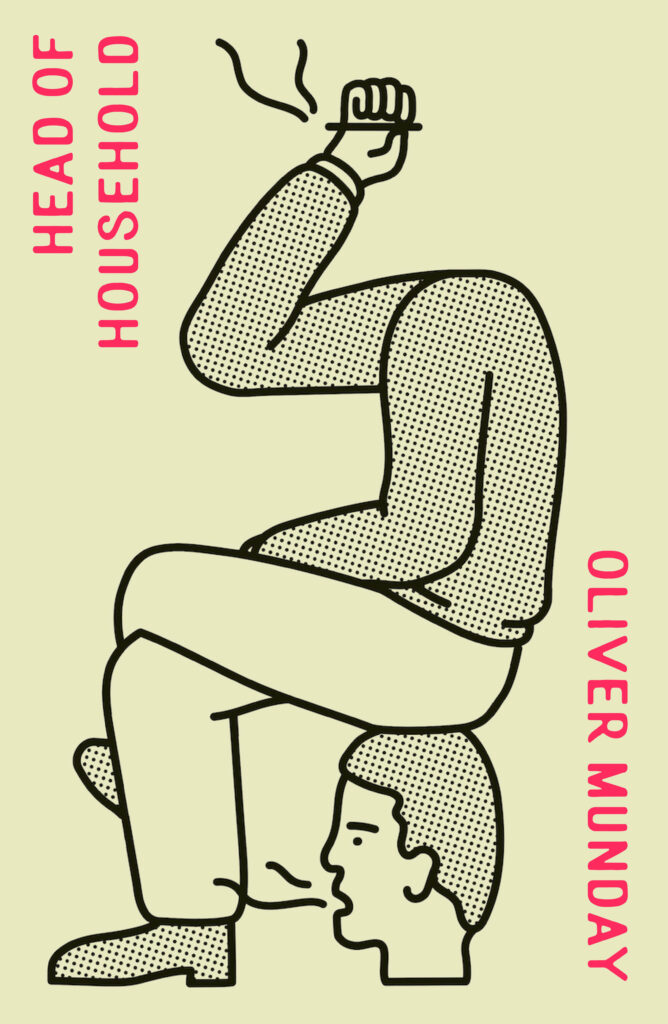
Unused cover art for Head of Household; designed by Chris Brand
Did you feel additional pressure during the process given the nature of the client?
This project definitely came with some extra pressure. I’ve designed hundreds of book covers, but never one for another cover designer. It’s safe to say that you’re one of the most celebrated designers in publishing, so most people probably would assume that you’d design your own cover. On top of that, you’re a longtime friend, and mixing friendship with work adds another level of complexity. I didn’t want to leave you in an awkward situation where you didn’t like the comps (I was also worried that I wouldn’t like the book!). Also, I had no idea what to expect because I know you primarily as a graphic designer and not an author. To my relief, I loved the stories. I came away impressed by the book and also feeling like you had some kind of alter-ego that I hadn’t known about for all these years.
You’re the father of a young daughter, as am I. I’ve been frustrated by the lack of fiction that directly depicts our experience. How, if at all, did Head of Household reflect your life as a dad?
It’s interesting, because some of the characters in Head of Household can be extreme. A few of the dads have problems that feel completely unrelatable to me, but even in those, there are small universal truths that emerge. It was nice to relate to those, to read about them. You deal with many of the typical familial aspects of fatherhood—the repetitiveness, the joy, etc—and in each story, I found myself being like: Yes! I’ve been there! But then there’s me as a person, outside of my role as a dad. I also loved the book as a New Yorker, and I enjoyed recognizing different aspects of the settings where New York or Brooklyn was central (being a parent here feels different). But even while the book revolves around fathers, I can see the stories being relevant to people of a certain age who call New York City home.
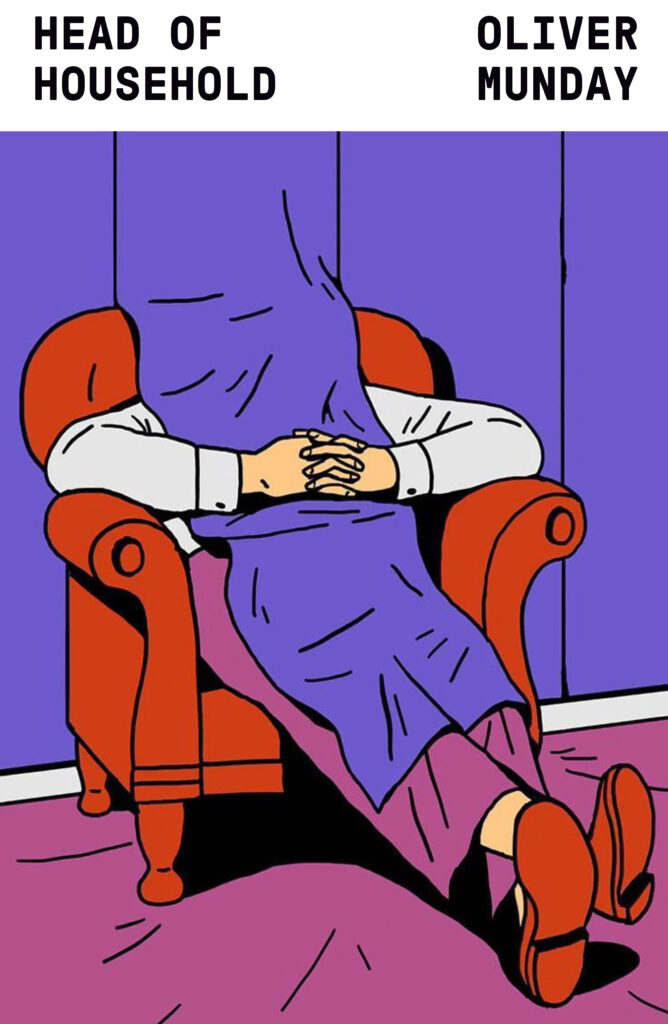
Unused cover art for Head of Household; designed by Chris Brand
You’ve designed so many iconic covers, like Ready Player One, The Dinner, and How Democracies Die. Is there a point in the process when you know you’re onto something?
After doing this for so long, I feel increasingly like there’s no rhyme or reason to any of it. Your examples are all amazing books. Sometimes I get lucky enough to work on a great project and make it through the gauntlet of covers with a good result. Other times, I work on a great book and there ends up being so much scrutiny over the design—from the many interested parties—that the cover gets watered down, and I end up with something that’s not very good. Every book, and author, is so different, and that’s part of what keeps the job interesting. When I’m lucky, the stars align and I end up with a cover I’m proud of for a book that I actually love.
Talk to me about Head of Household’s painting. In my view, it’s a genius choice for too many reasons to state here. How did you find it? And what initially struck you about it?
The painting is by Aleksandar Đurić, a Serbian artist based in Berlin. I stumbled upon it by chance while going down a Pinterest rabbit hole. I’d been looking for artists that I might commission for the cover, or existing art that I found compelling on its own. I was searching for something subversive, that cut against the title of the book. I like that Đurić’s painting suggests vulnerability. It has a tenderness to it. But in my initial PDF of designs, I used art from some other great artists, too, like Gabriel Alcala, Jonathan Wateridge, and Miller McCormick.
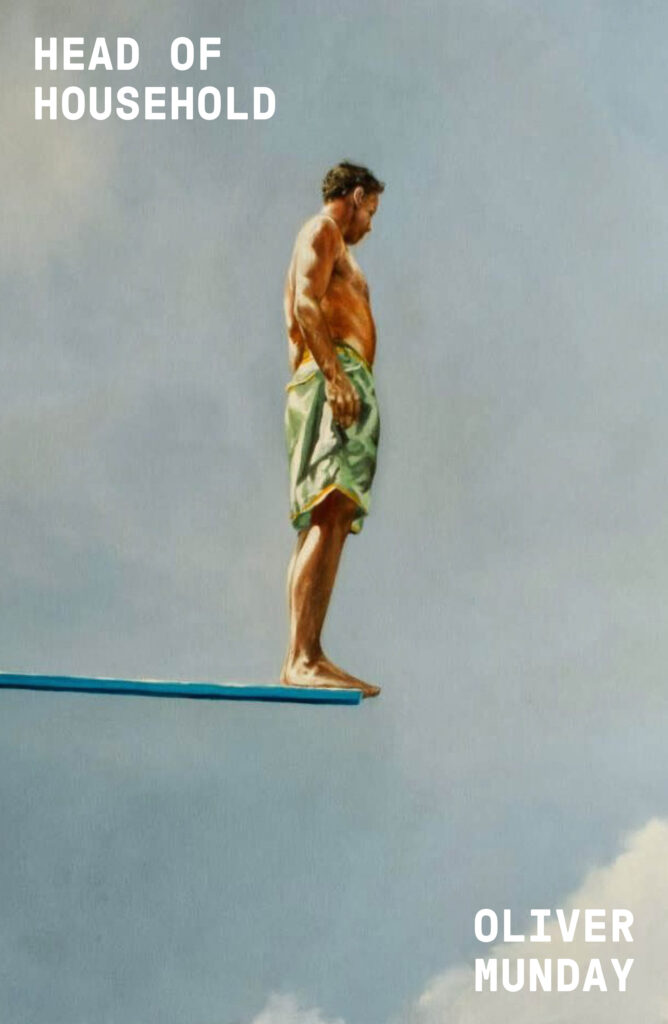
Unused cover art for Head of Household; designed by Chris Brand
Was the final cover a favorite of yours along the way? Did you always feel it was the one?
Honestly, I never know which cover is going to be the one! That’s probably why I end up doing so many comps (as in the behavior described above). I like where we ended up though—it was one of my favorites from the beginning. I always found it quirky—a bit literary—but it possessed a deeply human component that some of the other artists I found lacked. In the end, I think it has a bit of mass-appeal to it too.
The most exciting part of seeing your designs was how each version revealed something different about the book: some were wry, others emotional. As a result, you helped me better understand my own work. Are there certain narrative elements you tend to look out for when reading to design a cover?
I’m always thinking about how to present a variety, but I remember texting you after I finished reading to tell you how surprised I was by the range in the stories—some are hilarious and others are heartbreaking. They all dance around a common topic but come at it from different angles, so that gave me a lot of different ways to approach the cover. Whenever I design a cover though, the most important thing is making the art or design connect to the title. If the book is fiction, I take notes as I read; I’m on the lookout for objects or scenes or ideas that might work on the cover and respond well to the title. Also, I’ve always found it pleasantly surprising when I’m able to work something into a design that might not make sense until the reader finishes the book. It can create a moment of discovery later on.
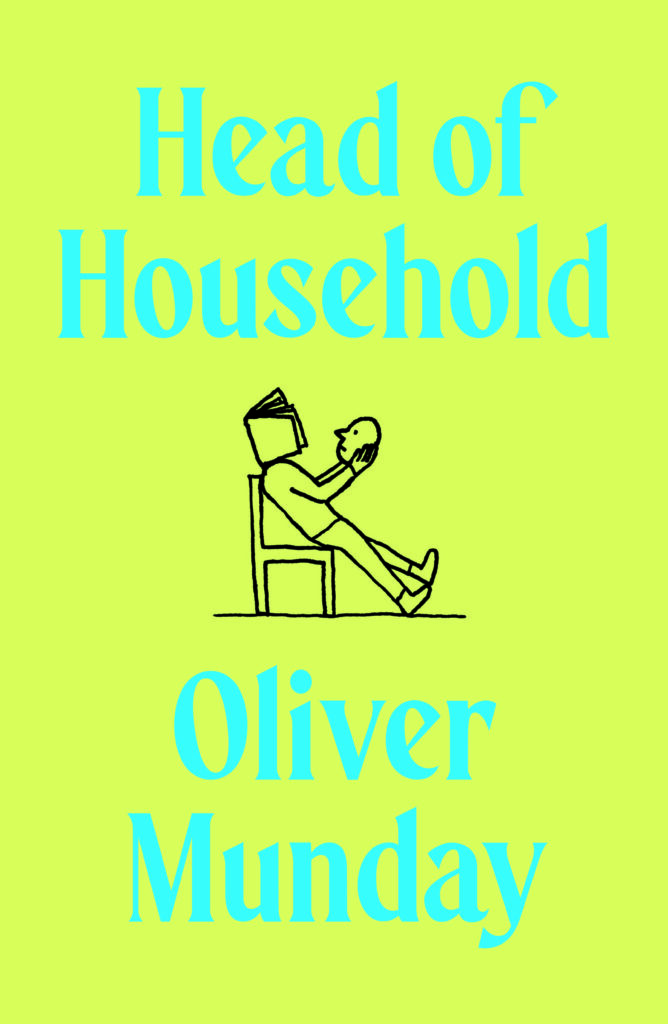
Unused cover art for Head of Household; designed by Chris Brand
Who are some of the designers that have influenced your work?
I started my career at Rodrigo Corral Design and I learned a lot from Rodrigo—he was definitely my biggest influence. There was another designer that worked there at the time, Ben Wiseman, and we’d bounce ideas off each other and I learned a lot from him too. After that, I did a short stint at Penguin where I worked for Paul Buckley. This was my first experience at an in-house art department at a big publisher, and I got to see how Paul managed a team, commissioned freelancers, and navigated a corporate environment. All of it was new to me but now it constitutes a huge part of my job. Also, while at Penguin, I met Darren Haggar, whose work has a brilliant simplicity and elegance that I love. And of course, sharing a studio with you after all of that was fun (not just because we had a foosball table). We were both young and trying to establish ourselves and hanging around with you at the studio definitely kept me on my toes and made me feel like I had to step up my game.
Do you ever plan to write a book? And if so, will you let me repay you by doing your cover?
You’re off the hook—you won’t see a book from me any time soon!
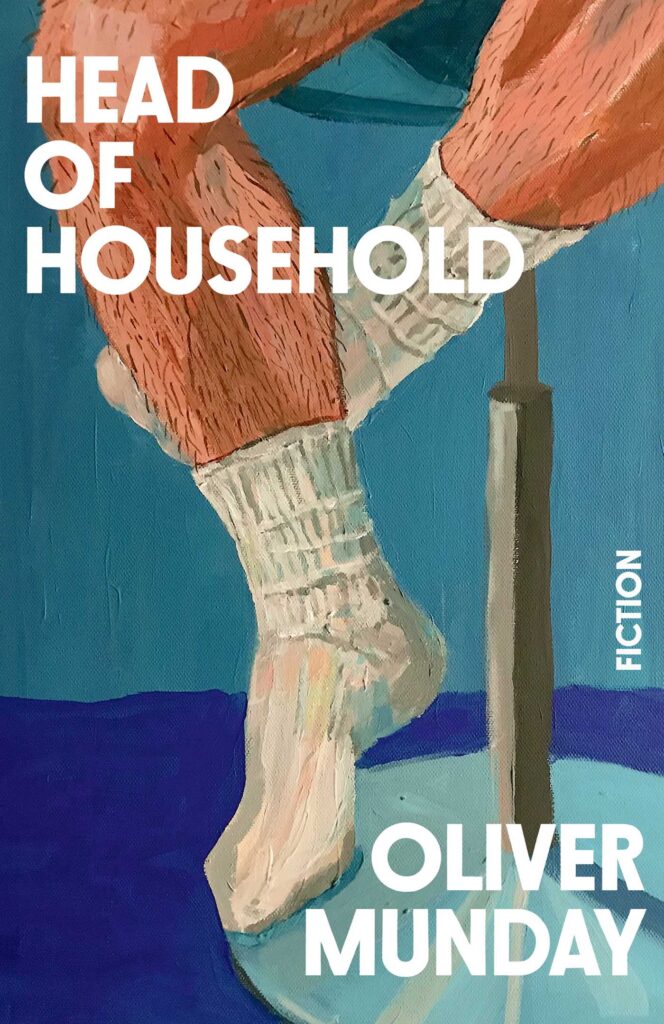
The final cover!

Oliver Munday
Oliver Munday is the author of Head of Household and Don't Sleep. His writing has appeared in The New York Times, The Atlantic, The Believer, The Sewanee Review, and Lit Hub.