What’s the Word for...
Forgetting Words?
Mira Ptacin on Grappling with Perimenopausal Aphasia
Lately I have been losing words. Not poetically, not as a metaphor for grief or heartbreak, shock or awe. I mean I am literally losing them. A name I should know (my own child’s), nouns that once arrived without coaxing (lichen, ottoman), verbs I trusted (pivot, hydroplane). Mid-sentence, mid-thought, mid-story I’ve told a hundred times; the word I want stands just out of reach, waving its little arms from a foggy distance.
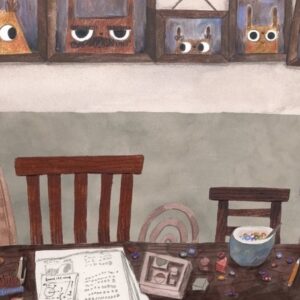
I’m a writer by trade. Words are my raw materials. Every morning I sit down at my old wooden desk with my laptop, talisman books, and dark-cherry seltzers, ready to iron out a sentence or paragraph. But lately the process resembles a middle-aged scavenger hunt: wandering through half-formed clauses, patting my pockets, squinting for meaning. It feels like looking for glasses that are already on my head.
This isn’t writer’s block; I know that old clown too well to confuse it with this. Writer’s block is self-inflicted, and can be bullied with ritual, caffeine, or a stern internal monologue. This? This is something else. It’s bodily. Hormonal. This is perimenopause—an ugly word I will never forget. Perimenopause has seeped into my mind like a trickster and rearranged the furniture, switched the labels on the drawers, locked me out of my own filing cabinet. A younger, sleeker, more patient writer might describe this more elegantly. But I won’t. Perimenopause is a bitch. The aphasia that has come with it? Even bitchier.
Scientists, naturally, have a gentler name: perimenopausal cognitive decline, which is not inaccurate but lands about as softly as a man explaining your own female brain to you. Estrogen, it turns out, helps regulate memory and language. When hormone levels are seesawing, neurotransmitters get jumpy and gray matter thins. Temporarily, they insist. Reversible, they say. Meanwhile, I’m in the kitchen trying to remember the word cinnamon and calling it “the spicy dust.”
This acquiescence of mine isn’t a “benediction.” It isn’t acceptance in a soft-lit, inspirational sense. It’s surrender in the practical sense: using the brain I have today.
If this were the only problem, I might muscle through it with grim determination. But I’m also a mother in my forties, which means daily life is a gauntlet of logistics: lunches, permission slips, orthodontist appointments, emotional squalls, school emails multiplying like fruit flies. Middle age parenthood is, above all else, administrative. My mind, once a private room lined with books, now feels like a public utility. Everyone needs something. And these logistics don’t just fill the mind; they occupy it by force. I used to daydream about sentences, turning over a phrase like a coin in my pocket. Now, in the middle of a paragraph, I’ll suddenly wonder: Did I switch the laundry? Did I RSVP? Did I move that appointment I forgot to move? My brain has become a cul-de-sac of errands, looping, repetitive, nearly impossible to exit.
The domestic always wins the thumb war with the literary. Layer maternal overload onto perimenopausal fog and what you get is not charming. It’s closer to panic: my brain feels like a workplace where the supervisor—my endocrine system—changes the policies daily and then denies ever having written the previous version. I don’t cope; I bulldoze. I push sentences forward the way you shoulder a stalled car off the road: jaw clenched, muttering new curse words into existence. It ain’t pretty.
The moment that undid me wasn’t public or dramatic. It was small. My ten-year-old daughter gently supplying me with a word I couldn’t find. It was a simple word, something like cole slaw. I thanked her, because I’m an adult, but the sting landed anyway. Not because she’d caught me flailing, but because she’d named the thing I was trying not to see: that the instrument I rely on most—language—was no longer obedient. After that, I stopped pretending this was a temporary inconvenience I could outmaneuver with grit. I stopped waiting to “get my old brain back.”
I accepted that my sentences might be plainer now, my message straightforward, not laid out as a puzzle, or a demonstration of my writing chops (as demonstrated in this essay), and that I can’t always rely on the baroque turns of phrase I once plucked from the air like low-hanging fruit. Precision used to be instinct. Now it’s labor. Some days I bulldoze through the gaps and patch them later. Some days I leave the gaps.
This acquiescence of mine isn’t a “benediction.” It isn’t acceptance in a soft-lit, inspirational sense. It’s surrender in the practical sense: using the brain I have today, not the one I had at twenty-eight, thirty-four, forty. Now, I’m letting truth outrank performance: my writing has changed. The surprise is that this recalibration brings its own kind of clarity. As E. B. White put it—brilliantly, and with his usual thrift—the cardinal rule is to omit needless words. When I stop reaching for elegance, something steadier appears on the page, something less showy and more durable. Something that feels (infuriatingly) more like me.
Science offers a sliver of reassurance. A 2021 brain-imaging study led by neuroscientist Lisa Mosconi at Weill Cornell Medical Center found that gray matter volume often dips during perimenopause, then rebounds after menopause—sometimes surpassing previous levels. A pruning before regrowth, a renovation disguised as demolition. Maybe what feels like decay is actually compost, feeding the next thing. Or maybe, maybe this is what it feels like to move from the bright center of youth to the edges, where middle-aged women are quietly assumed to be winding down. Out to pasture, as they say. But a pasture is also a field—wide, unmapped, rough in places, full of things you only notice when you stop sprinting. So I’m closing a chapter. I’m stepping into new ground, unsupervised and unsure, but still looking around. Still curious. If the words want to stray, fine. I’ll stray, too. And what’s the word for that again? Ah yes, grace.

Mira Ptacin
Mira Ptacin is an American author, literary journalist, and educator. Her memoir Poor Your Soul (2016) explores pregnancy loss and was named a Kirkus best book of the year, while The In-Betweens (2019) examines Spiritualism in Maine’s Camp Etna, praised by The New York Times as the best book to read during a pandemic. Her work appears in The New York Times, The Atavist, Harper’s, Tin House, and more. She holds an MFA from Sarah Lawrence College and has taught creative writing at Colby College and the Maine Correctional Center. Ptacin lives on Peaks Island, Maine, with her family, and serves as 2025-2026 Writer in Residence at Mechanics Hall in Portland, Maine.