What The Real Housewives of Beverly Hills Taught Me About Writing Conflict
Saleem Haddad on the Craft Lessons He’s Learned From Reality TV
My first interaction with The Real Housewives franchise happened sometime in 2015, when my partner became hooked on the show. I had just begun work on what I expected to be a big and research-heavy multi-generational family novel, and all I could hear was a chorus of accusations about who said what to whom, who lied to whom, and who hadn’t followed the correct etiquette at a charity event. One day, while trying to read in the next room to the backdrop of octave-defying accusations drifting through the thin wall, I told him that if he kept watching this show I would certainly lose my mind.
“As a writer, you have to get into this,” he insisted. “These women are incredible.”
At first, I resisted. I’d half-watch an episode while we ate dinner, or overhear a fight from the bath, but mostly I learned how to tune the chaos into background static.
But a couple of years later, while going through an intense writing phase, something happened. I was in the midst of writing the first draft of Floodlines, a family saga about art, memory, and the fractured relationships between three Iraqi-British sisters. I had the apartment to myself for a week and decided to break long stretches of writing with episodes from the first season of The Real Housewives of Beverly Hills. A palate cleanser, I told myself. Intellectual junk food between bouts of deep focus.
I didn’t expect the show to be creatively stimulating, let alone instructive. My novel about a family of artists reckoning with war, exile, and historical legacies felt galaxies away from diamond-clutching confessionals and slow-motion shots of women stepping out of limousines. But lessons in craft don’t always come wrapped in respectability, and over the course of that week, as I watched the show while writing scenes where family members orbit one another in a mixture of love, rivalry, and long-simmering grievances, something began to shift. What at first seemed like incoherent screaming matches suddenly revealed something psychologically deeper and anthropologically much more interesting. The Real Housewives, I realized, offers a masterclass on understanding how to write the social and psychological roots of interpersonal conflict.
Once we are attuned to each character’s purpose, backstory and relationship with one another, the episode is elevated into something else: a high society battlefield and a masterclass in how to structure multi-character conflict.
Nowhere is this clearer than in Episode 9 of the first season of Beverly Hills, titled “The Dinner Party from Hell.” The episode originally aired on December 16, 2010, and has since become Housewives canon, producing a trove of one-liners and GIFs still circulating fifteen years later. But beyond the memes and mythology, the scene itself holds extraordinary narrative architecture, offering an interesting example of how to write a scene involving multiple characters with complex personal histories and interiorities.
The episode is structured around the slow build and spectacular implosion of a dinner party. A Bravo-inflected descendant of the grand social set pieces of 19th-century literature, “The Dinner Party from Hell” feels reminiscent of Austen’s ballrooms or Tolstoy’s soirées, even the volcanic emotional architecture of Albee’s Who’s Afraid of Virginia Woolf?, a social gathering where conflict accumulates, gesture by gesture, until the emotional scaffolding collapses. Inner lives and relationships are exposed through sideways glances, simmering moments of silence, and dialogue that cuts in multiple directions, revealing shifting tectonic plates of alliances and relationships.
To understand why “The Dinner Party from Hell” works so well, it helps to understand the characters at its centre (spoilers ahead).
Camille Grammer enters the show in the midst of a slow-simmering identity fracture she refuses to acknowledge. Her marriage to famous actor Kelsey Grammer—the axis of her selfhood—is collapsing. Kelsey can barely stand her, is hardly ever there (he’s already met someone else, we later discover), and this fracture is something she tries to hide from herself, the cameras, and the other women. The truth emerges somatically: in defensive overreactions, a growing sense of humiliation, and a frantic need to be desired and validated. Her beauty and sexuality have always been her shield, but they are her wounds too. She is getting older, she feels undesirable in her marriage. A self-described “guy’s girl,” Camille performs cool femininity: the soft and breathy voice, the dainty California nonchalance, but underneath is a deep terror of losing her currency of desirability.
In many ways, Kyle Richards represents the kind of woman Camille is threatened by. She is grounded, socially fluent, secure in her marriage to a young, handsome, up-and-coming real estate tycoon, and surrounded by a strong circle of female friends. But Kyle carries her own psychic baggage. The youngest of three sisters raised by a domineering mother, she grew up overshadowed by her sister Kim, a former child star whose fame curdled into addiction. As the overlooked younger sister, Kyle resents Kim’s past stardom almost as much as she resents—and feels superior for—having to care for her, helping to conceal Kim’s spiraling substance abuse from the cameras. Years of living inside other people’s distortions have made Kyle hypervigilant to any suggestion that she is misrepresenting reality. She is conflict-avoidant, but when accused, she becomes reactive, insistent that any conflict is not her fault.
Around them orbit the other cast who, despite having their own fully fleshed-out narrative arcs, serve as secondary characters in this particular episode.
Kim Richards, Kyle’s fragile and volatile older sister, a former child star drowning in an unspoken substance abuse problem. Taylor Armstrong, quietly carrying the secret of domestic violence in her marriage. Adrienne Maloof and Lisa Vanderpump serve as dual narrators in the scene. Adrienne is the everywoman, the reluctant diplomat documenting in horror the women’s deteriorating dinner party behavior. Lisa is the elegant Greek chorus, offering dry British froideur and gleefully wicked commentary. They stabilize the narrative by showing us the absurdity and the stakes from different emotional angles: one horrified, the other delighted.
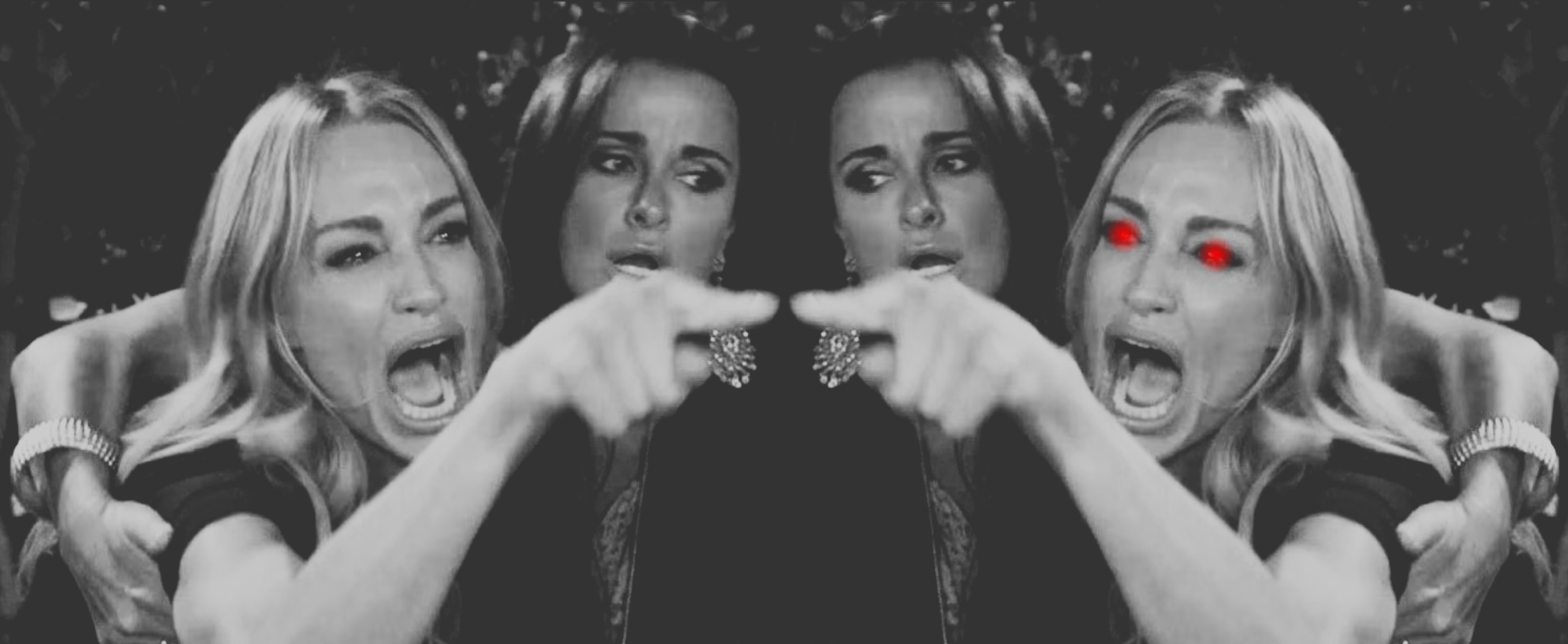
The primary tension here is between Kyle and Camille, two women locked in a season-long battle of paranoid insecurity and misread intentions. During a trip to New York, an off-camera exchange detonates the conflict. Camille had mentioned to the group that the show’s cameras had been filming her on holiday. Kyle asks whether Camille’s famous husband Kelsey was present when the cameras filmed her. Camille later claims Kyle actually said, “Why would anyone be interested in you without Kelsey there?” Kyle emphatically denies this, uttering the infamous line, “You’re such a fucking liar Camille!”
Regardless of the words Kyle actually used (which we will never know as it happened off camera), Camille heard only the echo of her deepest fear: You’re irrelevant without your husband. This is a crucial craft insight, and a reminder of how dialogue works not just on the page but in life. Psychologically astute dialogue recognizes that when two people speak, they are seldom responding to the literal words being said but rather to the imagined subtext, the intention they assign to the other person, one colored by their own projections, wounds, and private fears. Dialogue becomes a hall of mirrors where two emotional worlds collide, and characters respond less to the words being said than the subtext they infer—or, more accurately, the subtext projected onto the other person.
Whatever Kyle actually said, Camille hears something else: You’re worthless, desperate, paranoid. Similarly, when Camille tries to express vulnerability towards Kyle, telling her that she felt that Kyle actually meant something more sinister with her comment, Kyle—whose personal history makes her sensitive to the slightest amount of distortion—remains wedded to the literal facts of what was said, refusing to examine her words for any deeper undercurrents.
By the time the dinner party episode begins, the stakes are already sky-high.
The episode opens with Camille talking about her desire to throw a dinner party for “the girls” in order to clear the air after New York. Over lunch with Taylor, Camille says she is “cautiously optimistic” that she and Kyle will remain civil. But not optimistic enough to arrive at the dinner party unarmed, because Camille also invites two friends: her personal assistant Didi and the now-infamous psychic Allison Dubois, best known as the inspiration for the series Medium. A self-described profiler who claims she can ‘read’ people instantly, Allison walks into the dinner party with a practiced air of superiority that thinly veils her own deeper insecurities: she is not as elegant or rich as the other women, and doesn’t quite belong in their glamorous world, feeling a need to assert her own importance (and superiority) before anyone can dismiss her.
“Allison likes a cocktail,” Camille warns, a foreshadowing. “And when she has too many, she may hit below the belt.”
Kyle also arrives armed with her own ally in the form of Faye Resnick. A long-time friend, Faye is there to anchor Kyle’s reality and to detect and counter Camille’s narrative distortion. But Faye also comes with her own complicated history: a woman pulled into the vortex of the O.J. Simpson trial, she became a national symbol, vilified, sexualized, and accused of capitalizing on the murder of her close friend when she posed for Playboy in the aftermath of the trial.
The battle lines are drawn before dinner is served. As Camille, Allison and Didi wait for the guests to arrive, Allison makes a toast. “To new friends and old friends, and some new friends who may soon become old friends,” she cheers, taking a sip from her large cocktail, squinting villainously from above the rim.
Meanwhile, on the limo ride to dinner, Kyle is with her soldiers: Kim and Faye. Kyle plays the victim, expressing fear and vulnerability. Faye reassures her that “if [Camille] is mean to you, I’m obviously not going to just watch her.” Kyle asserts that Camille “will never be my best friend. Her reality and my reality are two very different things.”
One by one, the guests arrive, walking in like characters entering a haunted mansion, sensing but not yet naming the threat. As the women are introduced to the newcomers, Lisa cannot help but subtly put Allison down when Allison introduces herself as the inspiration behind the show Medium.
“Patricia Arquette plays me,” Allison says, smiling aggressively. “But I actually have a job and do something real, like profiling serial killers.”
“Oh really?” Lisa says, amused. “I must watch it,” she adds condescendingly.
The cocktails are strong, something noted by both our narrators. With Camille’s earlier warning that Allison may “hit below the belt” if over-served, this plants the seed in the audience’s mind: did Camille spike these drinks on purpose?
By the time the women are seated on velvet-upholstered chairs that rise behind them like thrones, with glistening silverware and a large bouquet of flowers at the center of the table, the tension has reached breaking point. Camille insists that her two friends sit on either side of her at the head of the table, like emotional bodyguards. “I don’t care where anyone else sits,” she says, feigning nonchalance. As servers delicately navigate around the women, serving plates of food that will never be touched, micro-aggressions are tossed, disguised as jokes.
“So how do you know Faye?” Camille asks Kyle with a chuckle. “Who is Faye?”
Faye is visibly irritated.
“I know she looks familiar…” Camille continues, teasing it out. “Wait, you know how I know her? I saw her naked on Playboy. She posed naked on Playboy after the O.J. trial.”
The first real attack. Before anyone can respond, Camille adds, “And I thought you looked amazing.”
In a confessional, Camille is more candid. “I recognized from the extensions and the blown-up fake lips, I recognized that’s who it is. It’s Faye Resnick. The morally corrupt Faye Resnick.”
By bringing up Faye’s Playboy spread, Camille subversively calls into question the moral character and sanctity of her enemy’s closest ally, thereby challenging Faye’s presence as a valid witness to Kyle’s reality while also hitting Faye where it hurts.
Meanwhile, Kyle and Lisa goad Allison the medium (who is getting drunker by the minute) to give them a psychic reading. Allison gets angry as the women challenge her claim to knowledge. At one point she pulls out an electronic cigarette, dramatically puffing out smoke from the corner of her mouth like a smug steam engine: a declaration that the rules of decorum have fallen apart and the gloves are off.
Allison, gently slurring her words, says that her psychic powers means that she “knows things”. This statement destabilizes the table, threatening each of the women who hold their own secrets and wounds. The camera cuts to Taylor who—hiding a variety of secrets—suddenly appears concerned. “But I’m off the clock,” Allison insists, refusing to disclose what it is she knows.
“We’re just curious,” Kyle taunts. She turns to Faye and says, in a voice loud enough to be heard by others: “She’s ‘off the clock.’ Maybe I should whip out my credit card.”
Alison swivels her head towards Kyle. “Don’t tempt me…really,” she warns, taking a drag off her cigarette.
“What does that mean, ‘don’t tempt me’?” Kyle asks.
“Do you really want to go there,” Camille gently advises. “Because she might pull some stuff out that some people might not want to hear.” Though feigning concern, the audience is left to wonder how much of all this Camille has planned—from inviting Allison to ensuring the cocktails are exceptionally strong.
Allison turns to Kyle, smiling mischievously. “What I want to tell you might be irritating to you, so I hesitate.”
“Just say it,” Camille says.
“Your husband will never emotionally fulfill you,” Allison snaps. “Ever. Know that. As soon as the kids are bigger, you’ll have nothing in common.”
Allison’s chilling prophecy about Kyle silences the table, quickly shifting the mood. Some women gasp. Allison’s comment lands with force because it is the first overtly aggressive statement made. It is the kind of line that becomes instant Housewives canon: camp and cruelty intertwined. What makes it brilliant—narratively and psychologically—is that it challenges Kyle’s core identity as happy wife. Allison has located the vulnerability Camille has been jabbing at all season, and she pierces it with surgical accuracy.
Faye then accuses Camille of orchestrating the entire set-up. Camille denies this, and when Faye says she doesn’t believe her, Camille says she feels Faye is “dismissing” her truth.
“Faye was like a panther,” Lisa narrates in a confessional, “prowling through the jungle.”
“I’m so bored by this conversation,” Faye says.
“Then leave,” Allison snaps. “You’ve got two legs…the last time we checked.”
At this point the dinner party falls apart. Kyle and Camille begin to argue, and when Kyle tries to bring in her sister Kim for support, an argument breaks out between Kim and Taylor. The group polarizes into shifting alliances as battle lines are drawn and re-drawn throughout the dinner party, the conflict between and within the women serving as choreography for the shifting relationships. Taylor, who is living in a violently abusive home environment, is overwhelmed by all the fighting and stands up, dramatically waving her arms and screaming: “Enough! Enough!” Camille smirks into her wine, feigning terror but secretly gleeful at the display.
“It was a few clowns short of a circus,” Lisa tells the audience in a confessional, smiling mischievously.
Finally, Kyle and her allies storm out of the house.
“Erm, thank you for having us,” Kim says awkwardly, the last of the women to leave. She slowly backs away from the table, walking into a large plant in the process.
Camille and her allies—Didi and Allison—remain at the table. Allison looks humiliated, already knowing she will regret her drunken outburst the next morning.
“She’s a mean girl,” Allison says, “the kind of girl in high school who would make other girls kill themselves.”
We watch as the women lick their wounds, desperately trying to spin the events into some kind of victory. The women are jealous of her, Camille argues. “Kyle came into my house and verbally assaulted me,” she says. The scene contains a deep loneliness—Camille, clutching a rose to her chest and surrounded by her only two friends who are, effectively, her employees, spinning a narrative even she doesn’t fully believe.
Behind the champagne and diamonds, the screaming matches and the electronic cigarettes, we are all simply wounded creatures brushing against one another, hoping to make ourselves whole.
Meanwhile, as they wait for their limos to arrive, the other women de-brief under fairy lights in Camille’s garden. The emotional wounds exposed at the dinner table spill over into the wider ecosystem of their relationship. Most importantly, Kyle is furious with her sister Kim for not having her back, a fracture in their already tumultuous relationship that will reverberate for years. Then, in a moment of Greek tragedy rendered in Bravo high camp, the sprinklers turn on, sending the women scattering away in their heels. Kyle banishes Kim to a separate limo while she rides with the other women. The episode ends with Kyle, surrounded by the other women, laughing and joking in the car, while Kim—the forgotten former child star—rides alone in her own limo, trying to call her sister, who refuses to pick up the phone.
The magic of the episode is that it operates on several levels simultaneously. At the very basic level, the scene is entertaining: replete with unforgettable one-liners and funny moments (the e-cigarette, the rose Camille cradles in the final scene, the sprinklers, Kim walking into a plant), which are enhanced by camp theatricality—Allison’s line, “He will never emotionally fulfill you”, is heightened by how seriously the women react to it. (Fifteen years later, Allison will be vindicated when Kyle’s marriage falls apart, just as she had predicted: “Once the children are bigger, you’ll have nothing in common.”).
But there is a deeper psychological impulse that drives the conflict, rooted in what we know about the different characters. To Camille, Kyle is a woman who threatens her vanishing worth and desirability. To Kyle, Camille is a woman who rewrites history, reminiscent of Kyle’s sister’s wilfull denial of her addiction issues, which forces Kyle to live in a distorted narrative. The dinner party shows the women unravelling into their truer selves under pressure. Intimate revelations and character development happens through conflict between the women, rather than confession.
Even Allison, a one-episode guest, serves an important narrative purpose: she operates as Camille’s shadow self, voicing everything Camille cannot say aloud. A prophetess of doom, she is a dramaturgical device, the wildcard who exposes the women’s deepest wounds. Once we are attuned to each character’s purpose, backstory and relationship with one another, the episode is elevated into something else: a high society battlefield and a masterclass in how to structure multi-character conflict.
The characters in my novel would need to do something similar, and I would need to find a way to showcase the tectonic movements beneath the surface. When writing Floodlines, I found myself studying the interactions between my characters through this lens: examining the micro-moments, trying to see how each scene moved the characters forward, how their wounds brushed up against each other, how they tried and failed and tried again to find reconciliation. Conflict is never linear, it loops, ricochets, spirals, igniting fires in unexpected places.
What mattered was how the emotional landscape of each of the ensemble simultaneously drives the conflict forward, while also shifting throughout the scene. How one sister’s defensiveness could trigger another’s guilt, how one’s olive branch could inflame another’s jealousy, which would sharpen into resentment, and would lead to an unrelated memory that triggers a comment that might ignite an argument, as it touches on a hidden wound. In my novel, an argument about a hidden artwork cannot just be about the artwork: it must also be about professional or personal jealousy, about why one sister left Iraq when she did, or about how their mother never really gave them enough love and care.
This is the psychological engineering that operates under the layer of the scene, and watching this unfold on television in a reality framework helps us understand real people. The dialogue is imbued with the different characters’ complex psychologies. No one speaks only to the person they are addressing—rather, every line is triangulated. Communication is a maze of deflections, accusations disguised as jokes, taunts masquerading as sincerity.
For a writer, examining this architecture is a gold mine. When constructing ensemble scenes in my own novel, I applied the same structural principles. Each family member speaks not just to the others, but also to the past version of themselves they carry like ghosts, to ex-husbands, lost dreams, traumatized childhoods, and unmet desires. And the challenge for a writer is to let the reader feel the pressure of all these layers through dialogue and, as an added bonus, humor.
Most importantly, it taught me that each character must believe the story belongs to them. Each one is fighting for dominance, or dignity, or survival—and the scene must allow them all to be right, and wrong, simultaneously. Each of the women in “The Dinner Party from Hell” believes she is the protagonist. No one’s arc is insubordinate; no one’s emotional logic is insignificant. The magic is in the ensemble and the shifting dynamics between them.
The candor of early Real Housewives seasons provides the kind of character complexity and interpersonal conflict seen in the best classical and modern literature, where scenes with a large number of characters interacting allow writers to flex their muscles. It provides a chance to examine how competing wounds, insecurities, desires, and delusions collide within a single volatile scene. The scene holds humor, tension, resentment, backstory, shifting alliances, self-delusion, choreography of bodies, and the revelation of interior truths. Behind the champagne and diamonds, the screaming matches and the electronic cigarettes, we are all simply wounded creatures brushing against one another, hoping to make ourselves whole.
In the final moments of “The Dinner Party from Hell,” as Kyle rides off in a limo with her friends, leaving her sister alone in a separate car, the viewer is left to wonder whether Camille may actually be right. Perhaps Kyle really is a mean girl, and much more vindictive and manipulative than she lets on. Kyle’s complexity—her unknowability—is what has made her the franchise’s central character for fifteen years. To this day, viewers are divided over how to perceive Beverly Hills’ anti-hero, and how we do so often tells us more about ourselves than it does about Kyle.
And that’s the role of great literature.
__________________________________

Floodlines by Saleem Haddad is available from Europa Editions.

Saleem Haddad
Saleem Haddad was born in Kuwait City to a Palestinian-Lebanese father and an Iraqi-German mother, and educated in Jordan, Canada, and the United Kingdom. He has worked as an aid worker with Doctors Without Borders in Yemen, Syria, and Iraq, and has advised on humanitarian and peacebuilding issues throughout West Asia and North Africa. He is the author of the acclaimed debut Guapa, a 2017 Stonewall Honor Book and the winner of the 2017 Polari Prize. His 2019 directorial debut, Marco, was nominated for the 2019 Iris Prize for “Best British Short Film” and is available to watch on YouTube. He is currently based in Lisbon.