What the Ghetto of Venice Reveals About Jewish History and Identity in Europe
From Alexander Lee's Cundill Prize-Shortlisted The First Ghetto
“But how I caught it, found it, or came by it,
What stuff ’tis made of, whereof it is born,
I am to learn…”
–William Shakespeare, The Merchant of Venice, 1.1.3-5
*Article continues after advertisement
It was a cold January afternoon when I first came to the Ghetto. I got there much later than I had hoped. I had spent much of the day elsewhere and had lost track of time. It was already beginning to get dark. The campo seemed deserted. Shutters were closed and, apart from the tinkling of water in the wells, there was hardly a sound. There were no streetlights; barely even the glimmer of a lamp. But in the branches of the trees, thousands of tiny lights were shining.
Having nothing else to do, I wandered idly across the square. On a wall opposite, I spotted an imposing bronze plaque. It was hard to make out in the gloom. Squinting, I could just see the image of a train pulling what looked like trucks. Hundreds of people—and around them, soldiers with guns. I caught my breath—a sharp intake of icy air. Behind the plaque, in a large irregular recess set with a metal grille, there was an inscription with names. Not far off, there was another with a date. I picked out the numbers slowly. 5 December 1943. I stopped. 5 December. My birthday.
Just then, I heard a sound coming from my right. A gentle song, joyful and defiant. Turning, I saw a light in a ground-floor window and a small group of men dressed in black, shawls pulled up, nodding their heads in prayer. Then it struck me. It was Friday. The Sabbath was beginning. Something stabbed at my heart. Without knowing why, I burst into tears.
Most of all, the Ghetto’s story is a testament of hope. Despite all they endured, its inhabitants not merely survived but thrived.
It was in that moment that my fascination for the Venetian Ghetto began. Although I did not realize it at the time, I had glimpsed—felt—the essence of its past. To most of us, the word ‘ghetto’ will be familiar. We know the tragic stories of the Warsaw Ghetto, the Łódź Ghetto, and the horrors which followed. We have heard it used of the ‘imprisoned cities’ of Black Americans in parts of Harlem and Chicago, Brownsville and Detroit. We have seen it reimagined in poems and songs. But it was there, in an out-of-the-way corner of Cannaregio, that the word—and its benighted history—was born.
*
In many ways, there was nothing particularly new about the Venetian Ghetto. It was certainly not the first time Jews had been confined to a quarter which was ‘obligatory, separate, and enclosed.’ Far from it: by the time it was established on March 29, 1516, the practice of enforced segregation was already a painfully familiar feature of European life. From at least the thirteenth century, Jews in Prague, Frankfurt-am-Main, Marseilles, and more than a dozen other cities had been required to live in specified neighborhoods, cut off from the surrounding area by barriers and iron gates.
But the Ghetto was not ‘just’ the culmination of earlier trends. There was no conscious effort to model it after Jewish quarters elsewhere, no clear awareness of its past, and no vision of how it might evolve more than a handful of years in the future. Rather, it was an ad hoc creation, occasioned by the tumult of the Italian Wars, and framed by Venice’s—perhaps myopic—determination to reconcile religious prejudice with its most pressing economic needs.
Like many other European states, Venice had long regarded Jews as a threat to its Christian identity. Preachers and patricians constantly warned that, if allowed to live unchecked in the city, Jews would ‘infect’ the Christian faithful, poisoning the minds of the pious and stealing souls away from salvation. Yet the Venetian government knew that it could not manage without a Jewish presence, either. By the early sixteenth century, the Republic’s economy was already showing signs of decline. The ‘working poor’ were especially vulnerable, but since the Venetians were unable–or unwilling—to offer any form of credit on their own account, they had no choice but to rely on Jewish moneylenders instead. The Ghetto was simply the easiest way of allowing Jewish loans to keep flowing while keeping the spiritual ‘risks’ to a minimum.
At first, it was intended to be a temporary measure; yet the collapse of Venice’s maritime trade—once the guarantor of its prosperity—demanded that the Ghetto not only be retained but expanded. Jewish merchants, originally from Spain and Portugal, were invited to make the Ghetto their home and, in doing so, help revive Venice’s flagging commerce with the Levant. One Ghetto swiftly became three; and as long as Venice’s fortunes continued to worsen, their existence was all but guaranteed—so much so that, by the mid-seventeenth century, their status could well be regarded as a barometer of Venice’s decline.
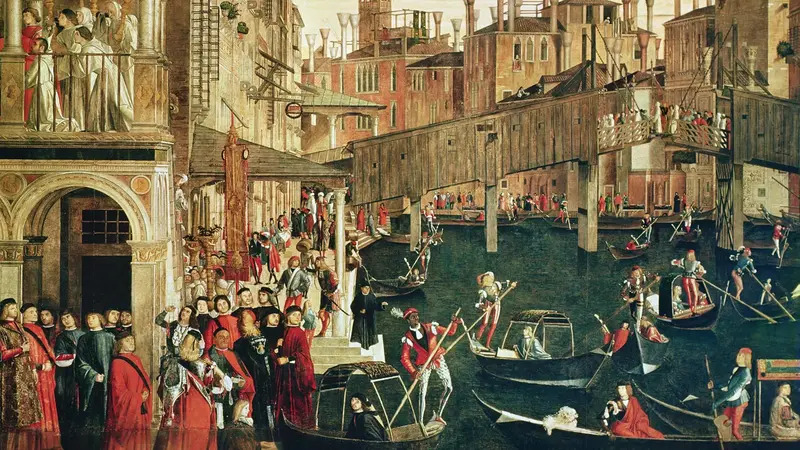
Though each of the Ghetto’s three areas (the Ghetto Nuovo, the Ghetto Vecchio, and the Ghetto Nuovissimo) retained its own, distinct character until remarkably late, it was always cramped, unsanitary, and marred by privation. Its residents were subject not just to innumerable petty restrictions, but to an ineradicable, if often variable, hostility. Comparisons with Shakespeare’s The Merchant of Venice are invidious, but perhaps unavoidable. Although most scholars now agree that Shylock’s ‘pound of flesh’ owes more to antisemitic hysteria in London than to daily life in the lagoon, the abuse he suffers at Antonio’s hand in the Rialto market would not have been all that unrecognizable, at least in a slightly earlier period. Insults were common, threats familiar. Accusations of blood libel periodically recurred. Physical attacks were not unknown. There are cases of Jewish corpses being abused on their way to the cemetery; and even one instance of a father watching as his son was stabbed to death in the street.
Over the 300 years of its existence, the Ghetto became a byword for the forcible segregation of Jewish communities. And after its gates were finally pulled down, it lived on—as much in mind as in space. To borrow James Baldwin’s phrase, its limits were ‘set forever.’ Jews, though relieved of their financial burdens and recognized as citizens, often struggled to escape the Ghetto’s shadow, and Venetian antisemitism, shorn of its religious mantle, took on the more vicious garb of race.
The Ghetto’s tale is anything but simple, however. Though its high walls were intended to protect the Christian population, they sometimes did more to defend the Jewish people within. Particularly after Venice’s break with the papacy in the early seventeenth century, the government went to great lengths to shield judaizers from the Inquisition’s glare and recast the Ghetto as a refuge. On other occasions, its walls could be remarkably porous. The Ghetto was, after all, founded in the expectation of regular exchange between Jews and Christians and was enlarged in the hope that it would be a window of sorts onto the East. Jews often lived outside the Ghetto; and, at times, Christians made their homes inside its walls. Conversions were common; apostasy not unknown; and the presence so-called Marranos (Jews from Spain or Portugal who had converted to Christianity) made it virtually impossible to draw a clear distinction between religious communities. Even at the height of Jewish segregation, Jews might work in partnership with Christians, call on Christians to arbitrate in disputes, or be welcomed into Christian homes as friends. And once segregation was ended, we find Jewish councillors at the heart of civic politics, Jewish restaurants being haunted by Venetian gourmands, and Jewish soldiers taking their place in the struggle first for Italian unity, then for Italian freedom.
The longer I have studied this most remarkable place…the more clearly have I come to see its essential truth: that its greatest monument is its endurance; its greatest blessing, its memory; and its greatest hope, its people.
Most of all, the Ghetto’s story is a testament of hope. Despite all they endured, its inhabitants not merely survived but thrived. They were, in a sense, a microcosm of the Jewish world. Having all fled persecution abroad, the early residents belonged to three ‘national’ groupings, worshipped according to two separate rites (Ashkenazi and Sephardic), and spoke any number of different languages. At various times, they practiced a dizzying range of professions: from doctors and rag-traders to merchants and copy-editors. More than once, they helped keep the Venetian economy from collapse. They founded no fewer than eight glittering synagogues, each a masterpiece of its kind; they founded innumerable charities; and they administered their own affairs with democratic probity. They were poets and scientists, musicians and philosophers; they put on plays and held festivals; and they transformed Venice into the greatest centre for Hebrew printing in the world. And almost five centuries after the Ghetto’s foundation—long after the horrors of the Holocaust—I found them still there, on that cold winter evening, proud, defiant, and full of hope.
*
In looking back at the Ghetto’s past, I have used three lenses. The first is context. As will perhaps already be apparent, the Ghetto is a product of much wider Jewish diasporas. Those who lived there came as refugees or migrants from Germany, Spain, Portugal, the Ottoman Empire, modern Ukraine—and perhaps even beyond; and the Ghetto’s story cannot be told except through their own. At the same time, it is equally impossible to understand the Ghetto except in relation to Venice’s own fortunes. Just as the Ghetto’s foundation was precipitated (if not necessarily caused) by the catastrophic defeats Venice suffered during the Italian Wars, so its subsequent history was shaped by the decline of Venetian shipping, its fractious relationship with the Ottoman Empire and the papacy, its shift towards the land, and its subjugation—to France, to Austria, and finally to Italy. I have therefore tried to link the daily happenings in Cannaregio with the bigger picture as clearly as I can. As will become clear, this has often necessitated giving a good deal of attention to Venice’s economic situation, the state of its public finances and—most of all—the workings of credit markets. These are, understandably, often rather tricky topics; but I have done my best to avoid unnecessary technicalities whenever possible.
The second lends is environment. Although the Ghetto’s story often unfolds across a large canvas, as a tale of negotiations and charters, wars and finances, the Ghetto itself was never anything less than a lived environment. Whatever the squalls raging about, those few small blocks structured and shaped the daily lives of Venice’s Jewish population. It was there, in those squares and streets, that people had their homes, ate their meals, celebrated, worshipped, and mourned. The fabric of the Ghetto is the warp and weft of its social existence. At each stage of the narrative, I have therefore tried to give as clear an impression as I can of the built environment and its evolution: the state of the tenements, the shops and synagogues, the wells, drains, and bridges. In this, I have been helped immeasurably by the abundance of primary materials still available and by the many wonderful studies which have been produced in recent decades, most notably by Donatella Calabi, Ennio Concina, and Ugo Camerino—not to mention the outstanding conservation work which has preserved so many of the Ghetto’s buildings for posterity.
The third is personalities. Although this book traces the Ghetto’s history from the arrival of the first Jews in Venice down to the present day—a period of some 700 years—it is above all a story of individuals. The Ghetto itself was a place to live; and though its fate was often shaped by factors beyond the control of any one person, it was always a living community of families, friends, acquaintances, and rivals. As such, I have tried to tell the Ghetto’s tale through the experiences, and (where possible) the voices of its inhabitants. Particularly for earlier periods, this has, admittedly, not always been easy. Far fewer first-hand accounts have come down to us than we might like. As a result, non-Jewish sources have necessarily had to be privileged, a fact which has the unfortunate effect of reinforcing Jewish exclusion. From the mid-sixteenth century onwards, however, the situation is quite different. Thanks to the wealth of materials which have survived, we are fortunate to be able to reconstruct many lives in exceptional detail. Some of these are ‘significant’ figures who made some noteworthy contribution to cultural, political, or religious life, or who are otherwise well represented in the documentary record, such as the poet Sara Copia Sullam, the learned rabbi Leon Modena, the revolutionary Daniele Manin, and the doctor Giuseppe Jona. But I have tried too, balance these with the lives of more ordinary people, too, like Simcà Todesca, the housewife who found a baby on her doorstep, and the children who were separated from their parents during the Second World War.
This book cannot pretend to completeness, however. It is the historian’s curse to see the past through a glass darkly; and even the most strenuous efforts afford nothing more than a brief and incomplete glimpse into the Ghetto’s history. Yet the longer I have studied this most remarkable place, the more deeply I have dug into its records and remains, the more clearly have I come to see its essential truth: that its greatest monument is its endurance; its greatest blessing, its memory; and its greatest hope, its people.
_______________________________
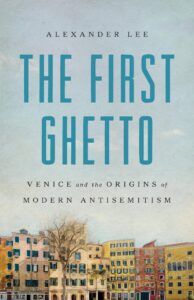
From The First Ghetto: Venice and the Origins of Modern Antisemitism by Alexander Lee. Copyright © 2026. Available from Basic Books, an imprint of Hachette Book Group. The First Ghetto has been shortlisted for the 2026 Cundill History Prize.

Alexander Lee
Alexander Lee is a prize-winning historian at the University of Warwick. He is the author of five acclaimed books, including Machiavelli: His Life and Times (a Financial Times Book of the Year). He writes a column for History Today and appears frequently on television, radio, and podcasts. Lee is a fellow of the Royal Historical Society. He lives in France.