What Night of the Living Dead Taught Me About Filmmaking—and Life
Daniel Kraus on Horror, Improvisation and the Power of Creative Passion
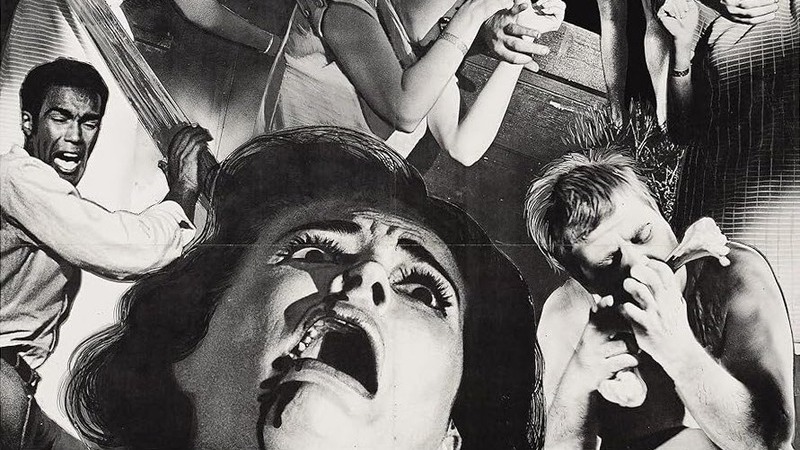
I first saw George A. Romero’s Night of the Living Dead at age five. A five-year-old doesn’t request a 1960s horror classic; rather, it appears on a screen before him. It helped to have a mother who aligned to the factory specs of a Midwestern mom of three except for the caprice of loving horror movies. Upon seeing undead shamblers on the tube, my mother didn’t turn it off or shoo me from the room. She proved her deep insight into her middle child by inviting me into the experience, poking fun at the characters and their cavalcade of misfortunes. It started there for me. Everything. My interests, my career. The world opened up from beneath a homemade quilt and atop a shag carpet. My rough estimate is that I’ve seen Night three hundred times. It’s a film that, no matter how many times I watch it, yields new information, especially once I began scrutinizing it frame-by-frame.
Night begins with a brand-new two-door 1967 Pontiac LeMans crawling on vertiginous Franklin Road outside Evans City, Pennsylvania, before making a hairpin turn up a steep, slender dirt road that leads into the famous cemetery. The LeMans pulls to a halt right where the camera can look through the open passenger window. First we see Barbra, then Johnny. Barbra’s peppy attitude is parried by Johnny’s sour one and we swiftly learn why: “You know, we’ve still got a three-hour drive back. We’re not going to be home until after midnight.”
Dialogue tells us that Barb and John have come to put a memorial on their father’s grave at their behest of their mother, who lives in Pittsburgh. Wherever we are, dialogue will soon confirm the siblings grew up here. Johnny wants to move the grave to Pittsburgh. This upsets Barbra. Naturally: disinterring a loved one is a reliably upsetting notion. Johnny lifts a plastic cross, festooned with plastic flowers, from the backseat and mocks it. The cross says WE STILL REMEMBER but he insists he doesn’t.
*
It makes sense, then, that the 1923 building was scheduled for demolition in 2011 until Night sound engineer Gary Streiner (Russ’s younger brother, who joined the Latent Image while still in college) raised fifty grand in a Fix the Chapel fundraiser (and then, along with several others, got a tattoo of the chapel). With assistance from Pittsburgh engineer Don Gilmore, the chapel received a new foundation, roof, columned porch, and was bestowed with historical status—all of which helped shift Evans City’s perspective on the film that, until then, some locals had scorned. Today you can even get married in the chapel, if necropolis nuptials appeal to you. A photo from the 2014 Living Dead Festival shows nearly all surviving cast and crew on the chapel’s new porch, including Judith O’Dea and Russell Streiner. Yes, Barb and Johnny drove all the way back out there, hopefully with a working radio this time.
Horror fiction cancels out our IOUs of existential dread. That must be why I write it.
The duo spends thirty-five seconds searching for their dad’s grave and bickering. The fact that most genre films center on romantic couples makes Night’s sibling relationship fresh and increased my investment as a child. I didn’t care about romance, but sibling rivalries? I had two sisters, and my feeling was that my older one, Jenny, got all the trust and privileges while my younger one, Julie, was the coddled baby. There’s truth to this appraisal, but it’s also true I, in what felt like caged frustration, was a jerk to both of them. Jenny deflected me with enervating ease. Julie, though, didn’t have the tools. Her peaceful play filled me with jealousy; I felt none of that peace. The energy I devoted to snuffing her joy remains one of my life’s most stinging regrets.
In other words, I was Johnny.
I’m not being metaphorical. Let me explain.
On March 16, 1991, when I was fifteen, my dad, a southern Illinois farm boy who moved to Iowa to work in soil conservation, inexplicably came home with a camcorder. (Perhaps not so inexplicably: The day before, our dog, Penny, had run away and gotten killed by a car, an incident I, probably unfairly blamed on my dad. The camera might have been an apology.) The camera wasn’t VHS, Super VHS, Betamax, or Hi8, but the extremely weird format of mini-VHS. To watch what you shot, you popped a blocky little tape into a VHS-shaped holster before inserting it into a VCR. So, like VHS, but even shittier.
My family toyed with it for a bit, but soon I established squatter’s rights. Over the next five years, I spent much of my free time directing a series of increasingly ambitious movies. To wit, my first outing, Kat Killer (shot on May 17, 1991, in unedited sequence, as I had no editing equipment) was five minutes long, while my magnum opus, shot in 1993-1994, The Godfathers, Part Two, was a soul-crushing two hours and forty minutes. I made these under the cringey moniker “Danman Productions” and aired them on a fledgling public access station broadcasted from the local library with all the pomp and circumstance of a teen employee pressing play on a VCR.
My siblings and friends became an adolescent Image Ten, everyone contributing (poorly but enthusiastically) in front of and behind the camera. If Jami was being stabbed, Julie was mixing the blood he’d spew. If Julie was being decapitated by hedge clippers, Shad was cueing her when to start screaming. Our budgets were less than Night‘s original, $6,000 (typically they were $0), but as we progressed, I began shelling out for props and music.
Once I was too broke to buy a cassette tape I wanted for soundtrack music and told Joe (my most frequent leading man and, perversely, our worst actor) that if he bought it for me, I’d thank him if I ever won an Oscar. The wild thing is, a quarter-century later, a story idea I had as a kid evolved into the Oscar-winning The Shape of Water. Sadly for Joe, it didn’t earn me a turn at the Dolby Theatre stage mic. (Though I did get to see, in person, George Romero’s picture come up in the Oscars’ “In Memoriam” section, as Eddie Vedder crooned through Tom Petty’s “Room at the Top.”)
One of my Danman Productions was Night of the Living Dead. It wasn’t the only remake in my adolescent oeuvre; I had previously shot mini-versions of Misery and The Blob. It shouldn’t surprise you that my version of Night remains the most watchable Danman Production. When my English teacher, Mr. Slechta, showed it in class, the applause was genuine. Love drips off every auto-focus shot. The fact that it’s only ten minutes long makes what I chose to include from Romero’s film revealing.
Shot on August 8, 1991—two weeks after another rewatch of Image Ten’s Night—my version begins with me as Johnny and sister Julie as Barbra. Siblings play siblings. Instead of Evans City Cemetery, we’re in our backyard beside a grave marker made from two nailed-together sticks. This “grave” sits between a hay bale my dad used for bowhunting practice and a random cinder block. We’re both wearing shorts. This was practically law in Danman Productions: Everyone must wear shorts. I’ve got chicken legs. I’m wearing a T-shirt from the school tennis team. But just like Russ Streiner, I complain about the long drive.
It’s not the finished product that matters, it’s the chase of it. Night of the Living Dead is a literal and symbolic chase all the way through, and that’s why I love it.
Several seconds later, my character dies on the grass (right alongside the clearly visible script). I often cast myself as the first character to die; it got me back behind the camera where I belonged. But I like to think there’s a little more here going on. As Daniel, I was a jerk to Julie, and as Johnny, I paid for it.
I didn’t come to my jackass style of moviemaking out of nowhere. Image Ten was to blame. They instilled within me a profound, lifelong affection for indie filmmaking. I’m not talking about “indie film” as applied to, say, Pulp Fiction ($8.5 million budget). I’m talking about the real stuff. The shooting-on-nights-and-weekends stuff. The we-might-all-die-if-this-special-effect-goes-wrong stuff. I’m talking Equinox ($8,000), The Battery ($6,000), Black Devil Doll from Hell ($10,000), and Bone Sickness ($4,000).
The importance of art like this grows by the day. In a world where AI and CGI create seamless visual media, seeing those seams right where fallible human hands put them is everything—it’s proof of intent, of passion, of life itself.
No-budget filmmaking is an especially American folly-slash-miracle, the dreams of the anonymous cauldroned in backyards and basements in hopes of acknowledgement. Of what? That their designs matter. That they matter. Much of this cinema falls into the horror genre, for horror is our equalizer. Cancer, car crashes, school shootings, they pluck us out at random. Horror fiction cancels out our IOUs of existential dread. That must be why I write it. Especially when you consider what a nervous, fearful child I was.
Conversely, the emotion generated by no-budget horror is rarely terror. It’s joy. Delight. Admiration and love. Every cruddy prosthetic (Night has several) and substandard effect reveal our dreams to one another. It doesn’t matter if it’s Steven Spielberg and Tobe Hooper building extravagant Poltergeist effects on an MGM soundstage, Image Ten splattering chocolate-syrup blood in Pittsburgh, or Danman Productions doing god knows what in Iowa.
Call it Don Quixote Disease. Or just call it the American spirit. It’s not the finished product that matters, it’s the chase of it. Night of the Living Dead is a literal and symbolic chase all the way through, and that’s why I love it.
__________________________________
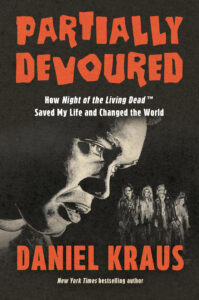
Excerpted from Partially Devoured: How Night of the Living Dead Saved My Life and Changed the World by Daniel Kraus. Copyright © 2026 by Daniel Kraus. Reprinted by permission of Counterpoint Press.

Daniel Kraus
Daniel Kraus is a New York Times bestselling writer of novels, TV, and film. His latest novel, Angel Down, was a New York Times Top 10 Book of 2025. His novel Whalefall won the Alex Award, was a Los Angeles Times Book Prize Finalist, and was named a Best Book of 2023 by NPR, The New York Times, Amazon, Chicago Tribune, and more. With Guillermo del Toro, he cowrote The Shape of Water, based on the same idea the two created for the Oscar-winning film.