What Keeps Us Human: How My Palestinian Father Met My Jewish Mother
Hannah Lillith Assadi on Overcoming Impossible Barriers to Love
They met for the first time past midnight in a Tribeca bar. This was in October of 1983, and like so many ephemeral New York bars, Prescott’s on Greenwich Street is now long gone. In its time, it had what the kids these days would call a vibe. I suppose, my mother and father were no different than the rest of us who arrive in New York so young and so cool. It’s almost as if—in this city at least—these sorts of mythical haunts are earthside portals to those enchanted rooms we see only in our dreams. Rooms where anything can happen, especially falling in love.
On this October night, Prescott’s was that sort of place, anyways.
My mother had been on a date with someone else. Legend has it, a lawyer. Tagging along was her best friend, the one who had given her the blow. My father came in with another taxi driver. He was wearing—my father was—his beloved thick framed glasses, half crooked and likely broken, when he ordered a vodka, a Stoli on ice, his life-long drink of choice until his future oncologist would order him off the booze. Unfortunately, the cancer got him anyways.
I do know one thing: The risk they took that night in each other is the risk which is required of us, of all of us, to stay human.
The Human League’s “Don’t You Want Me” was playing on the bar stereo. My mother and father danced. It was love at first sight. She ditched the date, her friend, and went back with him, my father, this random cabbie, to his studio at 17 Grove Street. In ’83, he paid a rent there of two hundred some dollars. That same building was last listed for $12 million.
So that was my parents’ first night—a year after the massacre at Sabra and Shatila in which an estimated 3500 Palestinians had been killed by Israel’s proxy militia, in the month when 241 US marines were killed by a suicide bombing in Beirut, in the midst of an epidemic destroying their own city. Yes, that same night, beyond the hallowed walls of Prescott’s, people all across New York were being brutalized by HIV, falling dead from AIDS.
It was a cruel world. Who could trust anyone in it? As usual, everything was coming undone. Being gay could kill you. Being Palestinian could definitely kill you. Being Jewish, from time immemorial, could kill you. Even making love could now kill you. Everyone was doomed. How could anyone anywhere ever fall in love again?
At some point that first night, my father must have told my mother he was a Palestinian. Though it must have been obvious. His dress, his voice. Sometimes it surprises me now to listen to audio recordings of him: Was my father always this Arab? I had become so accustomed to hearing his accent when he lived, I hardly noticed how heavy it was. Oh, how I miss it.
My mother would not have held back that she was Jewish, even if she might have left out the part about being from Alabama. How liberating it was to be a Jew in New York having grown up in the only Jewish family in her small Southern hometown! In Alabama, the punishment for this audacity had most often involved waking up to her family’s dogs poisoned in the night. As if the dogs were at fault for this utterly anthropocentric religious affiliation.
Strolling through the snow in my father’s taxi lot months later, my mother said she wanted to meet his family in Kuwait, and he said to her, There is only one way: She had to be his wife. The following winter, they were married in an Alabamian town incredibly named Andalusia after the Spanish region famed in Arabic poetry for being yet another lost paradise.
*
39 Octobers later, my father passed away in the American desert, and within the first year’s anniversary of his death arrived October 7, 2023. In the early weeks of Israel’s horrific retribution, followed by 24 months and counting of genocide in Gaza, I have often asked myself: Would my parents have made it through this?
I’ll never forget sitting with an old friend, a Palestinian Muslim, a year or so ago when he asked a third friend, another Palestinian, though Christian—who had been complaining about his loneliness all night—if he would ever consider dating a Jewish person. One, my friend went on, Who thinks like us of course, who believes in the right things?
And the third friend replied, No. No definitely not. I just couldn’t do it. Not after all this.
What hurt me was not that he said no, but that he said it so quickly. That he didn’t even need to think about it. And at the same time, what hurt me, is how well I understood him.
Imagine you’re a Palestinian after all this, all this watching children who may or may not be your cousins burned alive in tents as the world turned its eyes away, you’re the Palestinian after all this screaming for something as simple as a true and lasting ceasefire, and being gaslit and told that your desire for freedom, for peace, makes someone feel uncomfortable, feel threatened, and that someone who says this, claims they are speaking for all Jews (though they most certainly are not), and now you’re at the Prescott’s of the month, you’re a Palestinian, and a cab driver, you’re broke, you can barely pay the rent, its New York City for god sakes, but you just want a vodka on ice, it’s getting cold out there, already another October come and gone, and you’re lonely, so lonely, and there she is, and what a beauty she is, she’s definitely your type, at first you think maybe she’s even an Arab, and she asks you to dance, and you really want to, and it’s Lana, or even some old school Cure on the speakers and then you see she is wearing a Magen David necklace, and you don’t know if that means she will hate you or love you better than anyone ever has, and you’re just you, a human being just like her, but with an Arabic name, and a Palestinian accent, so what do you say? Do you say yes?
Since that October which none of us can forget, I’ve often thought about my father, and I’ve tried to imagine him in his same position in 1983 but in 2026, and what he might say.
Can any lover just remain in the Garden of Eden? According to James Baldwin and God, the answer is no.
*
I wonder, I really do, if that meeting at Prescott’s could happen again now. The other night, I overheard a stranger say: I swore I’d never leave Palestine, but then I began to imagine them dead. The stranger went on: I knew then that the hate had gotten to me. It was outpacing the love I had even for my homeland. The hate would destroy all the love I had left.
And I confess, I’m not unlike that stranger: Yes even me, a romantic, a notorious fool for love, me who was made of this star-crossed stuff.
I’m thinking about all this tonight, about hate, about uncrossable borders, about my children emerging into this much too lateness of our world, after taking out the trash, because there it is: The full moon gazing at me, like a lover from the other side appearing unannounced in the winter night. Forbidden, stunning. I don’t know how to look back at it. It is too much, its beauty. It seems to be asking me a question, like: Did you forget all about me? Did you forget about a love like this?
And I want to answer: Well, I haven’t forgotten how much it hurts.
Sometimes my five year old daughter screams that she hates me, sometimes my daughter screams she hates her shirt or her shoes, sometimes she screams that she hates her sister, her father. And when I ask her why, say, Hate isn’t good. We don’t hate. The answer is always the same: Because you hurt me, because it hurt me, because they hurt me, because she hurt me, he hurt me.
Like Noor Hindi, I want to be like those poets who care about the moon. But how can I, after all this?
Then I think, maybe it’s all I care about actually, the moon that is. That surprise of illumination, that miraculous, orbiting satellite in the dark, bellowing night. That’s love isn’t it? And I can’t bear to lose it, the moon, myself. After all, I descend from a Jewish woman who left her favorite bar with an extraordinary stranger, a Palestinian cabbie, and a man who let himself take the one they called his enemy into his most precious because once stolen thing: his home.
I don’t know anything about how all of this ends. I don’t know how our world stops turning on this axis of perpetual catastrophe. But I do know one thing: The risk they took that night in each other is the risk which is required of us, of all of us, to stay human.
We must go on loving, even after all this, and love, love, loving despite the howling and relentless coming of our ends.
So to the moon, I repeat Mahmoud Darwish who in “Eleven Stars Over the Last Andalusian Sky” writes, I love you, nothing hurts me.
I love you, nothing hurts me.
I love you, nothing hurts me.
My tata never spoke any English. And yet, the only words I remember her saying were: I love, love, I love, love, love.
*
Back in 1983 on that October night, after my mother said that she was Jewish, my father must have asked the question—that knowing him—he wanted to ask: Had she ever been there?
Yes, in fact, she had. Just a few years prior. She loved the Old City. Jerusalem. There was even a brief fling with an Arab guy there.
And when she asked, what about you? What might he have said?
That he was born there, of course, and that he last saw it, leaving, walking by foot with his mother, my tata, his infant brother, and siblings across the border to Syria at the age of five years old.
And that, one day he would return.
My father couldn’t know then that he would never see Palestine again.
Nor that the Jewish woman sitting across from him at the bar would be at his side until his last day.
And this is the real heart of their story, isn’t it? The real risk we take in each other. It’s like the moon. You almost can’t look at it. Not really. Because if you do, you must reckon with the fact that the next night, the next hour even, the moon will not look the same as it had from the window of your long gone Prescott’s and then one day….It will not appear in the October sky, unannounced and gorgeous and a little bit forbidden, for you, and only you, dancing with you to “Don’t You Want Me?”, ever again.
How could we hate it, the moon I mean? I mean ourselves. Even though we hurt us so.
We must go on loving, even after all this, and love, love, loving despite the howling and relentless coming of our ends.
__________________________________
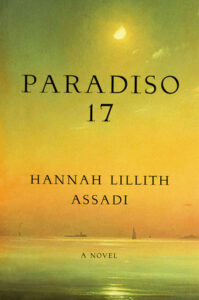
Paradiso 17 by Hannah Lillith Assadi is available from Alfred A. Knopf, an imprint of Knopf Doubleday Publishing Group, a division of Penguin Random House, LLC.
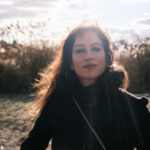
Hannah Lillith Assadi
Hannah Lillith Assadi, a National Book Foundation 5 Under 35 honoree, teaches fiction at the Columbia University School of the Arts and the Pratt Institute. She is the author of Sonora, which received the Rosenthal Family Foundation Award from the American Academy of Arts and Letters and was a finalist for the PEN/Robert W. Bingham Prize for Debut Fiction. Her second novel, The Stars Are Not Yet Bells, was a New Yorker and NPR best book of 2022. Raised in Arizona, she lives in Brooklyn, New York.