What It Means to Come From Appalachian Coal Country
Emilee Hackney Considers Family History Alongside the Rise and Fall of the Coal Industry
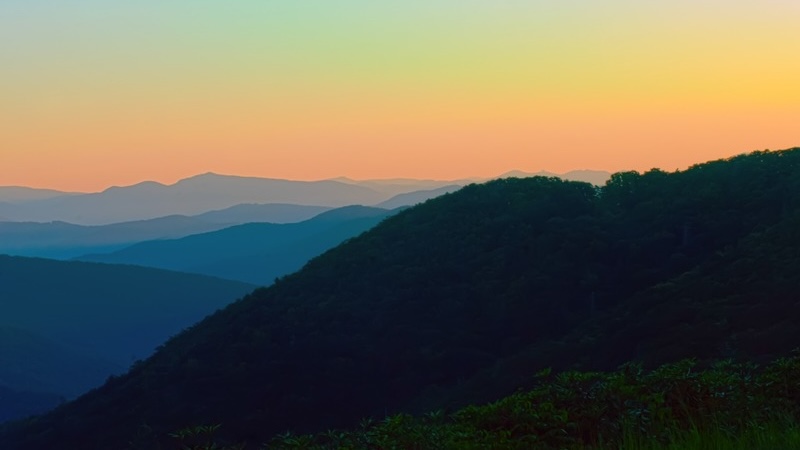
In one of my earliest memories, I’m shrinking. I’m in the back seat of my parents’ car, face pressed against the window, straining to see the peaks of the mountains outside. The road we’re driving on snakes through a deep, narrow cut between two ridges. The farther we go, the steeper the mountains grow, and the smaller I feel. I am dwarfed by their magnitude and majesty.
Even as a toddler, I’m awed by the mountains. They are confining and comforting, ancient and noble. They radiate a soft old wisdom, as if they were born at the very dawn of the world. I feel as if I were born from them, as if my bones were formed from their dirt. In a way, they were: I’m an eighth-generation Appalachian, attached to the land by something more sacred, more mysterious, than mere blood and history. There is magic in that mystery, and in the darkness of the valley that sits between the sunny ridges. I bounce in my car seat, thrilled by the swoop in my stomach as we round the hairpin curves. My parents glance back at me, amused: A dying little coal town, deeply isolated even by Appalachian standards, is my favorite place on earth.
*
Not that I knew of many other places. There was Tazewell County, where I was born and raised, and there was Buchanan County to the west, where my parents—and grandparents, and their grandparents, and their grandparents—were born and raised. That little corner of southwest Virginia was my entire world, my family’s entire world, too. Two and a half centuries ago, a German mercenary deserted the British army, fled the war, and settled in the mountains of what would eventually become known as Buchanan County. What drew him there, or made him stay, is unknown: The land was so rugged and rocky that it was never settled even by Native Americans. Since him, every one of my ancestors has lived and died within a few miles of his original homestead, in the shadowed hills and hollers that never see the sun.
Even as a toddler, I’m awed by the mountains. They are confining and comforting, ancient and noble. They radiate a soft old wisdom, as if they were born at the very dawn of the world.
I grew up feeling the weight of this legacy. It seemed congenital, so perfect was my family’s loyalty to the land. I would not think about leaving—it would not occur to me that I could—for many years.
My mother’s parents—Nanny and Poppaw, I called them—grew up in Grundy, Buchanan County’s only town to speak of, and spent the early years of their marriage in Lexington, Kentucky. The city was small, but not to two kids from the coalfields. Poppaw dug ditches for a water company. Nanny raised my mother. Poppaw racked up promotions—“literally worked his way from the ground up,” Nanny would say—until the little family moved from a trailer park to a real brick house in the suburbs and Poppaw had an office on the top floor of a building overlooking the city.
But no matter how far you go, you can never leave the mountains. Or rather, they’ll never leave you. Poppaw got antsy living among all those people. He grew to hate the noisy streets and busy office and looking out his kitchen window to see the next-door neighbor looking back. He moved his family back to Grundy, traded his suits and ties for coveralls, and went back to digging. This time, for coal.
Each time she told the story about why they came back, Nanny’s face shifted in a way I grew to expect. She spoke of my grandfather’s hard work with bright, proud eyes, recalling the smallest details of her respectable suburban life as if she feared forgetting. Sometimes she’d illustrate the story by pulling out Poppaw’s desktop nameplate, one of his few possessions she kept after he died. Her smile sagged when she spoke of his wild ache for home. She lamented the move, yet resigned herself to it long before it happened.
“The mountains are in our blood,” she’d say. Every time, the same words. “I knew we wouldn’t stay gone for long.”
*
As the crow flies, there were thirty miles between my parents’ house in Tazewell County and my grandparents’ house in Buchanan County. The driving distance was double that. It took an hour and a half to go sixty miles, longer if you got stuck behind a coal truck, which happened more often than not.
My mother hated the drive. “It’s like going down into a hole,” she’d say, white-knuckling her seat belt through the scariest curves. The road descended from Tazewell’s gentle hilltops to narrow canyons, winding deeper into Buchanan County until you finally reached the little town of Grundy. It sat in the shadows, cradled by mountains that held back the light. The buildings were dulled with age and coal dust. The ones nearest the river were slated for demolition, their walls soft and swollen with mold.
The Grundy of my grandparents’ childhood would have been unrecognizable to me. Main Street was once as nice as any city’s shopping district: You could find designer clothes, luxury furniture, and the latest record by any band you could think of. On weekends, the sidewalks were so crowded that you could barely squeeze through. Now the shops were empty, decaying. Nobody had a reason to walk down the sidewalk unless they were headed to the courthouse. In the time it took my grandparents to grow old, the coal industry waned sharply, and the town lost almost half its population. The aftermath of this exodus was the Grundy I knew, palpably unsettled by abandonment, shocked to silence by the awareness of what remained.
King Coal, as it was often called, was the reason Grundy existed, and the reason it continued to exist. Yet coal had doomed Grundy before the town was conceived.
Still, Grundy enchanted me. Maybe it was my blood connection to its history. Maybe it was the oddity of its existence, the mythic lore of its rise and fall.
When people talked about the Appalachian coalfields—my Appalachia—I hung on to every word. Their voices were reverent, the fact of the mountains transcended to legend. They spoke about coal as if it were sacred, and it was: Grundy was a single-industry town, built by mining companies and the men who flocked to work for them a century before I was born. King Coal, as it was often called, was the reason Grundy existed, and the reason it continued to exist. Yet coal had doomed Grundy before the town was conceived.
Mining was a cruel and fragile industry. Even in its post-World War heyday, the coal market was unpredictable, a constant, rapid cycle of boom and bust. Mines would open; mines would close. Miners would walk into work not knowing if they still had a job. When Poppaw moved back to Grundy in the mid-1970s, he started mining in the fallout that followed a record production year. He’d keep a job for a few months, maybe a year with luck, then get laid off without notice or furloughed indefinitely. That was how it went for the rest of his life. I have a few early memories of him in his coveralls, black from head to toe in a film of greasy coal dust, but I mostly remember him stuck at his house for days and weeks at a time, pacing from the patio to the front porch to the patio again.
“Antsy,” Nanny would say.
*
There’s a bronze statue of a coal miner in front of the Buchanan County Courthouse. If you’re passing through Grundy, you’ll see him at a distance of about fifty yards, standing on a base of dark stone. He appears strong and proud, with broad shoulders and a wide stance. He holds a pickax with steady, confident hands.
If you look closer, there’s a different story. The miner’s neck is strained. His mouth sags. His hard, flat eyes gaze so high above the mountaintops that his pupils almost disappear into his skull.
As a child, I was unsettled by those eyes. Looking at them stirred something within me, a feeling I couldn’t yet put into words. I sensed they were tuned to another world, somewhere far beyond the mountains. Years later, after I had made my way out of Appalachia, the mystery of the miner would remain. No matter how far I went, and no matter how many times I returned home, it haunted me always, the longing in his weary, heaven-bound gaze.
____________________________

From All That’s Unseen: An Appalachian Memoir by Emilee Hackney. Published by Penguin Press, an imprint of Penguin Publishing Group, a division of Penguin Random House, LLC. Copyright © 2026 by Emilee Hackney.

Emilee Hackney
Emilee Hackney grew up in the coalfields of southwest Virginia. She graduated from Harvard University with a BA in English and briefly attended Vanderbilt University’s MFA program. All That’s Unseen is her first book.