







What It Means To Be a Basque Writer
Kirmen Uribe on Language as Inheritance, Resistence and Community
“There is no such thing as an ugly language. Today I hear every language as if it were the only one, and when I hear of one that is dying, it overwhelms me as though it were the death of the earth.”
– Elias Canetti
*Article continues after advertisement
I did not have a name during the first months of my life. I was born in the early 1970s in the Basque Country, and Franco, the dictator, was ill but still alive.
My mother went to court to register me. The secretary asked for my name.
“Kirmen,” she said.
The secretary replied that it was not a name, that Basque names were forbidden. “Why don’t you call him José María, or something like that—like everyone else?”
My mother refused this double naming: I was Kirmen, and that was it.
She went back week after week, and each time they gave her a negative answer. “And if you name him Kirmen María?” the secretary suggested. “It will be easier to admit the name if you add something in Spanish.”
In the end, the secretary gave up. That is how my name stands: Kirmen, only Kirmen.
At the time, many families lived with two names: the Basque one used at home and among friends, and the Spanish one required in official documents. My mother refused that division. She would not allow the language of intimacy to become a private code while another name stood in its place before the state.
I remember something else from those years. Franco was on his deathbed, and there had been shootings days earlier. The police were going house to house, searching apartments. At ours, my mother gathered everything that could be dangerous—leftist posters, pamphlets, reports—and made them disappear, as many others were doing.
Soon she saw the guardias’ black car in the street below. Moments later they were at our door. They entered with certainty, convinced they would find something. Drawers were emptied, closets overturned, every crack inspected.
It is something magical: the language itself growing with you—small when I was small, larger as I grew.
One room remained. “It’s my daughter’s room,” my mother said in Spanish. “She’s sick.” My sister was in bed with a fever. They searched there too.
Suddenly a guardia found something in a drawer beside the bed and called his chief. My mother froze. Had she forgotten a paper? Had she missed something?
“Don’t worry, Mum, they’re songs,” my sister whispered in Basque. Lasai ama, kantak dira.
The chief asked what the child had said.
“She has a fever. She wants water,” my mother replied in Spanish.
The guardias left without finding anything.
In those years, Basque was not only a language of affection. It was a language of secrets. It allowed my mother and sister to speak freely in the presence of power. It protected them.
The anecdote illustrates the difficult situation the Basque language was living through then, and how much has changed since. I belong to the first generation to receive a full education in Basque—primary, secondary, and university. As I grew up, the language grew with me. From being intimate, spoken barely at home and in small villages, it expanded into society, gaining space and confidence.
We were taught in apartments because there was no legal education in Basque—everything was altruistic and idealistic. At first, we did not even have printed schoolbooks. Everything had to be made from scratch. Slowly, institutions appeared. A Basque radio station opened. Then Basque television.
We matured side by side, almost hand in hand. It is something magical: the language itself growing with you—small when I was small, larger as I grew. Not every writer can say that. Most are born into a language already powerful and complete.
*
The Basque language, Euskera, has around a million speakers, even though nearly two and a half million people live in the Basque Country. It remains a minority language in its own land, with Spanish dominant in the south and French in the north.
Basque is not an Indo-European language. Something resembling today’s Euskera was spoken in Europe long before the Indo-European migrations from the East began around 4,500 years ago. No one knows exactly where it comes from. Maybe someone settled in the Basque valleys thousands of years ago, and the language endured—not by accident, but through a shared sense of community. Theories abound, but none hold. Sometimes I wonder: are we speaking the language of the Neanderthals? We Basques can be rough—stubborn, but poetic.
What fascinates me is not the mystery of Basque’s past, but its present—that it is alive, that it is spoken. If we used only the most ancient words, we could not express love, go to the supermarket, or use a phone. Words like ur (water), hotz (cold), or bihotz (heart) are ancient, yes—but the rest? Borrowed. Adopted. Maite, the word for love, comes from Indo-European roots. The Romans gave us technology and cooking terms—cooking matters deeply to the Basques—and words such as libertate (freedom), even if they did not always live up to it. They also left us liburu, book. Alkandora (shirt) comes from Arabic. Xarma (charm), from French. Kixote (dreamer), from Spanish. And now gugleatu, “to google”—pure California.
Languages survive not through purity, but through contact.
*
I studied philology. During university, I considered writing a serious phonology paper on sibilants. I was convinced that the “s” in my hometown of Ondarroa was ancient—a fossil from the past, preserved by oral tradition. I wrote what I believed was a rigorous paper and hoped to see it published in a prestigious journal.
Then I realized the truth: the strange “s” was not ancient. It came from dentures. Older people had modified their pronunciation because of dental prosthetics.
That was when I understood I was not suited to science.
I had a tendency to fable. Half of what I said was true; the rest leaned toward story. I could not remember dates or numbers on exams. My mind wandered.
One professor told me, “You just aren’t rigorous.”
It was true. But I was good at something else: storytelling. So I became a writer.
Of course, I wrote in Basque. It is my mother language. I learned songs and stories from my grandmother, my mother, my aunts—an oral tradition that enchanted me. One story from childhood stays with me. A black cat visited a woman every night while she spun thread. One evening her husband, suspicious, dressed in her clothes and waited. When the cat entered and saw him spinning, it said, “What? A man spinning?” And the man replied, “What? A cat speaking?”
That story remained with me because it blends fantasy and linguistic playfulness—the magic of speech itself. I believe I write fiction because of stories like that—because of the power and strangeness of words.
I also felt different being Basque. I felt that by keeping the language alive, I was making the world a little more diverse, a little more just.
But over time I understood that diversity without empathy can harden into another form of exclusion. A language does not become generous simply because it survives. It becomes generous when it welcomes those who did not inherit it. The social changes that endure are those that persuade rather than impose, that expand belonging rather than narrow it.
In the democratic era, Basque has grown. A third more people speak it now than in the 1970s. Much of that growth came from those who chose to learn it—children and adults alike. Many were not born in the Basque Country. That gesture still moves me. They did not receive the language as an inheritance; they adopted it. They widened it.
In Basque, the word for someone who speaks the language is euskaldun. That is all. No passport required. No ethnic proof. No borders. My Japanese translator is euskaldun. Anyone who claims the language—even imperfectly—is euskaldun.
*
Here is another story.
I have too much iron in my blood—a genetic condition common among Basques. Every four months, the hospital removes half a liter to keep my iron levels stable.
My hematologist once told me, “This used to be an advantage—it protected your ancestors from bleeding to death.”
But in our time, it damages the organs.
“Your blood is too pure,” the doctor joked. “Your ancestors didn’t mix enough.”
Each time they insert the needle, I think about inheritance—about what travels through the body without our consent.
Hemochromatosis has made me wary of purity—of the fantasy of a pure bloodline or a pure people. I trust language more. Language has nothing to do with genes. It is a choice. A shared space. A bridge.
Basque literature has always faced obstacles. It began in print in 1545, when a priest in Bordeaux published the first Basque book. He rejected celibacy and wrote autobiographical and erotic poems—some from prison. Later, the first Basque Bible appeared in Navarre thanks to Queen Joana de Albret, a Protestant monarch who supported education in the vernacular. As usual, we chose the more precarious path: a rebellious priest and a Protestant queen.
In Mutriku, a coastal town, there stands a statue of Txurruka, a Basque naval commander who lost the Battle of Trafalgar. Admiral Nelson has the monument in London. We built one for the loser. We Basques have a fondness for underdogs.
Today Basque literature is experiencing a golden age. Multiple generations of strong writers are working simultaneously. And yet I sometimes worry about its fragility. What happened to Valencian Catalan or to Provençal could happen to us.
*
In 2005, at a poetry reading in Estonia, we read in six European languages. A naturalist in the audience said, “It was like hearing six species of birds singing.”
Languages are living beings. They require care. Like ecosystems or civil rights, doing nothing is a form of harm.
Recently, I was asked to write the preface to a new translation of A Room of One’s Own.
At first, I refused. “Shouldn’t a woman write it?”
The editor replied, “I want you to write it—as a man, and as someone from a small language.”
Reading Woolf again, I was struck by how modern she remains. She does not dictate solutions. She lets thought unfold. Her style is open, literary, subtly humorous—and revolutionary.
Woolf did not speak only for women. She spoke for anyone who had been silenced. I believe small literatures can do the same. They offer not only new stories, but new forms.
Being small is not necessarily a disadvantage. It can make you humble, curious, daring. Claudio Magris once suggested that border traditions—multilingual and mixed—often perceive reality more sharply than dominant ones.
But to matter, we must move beyond our particularities. We must seek connection, not enclosure.
It has not always been easy.
Writers from smaller languages are often read primarily through the lens of their origin. Innovation can be harder to recognize when it comes from the margins rather than the metropole. Work written in these traditions is not always encountered in its full literary context.
In certain contexts, I have sometimes felt reduced to “the Basque writer.” Not simply a writer who happens to write in Basque, but a representative—an emblem. Invitations would come not because of the form of a novel or the structure of a poem, but because a space had to be filled. I was not being read so much as positioned.
It took me time to understand that this reduction is not always malicious. It is often administrative. Institutions rely on categories; they simplify what is complex. But literature resists simplification. A book written in Basque is not an argument about Basque. It is an attempt to enlarge the possibilities of narrative.
Moving between languages carries the text into a territory that is neither entirely one nor the other. It is a space in between.
And yet I have also benefited from that label. In a larger tradition, I might have disappeared among many others. Smallness can grant visibility as well as impose limits.
Small literary traditions can resemble families: intimate, loving, protective. But as Milan Kundera observed about Czech literature, they can also demand obedience. You might write to please, not to push. Translation matters because it opens another universe—a universe of readers who approach literature not out of affinity, but out of curiosity and love.
In Spain, in certain circles, I was sometimes reduced to “the Basque writer.” I was not Kirmen Uribe—only a gesture toward inclusivity. Rarely was I placed on equal footing with Spanish writers.
Once, in frustration, I said to Basque—to the language itself—“You made me small.”
And Basque replied, “But I made you.”
It was right.
*
Now I live in New York. At home I speak Basque. I teach in Spanish at NYU. I live daily life in English. I move across languages constantly.
English is the widest of my languages. It moves easily through institutions. Spanish is also vast, but here it carries another tone—migration, labor, resistance; it sounds different in Queens than in Madrid. Basque, the smallest of the three, resembles most of the six hundred languages spoken in this city: languages carried quietly in kitchens, on construction sites, in small shops.
I love all three. Basque connects me to the earth. Spanish offers an elegant prose tradition. English has extraordinary flexibility. Think of the sentence “Fly me to the moon.” That construction is impossible in Basque or Spanish. English permits a certain audacity.
I now write in all three languages. Major works begin in Basque, but I also create versions in Spanish and English. At first, I thought I was translating myself—rendering my own text faithfully. But I soon realized I was rewriting. Each version became something original. Not identical, but alive in its own way. That is why I no longer call it self-translation. I call it self-writing. Sometimes I work in two or even three languages at once. The result is not one original and two copies, but siblings—texts shaped by different rhythms, different pressures, different possibilities. Translation, for me, is not a step that comes afterward. It is part of composition itself.
Writing translingually is like taking an X-ray of a text. When I rewrite a work in another language, I begin to see what was not working before—where I was too explanatory, too emphatic, too repetitive. We often write close to speech; instinct pushes us toward excess. But when the same idea must pass through another language, it cannot rely on habit. It must justify itself again. The unnecessary falls away. The image sharpens. The scene becomes more precise.
Moving between languages carries the text into a territory that is neither entirely one nor the other. It is a space in between, where meaning loosens from its first form and begins again. In that movement, I sometimes feel I am traveling from the leaves back toward the roots. Writing translingually is not only a technical process; it is a way of finding oneself—someone who exists between languages, not divided by them but formed in their crossing.
Living here changed how I understand this practice. I once thought writing in Basque, Spanish, and English was unusual. But New York does not think in one language. It thinks in hundreds. More than six hundred languages are spoken here. Moving between them does not feel exceptional—it feels ordinary. To live here is to live translingually. Language becomes less a fixed home than a set of doors, all open at once.
One afternoon in New York, we went to Zabar’s to buy bread. The baker offered us bagels at sixty cents—cheaper in the late afternoon, when bread needs to go.
He heard our accents and asked where we were from.
“Basque Country,” we said.
“Ah,” he replied. “Euskara.”
He had learned about Basque from books.
Then he added quietly, “I write too—two novels, though I’ve never published them.”
After a pause, he said, “Writing a novel is always a failure. You never feel satisfied. You call it finished, but it’s never really done.”
That migrant baker gave me a few truths. One: novels remain open, like life, and so we always retain the possibility of change. Two: the Basques are not as unknown as we sometimes imagine—not even in Manhattan. And three: bagels are cheaper in the afternoon.
*
Do you know what “Kirmen” means? It means “loyal.”
As a child, I felt that as a burden. Loyal to what? To everything I had inherited?
I think of loyalty differently now. Not as obedience to origins, but as a way of remaining open—to the world they made possible.
That professor once told me, “You just aren’t rigorous.”
He was right.
I am still the boy who closed the door to his room, invented stories, and imagined another world.
______________________________
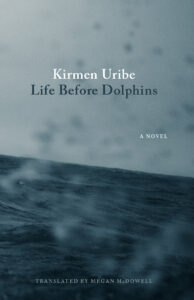
Life Before Dolphins by Kirmen Uribe is available from Coffee House Press.

Kirmen Uribe
Kirmen Uribe is a Basque writer living in New York. His work transcends borders, weaving together personal and collective histories, and has won honors including Spain’s National Prize for Literature and an NYPL Cullman Center Fellowship. His new novel, Life Before Dolphins, was translated from the Spanish by Megan McDowell, and won the Spanish Critics Award (Narrative in Basque) in 2022. He teaches Creative Writing at New York University.