







1918 or 2014? On Russia’s Cyclical Aggression Against Ukraine
Illia Ponomarenko Chronicles His Country's Long Battle Against Russian Domination
Fingers, frozen to the bone in the damp cold, barely obey.
A trembling hand fumbles in the scratchy wool of an overcoat pocket for another five-round clip. That damned bolt again. The last round stuck fast. One strike. Another—with a numb palm. New clip…stiff bolt handle forward and down…chamber a new round and close the breech.
So cold. Eyes ache from peering into the fogged dark. The head throbs from gunfire crackling since morning.
Anxious, cursed days—January 1918.
A minor railway stop, Kruty, lost in bleak fields, near a nameless hamlet beyond Nizhyn.
“They’re coming, still coming, stay alert!” officers shout hoarsely from the snow-covered embankment, voices strained. Through icy fog and under the dim light of a veiled moon, shadows advance across the wide field, cut through by endless rails.
The Reds send another wave into the attack.
A flash splits the darkness on the far horizon. Then a boom, and an explosion close by. The blasts throb like a pulse in the temples.
Teeth clench. The head pulls inward, wishing never to hear and see, shrapnel whistles overhead. This time for sure.
A hoarse shout—the machine guns burst to life, tearing the darkness with short volleys, chewing through belts of cartridges.
Around, thin lines of defense stretch across the silvery ribbon of rails: a motley battalion of whoever God sent, in whatever they had, with God knows-what instead of proper weapons.
Students from Kyiv. Young cadets in old overcoats, in felt boots, with grimy yellow-blue armbands on their sleeves. Gymnasium students, mere schoolboys who had hardly ever fired a shot before, in ordinary clothes, standing off to the left to keep away from harm. Fiery, dreamy lads who did not run, too ashamed to turn their backs.
So this was the revolution, marching from Petrograd, for the people’s happiness, of course. Cutting down the “old world” in its path, reeking of strong liquor.
One student—his face still untouched by a razor—keeps nervously adjusting his round spectacles again and again, brushing frost-dust with trembling fingers. They had all volunteered. Shivering in the cold, breathing heavily. Clumsily digging shallow trenches. They weren’t meant to be here. Schoolboys, maybe good enough to haul ammo, nothing more. So they were sent to a “relatively quiet sector” of the front, but ended up encountering the main enemy forces.
A handful of junior officers, none over thirty, stand beside them in Russian army uniforms, their epaulets torn off, imperial cockades missing. This was the young army of the Ukrainian People’s Republic—its most devoted part.
“Matviy, keep an eye on the youngsters here!” A gloved hand claps his shoulder, and the officer ducks low, moving on to steady the thin line.
*
All right.
Another deep, dull thud, one that rings sharp in the skull, not just the ears. The soft stubble of a cheek touches the frozen wooden stock again. Lungs pull in frost. Another shot into the darkness merges into the deafening cannonade. And another. And again.
Tired eyes blur.
They keep coming with bayonets fixed, advancing toward the machine guns across the field to the station. Navy peacoats, quilted jackets, caps, red armbands. They’ve been coming since morning. Sailors of the Baltic Fleet. Red Guards from Petrograd and Moscow…no strangers to this kind of work.
“Urrraaaa!”
There they lie, bastards. Dozens of black mounds, sprawled in the dark after a day of relentless charges—frozen mid-agony, a bullet still in the gut.
The Reds are advancing on Kyiv.
So this was the revolution, marching from Petrograd, for the people’s happiness, of course. Cutting down the “old world” in its path, reeking of strong liquor.
Kharkiv is lost, Poltava is lost, Chernihiv is lost. Through forests and steppe, along rails from Russia, the armored trains grind toward the Ukrainian capital.
Another heavy blow from the Bolshevik battery—and now they’re pulling him away: sotnyk Omelchenko, the student company leader, his head torn open by shrapnel, blood gushing from beneath his cap.
You won’t make it to Kyiv, friend. Remember us up there.
We can’t hold this alone. Not for long.
Darkness thickens over Kruty, and ghosts rise higher above the earthen ramparts at the station. A sharp cry—then the clang of a bayonet. A boy collapses, eyes wide with the horror of the pulsing, searing pain in his chest and realizing what’s coming.
They’ve broken through.
A cadet in a crooked cap bursts from behind the embankment and fires his Nagant toward the glinting bayonets in the powder smoke.
The Red, who had just stabbed the youth, recoils as if struck by a heavy fist and falls face forward, arms splayed.
One of the students rushes forward through the swirling dark to help. A hesitant shot. Another. Then a Red charges, shouting—only to drop to his knees. Another scrambles over the embankment, barely seeing through the blood running into his eyes.
And here again, a tall student with a dirty yellow ribbon on his tattered sweater grabs his three-liner by the warm barrel and strikes the guard on the skull. The student drops the rifle with its split crimson-smeared stock and vanishes into the flickering dark, coughing, gagging.
Things are bad. Very bad.
*
“Get down! Under the bank—go!” cadets yell.
“Matviy, get a grenade ready.”
A tired hand grips the handle; cold metal slips under damp fingers. Frost bites into the skin. The ring—forward. Finger—the pin to the side.
Click. Count. Or don’t count. Throw. Five, four, three…
The standard fragmentation charge flies behind the embankment, then there goes another one. Dull short blasts, the smell of acrid smoke among the rails. On the palm—a thin scratch from wire; blood mixes with dirt and sharp snow fragments.
Repelled…again.
To the north, on the Chernihiv track, the lantern of another Red armored train appears. Its 76-millimeter gun is already turning our way.
Semi-encirclement, that’s what this is. Darkness swirls, and there’s no end to this damned night.
Back in Kyiv, war rages in the streets. A Bolshevik cell has risen in armed rebellion at the Arsenal factory. Red workers, armed by Russian Bolsheviks, push through Volodymyrska Street, past the elegant hotel Praga, toward the domed Pedagogical Museum. There, the Ukrainian Central Rada has its headquarters, and it had proclaimed the independence of the Ukrainian People’s Republic—just days ago.
Now, along the frozen rails, the Red Guards are rushing in “to aid the working class of Kyiv against Ukrainian nationalists.”
At the same hour, far away in Brest-Litovsk, another fight is under way. Ukrainian delegates—some still wearing the ink-stained suits of tsarist bureaucrats—stand before pompous German generals and diplomats in pince-nez. Help us save Kyiv from the Bolsheviks.
We’ll give you millions of pounds of bread. Of meat. Take what you want. Just recognize independent Ukraine—and help stop the Reds.
In the command railcar near Kruty, the telegraph crackled. The operator, headphones on, sat up and muttered aloud, scribbling dots and dashes onto a crumpled form.
A cable.
Addressed to company leader Averkiy Honcharenko, the man commanding the Ukrainian People’s Republic forces at Kruty. There is no reinforcement, and there will be none. The rest have gone to Kyiv to fight the Reds at the Arsenal. And in Nizhyn, the local militia has gone over to the Bolsheviks. They now call themselves a “revolutionary detachment,” welcoming the Reds as liberators.
Ten miles behind us.
An order must be given.
The ammo’s almost gone, vanishing before the eyes. The machine guns roar less and less in short bursts; the belts are practically gone.
*
“Give whatever clips are left to the more experienced shooters. And retreat before it’s too late, back to the train at the station. Matviy, go with them, you’ll be in charge. Go. And don’t look back…”
And so, platoon after platoon, exhausted students disappeared into the dark. Barely a couple of rounds left, bayonets fixed. A couple of endless miles behind the machine gunners covering the retreat, on foot through the snow.
Eyes half blind in the wet, icy fog, searching for the rails.
And finally—there it was: the train, waiting in the middle of the field, its lanterns glowing through the mist.
The locomotive already huffs with clouds of steam. Someone offers a hand to help climb into the car. The defenders of the Ukrainian Republic sit in tight rows, breathing heavily, the butts of their Mosin rifles resting on the rough wooden floor.
The way back to Kyiv is long. A couple of student engineers lay the charges. Several booming blasts—rails twisted, ties blown apart.
The carriage jolted with a creak. That’s it—we’re moving.
Cadet Matviy, a native of Volhynia, looked at the little group of youngsters on the car floor, lit by the dim glow of a hanging lantern, and crossed himself. Godspeed to Kyiv…We did what we could.
They came up one platoon short after the difficult retreat.
Twenty-seven volunteers gone. Neither on the train nor among the dead.
What could be more hateful to such a regime in the Kremlin, obsessed with territorial expansion and imperial revanchism, than Ukrainians praising their own country?
A scout party secretly went back to Kruty, now under Bolshevik control. Only later did villagers quietly take them to where the boys were. That night at Kruty, twenty-seven students and schoolboys got lost on their way to the train. After hours of wandering in the fog, they came back to the station—straight into the Reds’ hands.
They say one of the students, Hryshko Pipskyi, when they were lined up in the snowy field and the rifles were being loaded, lifted his head and began to quietly sing: “Ukraine has not yet perished, nor her glory, nor her will…” And the other boys, hesitantly, in trembling voices, joined him in an off-key chorus: “Soul and body we will give for our freedom…”
And they lay there in the snow for some time, until the villagers gave them a proper burial. And two of them, they said, hugged each other at the end—and so they remained forever, frozen in an embrace.
Many years have passed since those days.
The battle at Kruty became legend. For a hundred years, it lived mostly in émigré memoirs. Only now, in the twenty-first century, has the forgotten drama returned to us. And only now, by that nameless station, a monument stands—a dark red column on black stone: the colors of the old Kyiv University.
*
Cadet Matviy Danyliuk, from Volhynia, was one of those who made it out that night.
He lived a long, quiet life in his small village. For decades under Soviet rule, he would jokingly greet people with the words “Glory to Ukraine!” making his relatives nervous. The village folk knew him to be a skilled fisherman and hunter—so all the men in the area sought his advice. Grandfather Matviy died in 1994 in his warm bed, surrounded by his loving family.
He was 103—the only Kruty veteran known to have lived long enough to see independent Ukraine. And on a bookshelf somewhere, a yellowed photograph stands: a smiling, very old man in glasses, with a white mustache, dressed in a weary field jacket, a trident on his cap.
And twenty years later, in 2014, his great-grandson, Volodymyr Ishchuk, died in the sunflower fields near Ilovaisk in Donbas—among hundreds of Ukrainian volunteers ambushed and murdered by invading Russian military without insignia.
For decades, Soviet propaganda erased not only the memory but even the very idea that Ukraine had declared independence in the early twentieth century. The resulting amnesia was so complete that artifacts from the World War I era now seem like relics from an alternate reality.
Faded photographs and documents preserve the very symbols we recognize in Ukraine today. Black-and-white newsreels show parades and rallies on Kyiv’s historic streets. A bearded Hrushevsky walks past an honor guard with sabers and banners, lifting his hat in greeting as he passes. Petliura and Vynnychenko—men who could barely tolerate each other—share a cigarette in the cold, surrounded by comrades in papakhas and soldiers’ greatcoats.
Cavalrymen ride past Saint Sophia, offering a military salute.
In these frames, flags ripple above the crowds—yellow-and-blue banners. Near the monument to Khmelnytsky, a trident flutters atop a standard. On the sleeves of greatcoats, armbands marked U.N.R.—the Ukrainian People’s Republic.
All of these symbols became national long before the Bolsheviks crushed the republic and proclaimed the Soviet Union.
And then there was the anthem.
The familiar melody—“Ukraine’s glory and freedom have not yet perished…”—was de facto embraced as the national anthem. The Rada merely recorded what had already taken root.
Around the same time, another phrase came into use: “Slava Ukraini!”—“Glory to Ukraine!” It could be heard from rally podiums and along the columns of marching units; it was shouted by volunteers and cavalrymen of the republic. The responses varied—“Glory to the Cossacks!” or “Glory forever!” or “Across all the land!”—but the meaning required no explanation.
*
Like much else born during the brief era of the republic, this greeting did not disappear with its fall. It was taken up by Ukrainian radical nationalist underground movements of the 1940s, then once again smothered by decades of Soviet oblivion.
Its full return to mass consciousness as “Slava Ukraini—Heroyam Slava” (“Glory to the Heroes!”) came only in our own time, amid the revolutions and Russia’s full-scale invasion—a unifying symbol of resistance, a greeting, and an unequivocal declaration of pride in a country that fights for survival so courageously.
In our time, it resounded around the world so loudly that even today we marvel at how readily it is taken up by people abroad who passionately support Ukraine in the war. A sincere cry from the soul, it turns out, can be remarkably contagious.
In Russian war propaganda, with its aggression often bordering on the absurd, these words have for years been officially presented as an outright Nazi slogan, criminal by definition. And indeed, what could be more hateful to such a regime in the Kremlin, obsessed with territorial expansion and imperial revanchism, than Ukrainians praising their own country?
For the French, it is normal to say “Vive la France.” For Spaniards, “Viva Espana.” But not for Ukrainians—and not when they stand together in shared pride.
And so it was that the Ukrainian soldier Oleksandr Matsievsky met his death in the final days of 2022, finishing his last cigarette in a nameless tree line in the Donbas and shouting “Slava Ukraini!” at the gun barrels of the Russians who surrounded him taking videos.
His words outlived the bullets by far.
______________________________
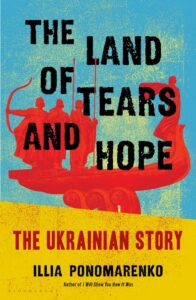
From The Land of Tears and Hope: The Ukrainian Story by Illia Ponomarenko. Copyright © 2026. Available from Bloomsbury Publishing.
Illia Ponomarenko
Illia Ponomarenko, the author of I Will Show You How It Was: The Story of Wartime Kyiv, is a Ukrainian journalist who has covered the war in eastern Ukraine since the conflict’s earliest days, as well as Russia’s full-scale invasion of Ukraine since 2022. Ponomarenko won the Alfred Friendly Press Partners fellowship and was selected to work as USA Today’s guest reporter at the U.S. Department of Defense. He lives in Bucha, outside Kyiv.