What Happens if Russia Wins the War it Started in Ukraine?
Carlo Masala Explores the Worst-Case Scenarios
Translated by Olena Ebel and Ruth Ahmedzai Kemp.
If Russia Wins is a deeply researched and chillingly plausible scenario in which Russia attacks a NATO country to see whether the alliance will respond, underscoring the danger of Western military complacency post‑Ukraine. The author, Carlo Masala, a Professor of International Politics at the Bundeswehr University Munich, is a widely known NATO expert and explicitly wrote the book as a warning to the West. If Russia Wins is currently forthcoming in nineteen territories around the world, and was published by Atlantic Monthly Press in the US on January 6th, 2026. The following is the afterword of the latest edition.
*
Donald Trump was inaugurated just as I was completing the first edition of If Russia Wins. As was to be expected, his campaign promise to resolve the Ukraine-Russia war within twenty-four hours came to nothing. Even he realized fairly quickly that it was going to be some time before a ceasefire or a permanent settlement could be reached between the two countries.
My scenario is based on the assumption that the US will withdraw its support for Ukraine and then largely pull back from Europe in order to focus on Asia. This is a plausible direction, and the first weeks of Trump’s second term made it even more likely. Being able to visualize the consequences helps us to understand the strategic situation the European NATO states find themselves in. When it comes to the existential question of its own security, if Europe is to become independent of decisions being made in Washington—decisions they can only influence to a limited extent—then now is the time to act.
But a US withdrawal is not inevitable, at least not immediately. Around the time of Trump’s inauguration, his national security team seemed to have come to the conclusion that Russia could not simply be allowed to have its way in Ukraine. This would only embolden Russia in its neo-imperial ambitions and pose a permanent threat not only to the rest of Ukraine, but also to neighboring states. Secondly, and we might assume more importantly from the perspective of Trump’s confidants, the US president would appear weak in the eyes of Putin and Xi, something to avoid at all costs, not least to prevent other countries from pursuing a military approach to redrawing their borders.
That is why initially it seemed the new administration might conclude that it should continue to provide military support to Ukraine, so the Ukrainians might stabilize the front and enter any negotiations from the best possible starting point. Trump also faces the challenge of how to persuade Putin to agree to a ceasefire in the first place. From Putin’s perspective, the war against Ukraine is going well at the moment. With the decline in arms shipments to Ukraine, Russian troops have gained ever more ground in Donbas, meaning Putin currently has little or no incentive to seriously engage in negotiations.
Just as people start wondering how a Russian agent in the White House would behave any differently from Trump, he threatens Putin with sanctions and tariffs if he doesn’t stop the heavy bombardment of Ukraine.
I therefore considered it possible that the Trump administration would, at least initially, do exactly the opposite of what happens in my scenario: that he would ramp up support, if only in the short term, and pursue a strategy of “escalating to de-escalate” in order to make Russia willing to compromise and force it to the negotiating table. This prognosis, which could be extrapolated from various statements made by the Trump administration’s national security team, did not ultimately prove correct.
This shows one thing above all: the core of Trump’s politics is its unpredictability. One day, the American president calls Volodymyr Zelensky a dictator, the next he thinks nothing of the kind and wants to strike a deal that would give the US control over valuable commodities. Shortly afterwards, he humiliates Zelensky in the Oval Office, churns out the Russian narrative, blames Zelensky for the lack of peace and ultimately throws the Ukrainian delegation out of the White House without a deal. He then suspends American arms shipments, and it becomes known that US intelligence agencies are no longer sharing information with Ukraine, all of which plays right into Putin’s hands.
On the other hand, Trump offers the Russian president extensive cooperation, pledging to lift sanctions and reinstate Russia to the G7, while his defense secretary makes it clear that the Americans will not participate in any military enforcement of a possible ceasefire in Ukraine. In an extremely innovative negotiating tactic, the Trump administration then announces before talks have even begun what concessions they are planning to make to Russia, including blocking Ukraine’s NATO membership.
Just as people start wondering how a Russian agent in the White House would behave any differently from Trump, he threatens Putin with sanctions and tariffs if he doesn’t stop the heavy bombardment of Ukraine. Just a few hours later, however, he rules out tougher sanctions against Russia’s shadow fleet, raving about how the Russian president wants to end the war and is going to be more generous in the negotiations than he needs to be.
Looking at it pessimistically, Trump is either a Russian asset or simply confused and haphazard. If you try to put a positive spin on things, the American president is pursuing a madman strategy, like Richard Nixon in the Vietnam War. A slightly modified approach would be to reduce reliability to such an extent that no one (neither opponents nor allies and partners) can be sure what Trump will do next, so that everything focuses on him and his agenda and he ultimately gets his way. The aim would be to break up an entrenched structure through deliberately irrational behavior. If that’s the aim, though, this strategy is doomed to fail—or else it will lead to the war in Ukraine ending in Russia’s favor, as described in the scenario. Because time is on Moscow’s side.
While Donald Trump needs success in negotiations with Putin because that’s what he’s promised, there is little incentive for Russia to rush into talks. Putin can wait until he gets what he wants, or he can break off negotiations and let his troops continue fighting. Trump has already given away all the trump cards he might have used to put pressure on Putin. And a well-versed KGB man like Putin won’t be intimidated by Trump’s erratic behavior.
To avoid the impression that he is now to be ranked among the American politicians who have failed to bring this war to an end, Trump is withdrawing.
Now, at the beginning of October 2025, as I revise this, it looks as if the Trump administration wants to withdraw from efforts to find a solution to the war, whatever that might look like. After almost nine months in which Trump has failed to obtain substantial concessions from the Russian side—on the contrary, Russian demands have remained unchanged at their maximum—the administration seems to be realizing that this war is now threatening to become Trump’s war rather than Biden’s war in the eyes of the US public.
To avoid the impression that he is now to be ranked among the American politicians who have failed to bring this war to an end, Trump is withdrawing. This withdrawal is manifested above all in his refusal to continue to act as a mediator between the two parties. The US administration is not working to normalize US-Russian relations, especially in the economic sphere, but is withdrawing from efforts to achieve a ceasefire in Ukraine.
Furthermore, to avoid the impression that Trump has failed to bring about a ceasefire, attempts are being made to blame the Europeans for this failure. Trump says he is prepared to impose tough sanctions on countries aligned with Russia, including 100 percent tariffs on China and India if they continue to purchase Russian oil. However, he has said he will do this only with European support, knowing full well that there are countries—including Hungary, Slovakia, and Turkey—that would never agree to these sanctions.
In summary, at the time of writing, the Trump administration is actively withdrawing from this war, which means that Ukraine’s survival currently depends solely on whether European countries are willing to increase military and humanitarian aid to the attacked state. However, when one considers that right-wing populists won the last elections in Czechia, that France is in a position of extreme political and economic difficulty, and that Keir Starmer is under massive pressure in the United Kingdom, doubts arise.
Resilience is the key prerequisite for mastering the challenges that European countries will face in the coming years.
No matter what twists and outlandish notions Trump surprises us with, in order to prevent a scenario like the one described in the book, Europeans will have to reach the position where they can deter Russia on their own, without the help of the US. The argument that’s always trotted out—that the key difference between Ukraine and the Baltic states is their NATO membership and thus the protection promised by Article 5 of the North Atlantic Treaty—is only valid to a limited extent, as demonstrated in this scenario and the Trump administration’s statements about the alliance’s security being contingent on increased spending commitments.
*
There have been many developments in European defense since the first edition of If Russia Wins. There has been a growing realization that the US can no longer be relied upon as a security partner since the Munich Security Conference of February 2025 and the Zelensky-Vance-Trump scandal in the White House. Most European countries are conscious that Europe will have to look out for itself and needs to do everything it can, and as quickly as possible, to ensure it can defend itself. To this end, unimaginably vast sums (800 billion euros) were released at the EU summit on March 6, 2025, and extensive measures were agreed on to enable member states to invest more in their defense. Even in Germany, sums are being discussed that were considered unthinkable even after Russia’s invasion in February 2022.
It is therefore quite possible that Europe will rise to the historic challenge it faces. But this is by no means certain. My scenario shows what threatens to happen if the momentum that has now been generated does not lead to effective action, if it begins to wane, or if the large sums of money are squandered or trickle away. The decisive factor is not the amount of money made available or even pledged. What matters is the military capabilities that ultimately emerge. And time is crucial here. Even if more funds are made available, it will still be several years before traditional armaments are in place on European military bases.
And in the meantime, the lack of US protection boosts Russia’s incentive to test NATO. How and for what purpose the money is spent is therefore also crucial. A rapid build-up of concrete deterrence capabilities is more important than the number of tanks on equipment inventories.
In my scenario, what plays a central role besides declining armaments is, in many NATO states, the lack of a public willingness to consistently face down Russia. A society that is unaware that its way of life is threatened by hybrid warfare, and that does not realize that Russia is seeking to undermine trust in the problem-solving capabilities of democratic institutions and processes through a variety of propaganda measures and disinformation campaigns—with the aim of discrediting democracy as a form of government—will not develop the willingness to become resilient or resistant.
Resilience is the key prerequisite for mastering the challenges that European countries will face in the coming years. Russia will only be deterred and kept at bay if European societies are prepared to pay the price. In the extreme case of defending the alliance, this price will be measured in human lives, but it is already being paid in economic and political costs.
Anyone who hopes to increase defense spending will have to make cuts in other areas or rein in investments elsewhere. This will also involve a reassessment of government priorities.
The lack of resilience in society has negative consequences beyond the financial impact. The armed forces cannot fulfill their mission for long without public support. It is resilience that enables the government to fulfill its mandate of guaranteeing external security. However, for a society to develop the willingness to become resilient, its government needs to communicate very clearly to them what is at stake. Democratic societies are threatened by hybrid warfare, and ultimately what is at stake is nothing less than the defense of the democratic form of government—or, to put it more dramatically: defending how we live and how we want to live.
_________________________________
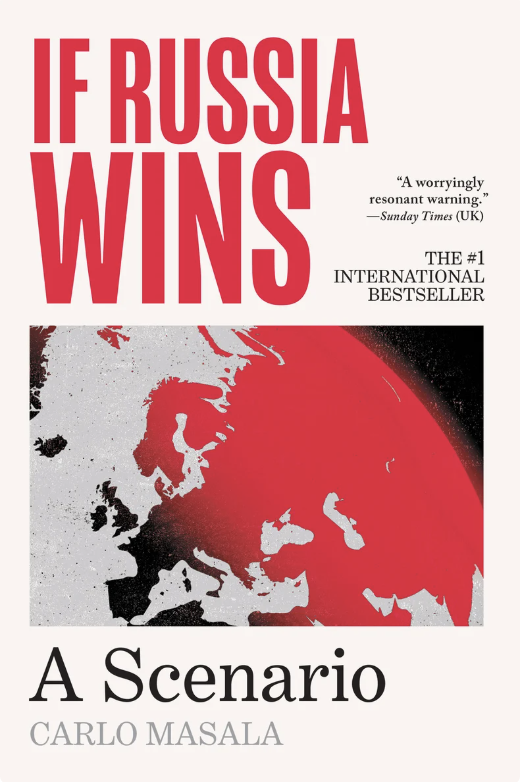
From Carlo Masala’s If Russia Wins available now from Atlantic Monthly Press; courtesy Atlantic Monthly Press.

Carlo Masala
Carlo Masala is Professor for International Politics at the Bundeswehr University Munich. He previously worked as Deputy Director in the research department at the NATO Defence College in Rome. Since January 2024, Masala has been Director of the Centre for Intelligence and Security Studies at the University of the Federal Armed Forces in Munich. He received the Lichtenberg Medal in Gold from the Lower Saxony Academy of Sciences in Göttingen in 2023 for his academic work and science communication. If Russia Wins was an immediate #1 bestseller upon publication in Germany and has since become a bestseller in the Netherlands. It is forthcoming in nineteen territories around the world.