What Did European Life Look Like at the Dawn of Capitalism?
Trevor Jackson on the Peasant Society of Early 1500s Europe
History is the process of change over time, and the history of something as big and complex as capitalism can easily lose sight of the tangible experience of the people living through it. For that reason, at the beginning, middle, and end of this book we will pause briefly to orient ourselves by looking at the economic world of a convenient, well-known, profoundly weird, and temperamentally apocalyptic historical figure. The people themselves are not important, which is exactly the point. These are snapshots of the economic world each one inhabited—economic processes that were outside the control, and usually the understanding, of these famous figures and everyone else around them.
In October of 1517, a 34-year-old monk named Martin Luther (probably) nailed his famous Ninety-Five Theses to the door of All Saint’s Church in Wittenberg, in what is now eastern Germany. Chief among his many complaints was the Catholic Church’s sale of indulgences, which had become not only widespread but even mandatory for many priests, in order to generate funds to pay for the construction of Saint Peter’s Basilica in Rome. Luther’s protest began the long and complicated process of the many Reformations that shook the foundations of morality and authority in Christian Europe.
The Lutheran Protestant Reformation, and later the Swiss Calvinist Reformation as well as the many varieties of German Reformations like the Anabaptists and Unitarians, were not only a threat to the power and prestige of the Catholic Church but also a political threat to the rulers of Europe who derived their authority from a claim to divine approval. Most immediately, Luther’s Reformation unleashed civil conflict and rebellion throughout the lands of Charles V, who was the heir to the Hapsburg dynasty.
Thanks to his many grandiose inheritances, Charles ruled over territory that today comprises Austria, much of northern Italy, the Low Countries, and Spain. He was also elected Holy Roman emperor, which meant he nominally was the sovereign authority over most of what today is Germany. As king of Spain, he also ruled the rapidly expanding Spanish Empire in the New World, which at the end of his reign began to produce a planet-enveloping wave of silver.
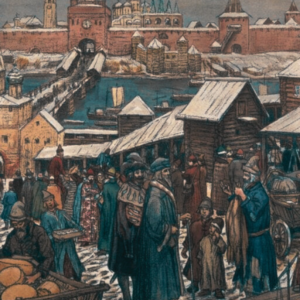
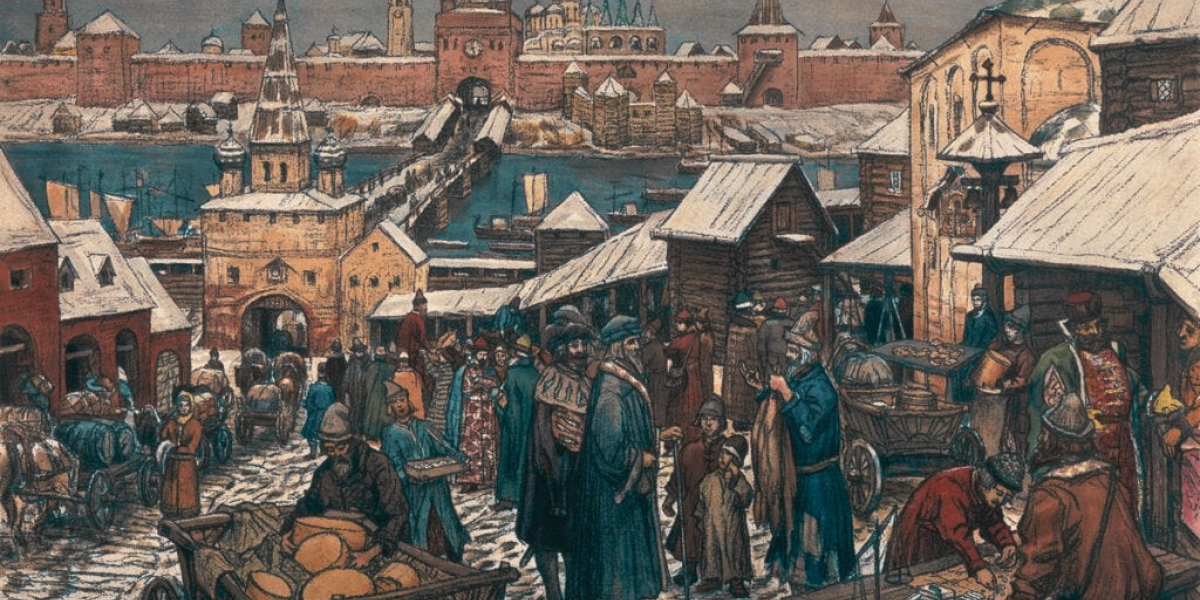
For peasants, “the market” was a literal, physical place, somewhere they would travel to visit on market days, to buy luxuries or sell their surpluses.
The story of the Reformations is rich, complex, and vitally important to the history of modern Europe and America. But it is not our story. It is true that many theorists and historians have seen a connection between the practices and ideas of the Protestant Reformation and the emergence of capitalism, or at least a “spirit of capitalism,” in England and the Dutch Republic. That too is a fascinating body of thought and scholarship that is very closely related to this story, but again, it is not our story. Instead, Luther marks a convenient reference point, a widely recognized historical moment that can focus our attention on the condition of the world right before the dawn of capitalism.
Luther was born in 1483 in the small town of Eisleben, in central Germany. When he was born, probably at least 90 percent of people in Europe and around the world lived in rural settings, mostly working in subsistence agriculture. Their households were both production and consumption units, meaning they made or grew most things that they consumed. Most people worked about 150 days a year, with very busy times during planting and harvest seasons and lots of idle time otherwise.
Diets consisted of 1,200 to 1,800 calories a day of the cheapest available cereal grain: varieties of wheat or rye in Europe, millet in Africa, corn in Central America, quinoa and potatoes in South America, rice in much of the rest of the world. That monotonous diet would be supplemented with eggs, milk, cheese, fish, or vegetables when available, and meat on special occasions. (Luther himself struggled with the diet: He was very bad at shitting, which afforded him plenty of time to cultivate his grievances.)
In Europe at least, most people lived in single-room dwellings without windows and families all slept in the same bed. Most people owned one or two sets of clothing, mostly made of unbleached and uncolored wool. Most people were short and slight due to childhood malnutrition, and diseases scythed regularly through their weak immune systems. By any conceivable standard, their lives were miserable, boring, uncertain, short, and full of tragedy. By modern standards, nearly everyone on earth lived lives of grinding, unthinkable poverty.
But it isn’t quite right to think that a subsistence economy was permanently balanced at the edge of starvation. It produced enough food to continue indefinitely, but without much surplus, which meant that disasters—whether wars, droughts, floods, or otherwise—could cause widespread misery, and the paltry surplus meant that only a relatively small urban non-food-producing population could be sustained, and thus a limited division of labor.
As with all preindustrial societies, European society was fundamentally a rural, peasant society. Scattered across the continent were hundreds of towns populated by a few hundred people, and each of these towns had an economic hinterland of perhaps 50 to 100 square miles, with the bulk of all agricultural and household production produced and remaining in that area. A small amount of output moved among these areas, consisting largely of luxury goods or marketable surpluses. The relatively few wage laborers mostly lived in these towns, and the relatively few merchants traveled or arranged trade among them.
For peasants, “the market” was a literal, physical place, somewhere they would travel to visit on market days, to buy luxuries or sell their surpluses. It might have been one of the few occasions when they would meet people from elsewhere and learn news and stories from outside their local area. It was also the main place where money was needed: Households did not need money for their own production and consumption, and trade among locals, who knew one another and went to church together, was mostly unmonetized, done through exchanges in kind or through keeping running debts with each other.
There were many circuits of long-distance trade, mostly organized around large bodies of water, mostly conducted by small ships that could not sail in open ocean. The Indian Ocean was a vibrant, multilateral trading zone, as was the South China Sea. The Mediterranean remained a trading world, but less than it had been before the Muslim conquests. Europe turned inward, with trade currents mostly running along navigable rivers. Some threads of trade connected the different zones, like the Silk Road across central Asia, or the trans-Saharan caravans. But in general, long-distance trade was in small amounts of luxury goods, and mostly conducted by ethnic or religious communities who were bound by trust and kinship. Most people never experienced those goods or the procedures of that commerce, or did so only rarely.
Serfdom came with a set of customary privileges and obligations, and serfs were often keen to assert their rights. But they were not free.
When Europeans did encounter protoindustry, trade, and commerce, it was almost always tightly regulated by government officials, guilds, customs, or local powers. Writing of 17th-century England (more than a hundred years after Luther), the radical historian Christopher Hill reminds us that the typical Englishman lived “in a house built with monopoly bricks . . . heated by monopoly coal. His clothes are held up by monopoly belts, monopoly buttons, monopoly pins. . . . He ate monopoly butter, monopoly currants, monopoly red herrings, monopoly salmon, monopoly lobsters.” Many places had sumptuary laws, which regulated consumption.
In the year of Luther’s birth, for example, England enacted a second Act of Apparel, restricting sable, ermine, velvet, and satin brocade to knights and lords, while damask and satin were allowed for people who had a yearly income of at least £40. These laws were probably rarely enforced, but they indicate how little economic activity was subject to markets and individual preferences, not just in land, labor, and capital or the methods of production, but also in consumption.
In 1517, wage labor was an unusual exception all over the world. European peasants were often serfs, not owners, meaning they lived on rented land and had to pay a variety of lords, priests, and judges, either by delivering a share of their produce or, often, by working a set number of days each month. They were legally bound to their plot of land, meaning they could not leave if they wanted, and they certainly could not sell their land, but they also could not be fired or evicted. Serfdom came with a set of customary privileges and obligations, and serfs were often keen to assert their rights. But they were not free. There were other forms of unfree labor as well: Guilds controlled entry and exit to trades, servants had no legal personage separate from their masters, indenture bound laborers to employers for set periods of time, and although slavery was not yet widespread in Europe it certainly existed.
Other places had other forms of unfree or bonded labor. Russian serfs were even more tightly controlled and had fewer rights than those in western Europe. There were widespread systems of Islamic slavery in the Middle East, Indian Ocean, and East African economies, as well as systems of captured slaves in West Africa. The Aztecs had enslaved laborers who could be bought and sold as well as peasants who could be temporarily conscripted by temples and local nobles into larger projects. In South America, Incan peasants were subject to a labor draft called the mita, which was later taken over by the Spanish conquistadores. But although unfree labor was the norm, with a few exceptions there was not yet the form of permanent, heritable, racialized chattel slavery that would emerge in the Atlantic economies, especially in the 17th and 18th centuries.
Both global and European population ebbed and flowed from generation to generation, but fundamentally remained static across centuries, held back by truly ferocious rates of infant, childhood, and maternal mortality. Low average life expectancy was a reflection of the fact that about half of all babies died before the age of five. People who survived childhood could expect to live into their 60s. European population growth was also unusual in that it was subject to what is known as the “European marriage pattern.”
Unlike most everywhere else in the world, Europeans married relatively late (in their early 20s instead of in their teens), and an abnormally high percentage of them never married, perhaps as high as 5 percent, mostly because they entered religious orders, which meant married women had one or two fewer children each, and a relatively large number of women never had children at all. Thus, the European population seems to have grown more slowly than that of South or East Asia. The great interruption was the Black Death of 1347–51, which killed between a third and half of the population of Eurasia, and from which the European population had only begun to recover in Luther’s time.
The relatively stagnant population and the preponderance of people living and working in subsistence agriculture meant that the desperately poor preindustrial world was also one of relative economic equality between societies. Of course there were profound and solid social, political, and gendered inequalities within societies, and of course kings and popes lived amid grandeur while most people lived in single-room dwellings with dirt floors. But that pattern of inequality was roughly consistent across space, unlike the sharp modern gaps between countries, and even kings and popes died of illnesses and suffered from toothaches like everyone else. Even as late as the 1820s, the richest countries on earth (Britain and the Netherlands) were only three to five times richer than the poorest countries, whereas today the gap is more than a hundred to one.
What kind of change was imaginable in this world?
I do not mean to suggest that economic life before 1500 was stagnant or unchanging. There were many phases of expansion and contraction, population growth and decline, commercial flourishing and imperial fiscal crises. There is good evidence of extensive economic growth when new lands, goods, and people were added to production, and certainly some productivity improvements in agricultural techniques. There was probably an efflorescence of economic growth in China under the Song dynasty, circa 960–1276, partly driven by a new strain of rice.
However, all over the world and over the course of perhaps 20 generations, most people lived in rural settings, mostly working in subsistence agriculture, and trade was always and everywhere of small scale, as were monetization and market relations. Nowhere were free wage labor markets a norm, nor free land markets, nor capital markets, and there were no banks, stock markets, or joint-stock companies. There was one notable exception, which is that a land market had existed in China since the mid-Tang dynasty, circa 800 CE. Land could be freely bought or sold or rented, although there were a variety of legal and customary restrictions that meant the land market was not a smooth mechanism of resource allocation.
In northern China, tenancy was the norm, mostly held by at-will tenants with little bargaining power, paying as much as half their output in rent, while in richer and more commercialized southern China, owner-worker systems were the norm. But even this private market existed mostly with benign neglect from the state, not through the rigorous enforcement of property rights and contracts, as under capitalism. Most agriculture was done by small-scale tenants or owners, not by large landlords employing wage workers, and the rural economy remained nonmonetized until well into the 16th century. The wage labor sector in China, as elsewhere, remained a tiny fraction of economic activity.
By 1517, the world had seen no sustained economic growth, nor sustained population growth. In fact, the world I have described here remained the norm for most people in most parts of the world throughout the entire time span of this book, and some elements persisted well into the 20th century. Indeed, the United Nations has estimated that 2007 was the first year when the majority of human beings lived in cities instead of rural areas. The life of rural agricultural workers in Siberia, inland China, sub-Saharan Africa, and India in 1917 would have been touched more often and more deeply by capitalism than the rural life of 1517, but capitalism still did not shape and determine every aspect of their lives, even their economic lives.
What kind of change was imaginable in this world? Luther was an apocalyptic thinker, and his ideas were spread through a vital new technology: the printing press, which had been invented by the German goldsmith Johannes Gutenberg around the year 1450. Print would go on to play a vital role in the development of capitalism, transmitting price lists, important news, advertisements, and policy disputes all around the world.
The rise of literacy and secular education were also important drivers of economic development. Luther’s vision of the possibility for radical change was very different from our own. Luther had no concept of a new economic system, or an environmental catastrophe. But Luther was not the only apocalyptic thinker of his time. His ideas precipitated a tectonic crisis of political legitimacy and unleashed a series of continent-wide wars, sometimes featuring millenarian protocommunist sects like the Anabaptists, who sought to overthrow the social order.
The radical theologian Thomas Müntzer predicted an apocalyptic social leveling, ultimately producing a kind of egalitarian utopia. Müntzer’s teachings helped provoke the widespread uprising of the German peasants in 1525, and have served as a kind of progenitor inspiration for later communist thinkers, from Friedrich Engels to Ernst Bloch. The Anabaptists were a radical nonconformist sect that took the egalitarian, pacifist, and renunciatory injunctions of the Bible seriously and tried to organize communal living, before being ruthlessly persecuted by the authorities and other Protestant sects.
But although these years saw a crisis of the old order and a profusion of utopian or apocalyptic egalitarian thinking, it was still organized around theological rather than economic ideas. There was not yet a capitalism to revolt against. The horizons of Luther’s and Müntzer’s thought were anchored to their time, and a reminder that even people who have a powerful effect on the course of history are unable to imagine what consequences will follow from their actions, or how the world is going to change.
__________________________________
From The Insatiable Machine: How Capitalism Conquered the World. Used with the permission of the publisher, W. W. Norton. Copyright © 2026 by Trevor Jackson

Trevor Jackson
Trevor Jackson is an economic historian at University of California, Berkeley, who also writes for The New York Review of Books, The Nation, Dissent, and The Baffler. He is the author of a monograph, Impunity and Capitalism. He lives in Berkeley, California.