What Being a Professional Athlete Taught Me About Writing—and What It Didn’t
James Hamilton Hibbard on Applying His Cycling Skills to His Writing Career
It is not coincidental that in 21st-century America, athletic success has become synonymous with virtue. Ostensibly instilling values like hard work, diligence, and perseverance, competitive sports both mirror the hustle of American capitalism and train the young for a mindset of unrelenting competition in which the lazy fall by the wayside while the “deserving” flourish. A great deal of advice about writing subscribes to this same fundamental mindset of effort yielding results—of “butt in the chair” success, of effort mattering and not waiting for inspiration.
For some I’m sure this message is necessary—after all, being a writer is indeed a job—however, as a former professional athlete turned author, I’ve learned first-hand that approaching one’s writing with the mindset of an athlete has its limits and that as hyperbolic as it may seem, compared to writing, being a professional athlete is easy.
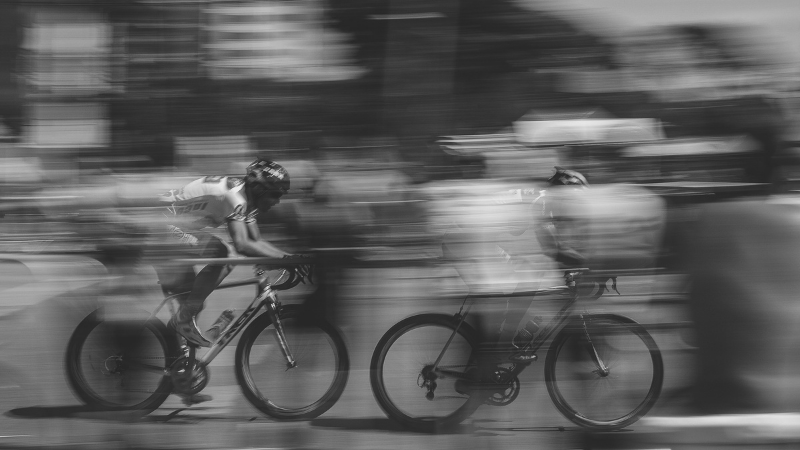
Growing up in a small town at the southern edge of Silicon Valley, I desperately wanted to succeed at something. Ambition—and the idea of being “special”—gnawed at me, and when I was 14 years old, I discovered my outlet: the sport of cycling. The talent pool was shallow and the success and the sort of validation I craved came quickly: junior state champion, then medals at the National Championships. Before I was 18, I signed my first professional contract.
With the wisdom of hindsight and age, professional sports were easy. I don’t mean physically, or that success came easily, but that the objective was straightforward and feedback so immediate that the complexities of the world were forced into a surreal sort of abeyance. There were double and triple days of training on the road, in the gym, and at the velodrome—in the heat and the freezing cold—and intervals so hard I would hunch over and vomit. My days were structured around training, food, and recovery and the sheer physical exertion calmed my anxious mind and tamped down the emotion which often felt as if it might overwhelm me.
I had been retired from the sport for nearly a decade and yet the emotion which motivated me to write it still felt pressing and urgent.
With effort came obvious improvement, and the sense of mastery and volition was nothing short of intoxicating. Quantified with power meters and stopwatches, every lung-searing effort was an imposition of my will on not just my body, but the world. Naïve to the doping scandals which would upend the sport in the years to come, I was certain that my hard work would pay off in a clear, direct, and seemingly meritocratic way.
Gradually, I realized not only that the playing field was far from level, but that I had interests which went beyond cycling. The version of who I wanted to become wasn’t someone who was obsessed with their own performance and recovery, but rather I aspired in some small way to create something of meaning and beauty. After I stopped racing, I began graduate school to study German philosophy, but it was always writing and literature which had been my real love, and I left my PhD program and began to work in marketing while pursuing writing.
I finally sold my first book project in 2019—a memoir about professional cycling, mental health and philosophy called The Art of Cycling. I had been retired from the sport for nearly a decade and yet the emotion which motivated me to write it still felt pressing and urgent. Throughout the early months of the pandemic I pushed like I never had before—applying the same ethos to my writing that I once had to my training. It worked, but I paid for this effort with depression and a deep feeling of let-down after the book was in the world.
Although the process was something I knew I could not repeat, my first book was successful enough to allow me to write a second—this one narrative nonfiction about a defiant antifascist German cycling champion of the Nazi era named Albert Richter who was ultimately murdered by the Gestapo. This time the stakes felt higher, and while I had been blissfully unaware of the realities of publishing the first time, as I embarked on writing RACING THE REICH, I understood timelines and advances and foreign rights, but most of all that while in sports effort nearly guaranteed improvement, in writing, effort guarantees absolutely nothing.
While my memoir had come in manic chunks, the deep factual research and structural care required for narrative nonfiction demanded that facts be understood not just topically—I also had to give their emotional meaning the time and space to emerge. I struggled with how to approach writing as a profession without repeating the unsustainable patterns that I’d internalized from my years as an athlete. As I did more and more research, people and events fanned out before me—when my protagonist was born, that as a child he’d liked kickball, and that his coach was Jewish—all demanding not just literary rendering but a sort of assembly into narrative coherence.
Like doing intervals on the bike so long ago, in the first months of drafting the manuscript I tried to force words and quickly impose structure on incidental facts unearthed in dusty archives and on the pages of period cycling magazines, but the pushing only made the work worse. None of the old tricks I had learned as an athlete worked; no word count goals or allotted time spent at the desk mattered, and there were sections which failed—sentences which I could not force to read well no matter how hard I tried and facts which conflicted or resisted being smoothly integrated into the arc I’d developed.
For now, I write until I know it is time to stop and I try to trust the world and myself in a way I never have before.
Paradoxically, it was only letting go which seemed to help the work—time spent pacing, daydreaming, and listening to the cadence of writers I admired. As I walked or ran among the oaks and scrub jays of the Santa Clara Valley foothills, I often thought about the late Arctic Dreams author Barry Lopez, well known for his slow approach to writing, who would wander the woods near his Oregon cabin for hours at a time before returning to his manuscript. But the stakes were so professionally and personally high that writing with anything other than anxious urgency felt indulgent. Here my experience as an athlete wasn’t an asset but a liability characterized by impatience and a fixation with hard work and agency.
Talking with other fathers at my son’s school events, I heard of back-to-back meetings and exhaustion—of new product launches and pushes to release new code—and felt guilty as I thought about how to any observer must have seemed idle as the innumerable puzzle pieces which are a book coalesced in my subconscious mind. Not only did I contend with my own self-reproach, but the very real loneliness which came from trying to so fundamentally swim upstream culturally. The slow pace of reading, writing, and the publishing industry itself felt antithetical to the “move fast and break things” culture which surrounded me, and as I endlessly reworked paragraphs or spent an afternoon researching an emblem on a Nazi uniform or where my protagonist was on a given day, I felt profoundly out of sync with the rest of the world.
But gradually, I learned that unlike with racing, the only way forward was to slow down—to accept each day as the story emerged (or failed to) and to in the most basic way set aside commercial pressures and personal ambition and to again and again return to the only thing which really ultimately matters—the prose on the page.
This is not tidy advice, but I suspect it is true and is hopefully a counterpoint to the cult of hustle and productivity which seeks to endlessly extract. Living this can still feel like a luxury and it remains something I battle every day as I try to muster the calm trust to allow not only narrative and characters to unfurl in their own time and fashion, but also to let my own writing career come into being on its own terms; for agents and editors to read and reflect, and to slowly grow one’s readership and one’s own skill and voice in a way that our culture which values agency, speed, and the imposition of will actively discourages.
For now, I write until I know it is time to stop and I try to trust the world and myself in a way I never have before. It remains a daily struggle, but I do my best to bring the only things that matter—care and attention—to my work and the people I love.

James Hibbard
James Hamilton Hibbard is a Northern California-based writer. His second book, RACING THE REICH: THE LIFE AND DEATH OF GERMANY'S GREATEST CYCLIST AND THE NAZI QUEST FOR THE SUPER-HUMAN, will be published by Farrar, Straus and Giroux in North America, Atlantic Books in the United Kingdom, and KiWi Verlag in Germany in 2027.