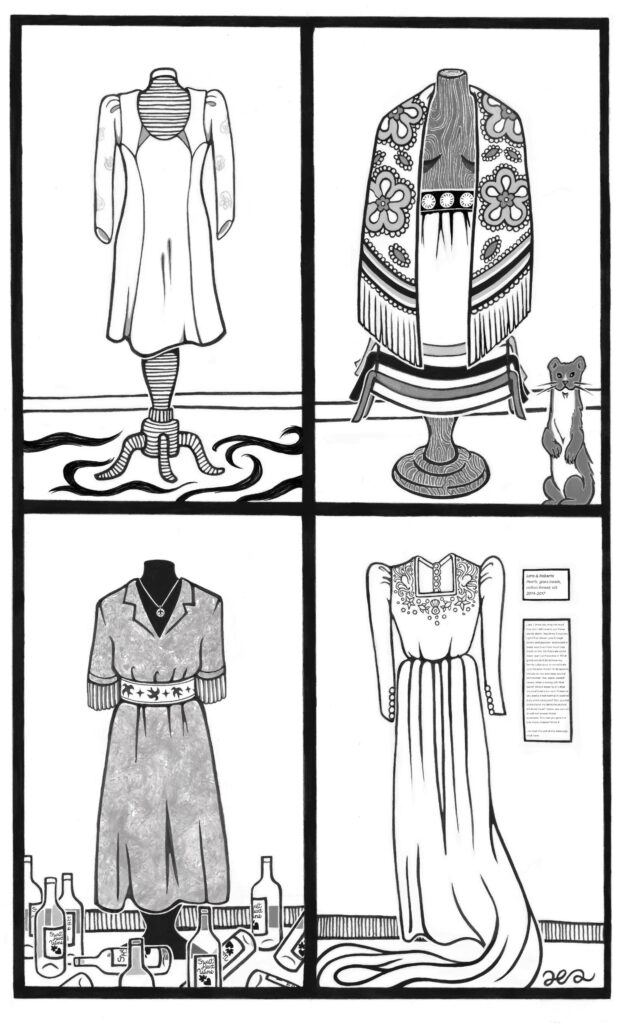
During a January thaw, water trickled from a burst pipe down an interior wall, into a basement storage closet, and ruined all of Dora’s wedding dresses. There was the perfect knee-length dress with transparent sleeves sewed from a Vogue pattern. There was the ecru ribbon skirt and shawl trimmed with appliqué flowers from Dora’s guess-again marriage—to a traditional man who played moccasin games. Then there was her green brocade dress with a beaded belt of indigo swallows. That marriage had not been legally recognized, but she counted it. And at last a heavy white satin dress with forty covered buttons up the back, a kick train, and a bodice trimmed with swirling sea creatures beaded of tiny pearls. This was from a vintage store and cost six hundred dollars, a purchase Dora had pondered for quite a while. All of the dresses were soaked and perhaps rotted, alive with pink-green bubbles of mold.
The leak had been stealthy and when she finally discovered it and opened the basement closet, she became more upset than the situation warranted—after all, they were just dresses she would never wear again. Just as she would never be married again. She had determined upon that. It wasn’t the loss of the actual dresses, she thought, it was their squalid disintegration that was so disturbing. Memories of her marriages had been dry and controlled. When she moved the hangers, she released a cloud of choking spores—as if she’d exposed a dead thing, a moldy growing thing moving with avidly feeding alien lives.
She turned off the water to the kitchen sink pipe and cleaned up the mess, hunched over, whimpering softly as she used a water glass to trap an eerily prancing house spider. The spider had crept into soggy folds of satin and set up a webby burrow. At the time, she was taking care of Martha, her eleven-year-old niece. Martha was always an eager participant in spider trappings, and was at Dora’s elbow when she released it into the snow.
‘Will it freeze?’
‘No,’ said Dora. ‘Look.’
Already the spider was creeping down the side of the house, back into the basement. Martha patted Dora’s hand and took the water glass. Dora told her niece that she was sorry for making pathetic noises.
‘Auntie. Your wedding dresses were wrecked.’
Martha said this as though it was self-evident that her aunt should be upset, and Dora let herself feel something, a twinge. The only mainstream bridal dress was the one with the stylized starfish and snails, so whimsical on a wedding dress. But the others had been made by relatives, and by Dora, gossiping and listening and giving advice while they worked. Her mother or one of her sisters presided at a sewing machine at the head of a kitchen or dining room table. Dora washed out the water glass, muttering.
‘I think it was the aliveness. How the dresses had turned into something like . . .’
‘Cheese?’
‘More alive than cheese. They were, like, bride gowns for zombies.’ Martha said this with a hint of pride at her idea.
‘You’re so right.’
‘Can we have Chinese food?’
To Martha, her aunt’s derangements were occasions for shrimp fried rice and lemon chicken. Dora and Martha usually drove over to the Rainbow and looked forward to its comforts. Breathing the mold had made Dora dizzy, and she told Martha they’d go but she needed her body to catch up with her unexpected emotions. Martha gave a wise, womanly nod. Dora lay down on her bed, which was just the way she liked it, both firm and sinkingly soft. Martha flopped down too.
‘I am reading Lord of the Flies.’
‘Do they still teach that? I’m sorry, honey.’
Martha moaned with satisfaction at the drama. ‘I have to do ten pages a night. You want me to read aloud to you?’
Dora pulled a comforter around the two of them and listened to Martha read in her competent, sensible, eleven-year-old voice. Piggy still didn’t know what would happen. The beaded starfish were still okay, Dora thought. They could be sliced from the slimy mass of satin once it stiffened. All the dresses were in garbage bags, freezing on the back porch. Tomorrow she’d have to fix the pipe.
Dora sat up. ‘I’m okay. We should go.’
‘Wait a second.’
Martha put the book down. She gave her aunt a calm look from under her brown bangs. Her eyes were deep, dark, and so warm and questing that Dora and her sister, Bonnie, agreed it was easy to get lost in them. Bonnie was on a short marriage-maintaining trip with her husband, Jeke. They were probably going to be okay because they did take these trips. Martha had brothers, but they were with an uncle who had boys. Martha gave Dora a pang sometimes. Should she have had a child? Perhaps a daughter of her own? She was an outlier, the only one of her siblings who hadn’t reproduced. She had borne the continual intrusive questions. Even her most feminist Native friends had said things like ‘for the good of our people.’ But she’d never wanted children of her own. Besides, no child could be as perfect as Martha, and she was perfect because Dora didn’t have to do things like make and enforce rules. Dora could just listen to and dote on Martha. Dora hoped that Martha would stay this person through the soon-approaching age of twelve, and that when she got her promised cell phone, then fizzed up with hormones, she would be spared the worst. Dora also hoped that the sight of her moldered wedding dresses, spiders dancing in the satin folds, wouldn’t blight Martha’s relationships.
‘Wait,’ said Martha again.
‘Wait for what?’
‘I have a question. What do those wedding dresses, you know, like, stand for?’
‘Stand for? They’re just dresses.’
‘But there’s four dresses. Four weddings? Four marriages?’
‘Right. I mean, a couple of the actual weddings were very small, only the witness basically.’
This was suddenly like being a real parent. Having to explain her own past to a child, and do it in a way that would have little impact, either negative or perhaps overly positive.
‘So what was each one like? Why’d you marry them and why’d you split up?’
They were putting on their down puffer jackets—Dora’s was black and Martha’s bright blue. Dora’s brain was scrambling around, hunting for words or ideas. How to even start.
‘So, the first one, with the see-through sleeves. What’s the story?’
Vintage Vogue with Transparent Sleeves
She’d been married long ago in a far distant land to a chubby white man, in New York City, when there was still a vacant lot next to the Mayflower Hotel, the New York Coliseum dominated the west side of Columbus Circle with car and trade shows, when there was a fanciful lollipop building and no Trump Tower. They’d lived in a one-bedroom condominium kitty-corner from Lincoln Center, where he had a job managing group ticket sales. She was there to become an artist, but there wasn’t much room in their apartment. In fact, she had left her wedding dress in storage at her parents’ house.
Dora started out by getting a job in the museum shop at the Metropolitan Museum of Art. Her husband, Merritt, had bought their condominium with his inheritance and put it in both their names in case he died. He was very careful with money and they were truly in love, but when they both signed the deed and title he did say, ‘I’m stupid to do this,’ and it stuck in her mind. Everybody in his family, including the women, had weak hearts and died young. To counter his genetics he began to run every day—this began as soon as they moved to the city. Dora thought that living in a place bought as the result of his father’s death was a constant reminder to Merritt of his own mortality. That seemed heavy. Still, they were happy and started out every morning together. They walked across the park to the museum and then he just kept running. In many ways, it was a promising, even glowing, life.
However, there was the question of what came next. Children weren’t immediately in the picture—the heart thing plus her reluctance. She and Merritt had a great rapport. He was funny, and she’d been fooled by that into thinking he was like an Indian. Her family was funny, he was funny, but then she was suddenly so far away from her family. So what came next was where they would live—New York or Minneapolis—because the apartment wasn’t forever, that was clear. It was surprisingly small. Merritt had an expansive wardrobe and a lot of running shoes. There was no place for her sewing machine, let alone a place to make art. She had a tiny table in the bedroom, where she worked on small drawings and paintings, which she pieced together into larger works that took up all of their walls. After two years Dora and Merritt were right on top of each other. The stuff on her tiny table overflowed onto the floor and took up one half of the bedroom. Merritt’s clothing and shoes took up almost the entire large closet on the other side of the bedroom and ended up in tubbies and laundry baskets. They tried to keep the living and dining area clear enough to entertain—mostly Merritt’s remaining family and a few friends from work—but eventually that also became too cluttered and it all felt overwhelming.
Twice in two years, she had saved enough money for a trip home to Minneapolis, but that wasn’t enough and she grew miserably homesick, while, in that time, Merritt grew more comfortable in his job and in the city. He also got thinner. The thinner he became, the more his personality changed—from easygoing to tense, from honest to dishonest, from funny to sarcastic, from excitable to morosely excitable, from loving how she looked to complaining about how she looked. One day she said to him, ‘I’m really unhappy with you,’ and he’d screamed, then shouted, ‘Your hair is everywhere. You shed like a dog. I’m going to chop it off while you’re asleep.’
For a month, she locked him out of the bedroom and made him sleep on the couch they’d hauled up from the sidewalk, the torture slab they’d kept so as not to encourage guests. They filed for divorce. He bought her out of the condominium. She shipped her art to Minneapolis and had enough money to buy an entire house.
‘Is it still your house?’ said Martha.
‘Yes,’ Dora answered.
She had finished the story in the parking lot of the Rainbow. Martha was quiet for a moment, thinking the story over.
‘You still have your house, your long hair, and now you’re an artist.’
‘It was because of sewing that dress at a table with my mom, aunties, sisters. They wouldn’t let me get married without telling me how to get divorced. Some might call that cynical, but it was a huge help. So all in all,’ said Dora, ‘things turned out.’
‘What about Merritt?’
‘I have no idea and don’t care. He knew hair is power.’
What She Didn’t Tell Martha
Merritt had promised Dora over and over that he loved her hair, that he wouldn’t dream of cutting it, that the very idea horrified him. He understood that shedding hair was her reaction to stress. He was pathetically sorry. She’d let her guard down, then awakened a week later, a lazy Sunday morning, with her hair all over the bed, sheared off raggedly. He’d gone for his run. She had gathered up her two-foot-long clumps of hair and locked him out of the apartment. In his morning fury, he’d left his wallet and his bank cards behind. After pounding on the door for a while, he’d slept at his brother’s house and on Monday morning she’d withdrawn half of their money, solicited lawyer advice from a friend she worked with, hired her friend’s attorney, filed for a divorce, had groceries delivered, used their credit card to hire a company to pack up her art and her other things too. She changed the lock on the bedroom door and put all of Merritt’s clothing in the living room. She let him back into the apartment a few days later but locked him out of the bedroom. In the middle of the night he scratched on the bedroom door. He was having the heart attack he’d dreaded.
She got him to the hospital and he had a second heart attack there, which he barely survived. His family blamed her in spite of their genetic problem. They helped him fight her for her half of the condo, which had already increased in value. She’d flown back to New York twice, her hair short and ragged because she was so mad she refused to get a decent cut. She finally did get half the money, and the last she’d heard he’d stopped running and gone into finance.
She thought he’d have another heart attack and die in his second wife’s arms, but he didn’t. He just became rich. By then, her hair had grown out.
The Rainbow’s entrance was dim and moody. A small shrine glowed red and there was a mirrored bar lined with colorful bottles of liquor. Dora and Martha stopped in front of the shrine, then walked toward a table behind the koi tank. They ordered their usual drinks—for Martha a Shirley Temple with all the trimmings (maraschino cherries, swords, monkeys, an umbrella). For Dora a glass of white wine, which she knew she wouldn’t finish. The drinks came and they ordered their usual food. They stared at the koi tank. Dora’s heartbeat slowed. The glorious fish flared side to side.
Dora said, ‘So much intelligence in their sleek bodies.’ The kois’ instinctive grace, dramatic and innocent, reminded her of how she’d been back then but hadn’t known. She saw herself walking through the mottled light on leafy paths through Central Park, her long dark hair swinging to her waist. It had never grown that long again. Past the fish, they watched wavery figures raising chopsticks to their lips.
‘What about the next dress?’ said Martha.
‘Really? You’re not satisfied?’
‘There wasn’t that much drama.’
‘You watch too much Real Housewives.’
‘No way. Mom won’t let me.’
‘I’m stalling for time.’
‘Just tell me, quick.’
__________________________________
From Python’s Kiss by Louise Erdrich. Illustrations by Aza Erdrich Abe. Copyright © 2026 by Louise Erdrich. Reprinted courtesy of Harper, an imprint of HarperCollins Publishers.